

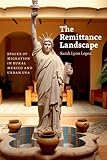
Sarah Lynn Lopez. The Remittance Landscape: Spaces of Migration in Rural Mexico and Urban USA. Chicago: University of Chicago Press, 2015. xiv + 315 pp. $30.00 (paper), ISBN 978-0-226-20281-5; $90.00 (cloth), ISBN 978-0-226-10513-0.
Reviewed by Richard Johnson (University of Arizona)
Published on H-Citizenship (July, 2015)
Commissioned by Sean H. Wang (Max Planck Institute for the History of Science and Syracuse University)
After living and working in California for a handful of decades, Antonio commissioned a human-size replica of the Statue of Liberty to adorn the courtyard of his home in rural Mexico. The statue exhibited a few key modifications. Lady Liberty’s face was recast in the image of Antonio’s mother, with the tablets she grasped now bearing Antonio’s birthday and her ankles remaining restrained by shackles. The statue (which graces the book’s cover) aptly encapsulates the central theme of Sarah Lynn Lopez’s The Remittance Landscape: Spaces of Migration in Rural Mexico and Urban USA. Lopez explores how remittances from Mexican migrants shape the built environment in communities in rural Jalisco, Mexico. As she notes, past research on migration has often bundled the topic of remittances with a slew of other related factors and forces, such as gender and depopulation. Here, Lopez places remittances at the forefront by directly exploring their material and cultural manifestations, significance, and implications for rural migrant-sending communities.
Lopez grounds her study of remittance landscapes in “building ethnographies” that highlight the processes of envisioning, planning, and executing assorted construction projects and their broader socioeconomic outcomes. She argues (and as Antonio’s statue demonstrates) that “remittance spaces” are shot through with representations and symbols that convey the aspirations of remitting migrants and/or organized migrant hometown associations in the United States. Specifically, remittance spaces embody migrant vacillations about identity and a desire to hold a place/role in their home communities. To build is to work “through ambivalent feelings about where [migrants] belong. Buildings provide evidence that they are returning heroes and pillars of the community rather than deserters” (p. 31). In their physical absence, migrants fund projects that aim to reinforce traditional cultural practices and meanings (i.e., gender roles, notions of civic pride, and community events), yet also convey other material/cultural elements garnered from experiences in the United States (i.e., house design, “development,” and a home for the elderly). Building also assuages sentiments of guilt and obligation that migrants might harbor from their economic successes vis-à-vis their perceptions of stagnation and poverty of their home communities.
The chapters examine a handful of remittance building projects at different scales in rural Jalisco. They include households, jaripeo (Mexican rodeo) and sports venues, a cultural center, and funeral and retirement homes. Lopez also explores the new meanings and practices around migrant death and burial, as well as state efforts to capture and direct remittance capital to development efforts. The book concludes with a brief examination of the “negative” of these remittance spaces—those spaces created by Mexican migrants to reproduce Mexican practices and meanings in the United States.
Lopez sets out to evaluate three additional themes throughout the work. First, she examines the role of remittances as a driver of “development from below” and the involvement of the Mexican state in capturing and shaping remittance expenditures. Second, she looks at the disconnect between migrant aspirations and the realities/capabilities of their communities of origin. Third, she analyzes the qualitative differences of contemporary migration from its precedents. We learn that migrants’ aspirations often differ from state and local visions of development and their capabilities to build or even utilize them. Thus, the production of remittance space manifests as a negotiation between remitting migrants, the state, and other community members. These negotiations can lead to tensions, uneven state intervention, and ultimately dysfunctional or failed building projects. Yet, despite these tensions, contradictions, and failures, Lopez argues, “social spheres” both “here” and “there” are “increasingly structured by the logic of remittances” (p. 10). The messy conjunctures of migrant capital, aspirations, meaning, and practices ultimately produce new social relations, meanings, and daily practices both locally and transnationally, which qualitatively set contemporary migration apart from the past.
Lopez’s work offers novel perspectives on the production of material and cultural representative spaces by remitting migrants, especially as remitting appears to have increasingly become a “way of life” for many rural Mexican migrants and their families. The work attempts to cover a lot of ground. Her strongest observations here include migrant ambivalence over identity and belonging, the embodiment of migrant aspirations and meanings in remittance building projects, and the frequent disconnects between migrants’ building visions and local realities. Her conceptual framework is blistering and potent, with clear potential for application beyond her own study.
Unfortunately, however, the work’s empirical offerings do not quite match its conceptual promise and purported objectives. Lopez claims to “study what is envisioned, how the construction process influences social relations and local political economies, and subsequently how the built environment affects daily life for those who build it and those who live with it” (p. 12). With the exception of the envisioning, these themes are not comprehensively addressed in the accompanying chapters. We learn that remittance-funded construction projects can drive local tensions and conflicts. Yet how this constitutes a transformation of social relations, political economies, and daily life remains vague. This gap could have been rectified through the inclusion of the voices and lived experiences of diverse nonmigrant groups—such as women, workers, youth, and the elderly—who remain surprisingly absent from Lopez’s account. This silence leaves us grasping for how exactly nonmigrant groups are involved in the coproduction of remittance spaces beyond their actions as mute laborers and occasional consumers. A broader review of transformations in land distribution and labor opportunities in rural Jalisco from the influx of remittance capital (and outpouring of working-age men) would have proven insightful here as well. The class relations that are described in the book are not clearly differentiated from relations seen in the historically high-migration region of rural Jalisco for decades. Her findings seem to indicate that successful migrants mainly assume existing class positions (such as in the compadrazgo system) rather than producing something qualitatively new. In this sense, Lopez may be mistaking the reshuffling of personnel within static class differentiations with an actual change in the class structure.
These gaps lead to a second grievance: the slim review of debates and contributions relevant to Lopez’s claims. For example, Lopez fails to note that the concept of “remittance landscape” has already been employed in work on migration, remittances, and agrarian/environmental change in Latin America.[1] Moreover, this particular body of work would have helped Lopez to disentangle the changing relations of production and campesin@ livelihoods that she seeks to evaluate. Brad Jokisch’s past work in Ecuador on migration, remittances, and real estate development seems particularly befitting to Lopez’s interests.[2] As a separate example, her dissection of vaquero (cowboy) masculinity upheld through the “gendered spectacle” of remittance jaripeos draws hastily from texts on North American cowboys as a proxy for vaquero identity. Other claims, such as “the remittance house creates inequalities between those who emigrate and those who never leave Mexico,” have no clear metric or substantiation (p. 70).
Key elements of contemporary migration are not unpacked either. Perhaps most glaring, Lopez overlooks the dramatic rise in the risks and costs of unauthorized migration from Mexico to the United States over the last two decades. US border militarization, domestic migrant policing, and unprecedented rates of deportation that have escalated since the mid-1990s have greatly imperiled migrants’ abilities to work and remit. This proliferation of risk would seem particularly worthy of examination given Lopez’s observation that the maintenance of remittance spaces often (paradoxically) necessitates remaining in the United States to ensure a constant flow of capital. How might the expansion of spaces of risk and the omnipresent threat of removal influence the production of remittance spaces in both Mexico and the United States? Does legal status influence the form and content of remittance projects among immigrants, or lead to particular power dynamics within hometown associations? What role does the growing presence of women as migrants and remitters play in the production of remittance space? That both Mexican remittances and net migration have declined since the Great Recession might complicate Lopez’s instance that remitting is increasingly a “way of life” in rural Mexico.[3] Some of these general issues are offered (indirectly) as outstanding questions in her conclusion, and perhaps Lopez was focused on solidifying her initial conceptual pieces with this work. Yet their omission greatly undermines the strength of her overall contribution.
Despite these omissions, The Remittance Landscape offers several important perspectives for understanding how remitting migrants and their families/communities put newly acquired capital to use. We see how this capital shapes the built environment (particularly architecture), transnational culture, and spatial practices in both Mexico and the United States. Elements of Lopez’s framework will be useful for thinking through the multiple processes and implications of remitting and the production of sociocultural space beyond the Mexican context. If guilty of anything, perhaps the work attempts to cover too much ground. Yet in doing so it leaves us a wealth of intriguing questions and trajectories that merit future research.
Notes
[1]. For example, see Priya Deshingkar, “Environmental Risk, Resilience and Migration: Implications for Natural Resource Management and Agriculture,” Environmental Research Letters 7, no. 1 (2012): 1-7; Silvia Hostettler, “Land Use Changes and Transnational Migration: The Impact of Remittances in Western Mexico” (PhD diss., Ecole Polytechnique Fédéral de Lausanne, 2007); and Brad Jokisch, “Landscapes of Remittance: Migration and Agricultural Change in the Highlands of South-Central Ecuador” (PhD diss., Clark University, 1998).
[2]. Brad Jokisch, “Migration and Agricultural Change: The Case of Smallholder Agriculture in Highland Ecuador,” Human Ecology 30, no. 4 (2002): 523-550.
[3]. Jeffery S. Passel, D’vera Cohn, and Anna Gonzalez-Barrera, “Net Migration from Mexico Falls to Zero—and Perhaps Less,” Pew Research Center, April 23, 2012, http://www.pewhispanic.org/2012/04/23/net-migration-from-mexico-falls-to-zero-and-perhaps-less/; and “Mexico Remittances: 1995-2015,” Trading Economics, http://www.tradingeconomics.com/mexico/remittances.
If there is additional discussion of this review, you may access it through the network, at: https://networks.h-net.org/h-citizenship.
Citation:
Richard Johnson. Review of Lopez, Sarah Lynn, The Remittance Landscape: Spaces of Migration in Rural Mexico and Urban USA.
H-Citizenship, H-Net Reviews.
July, 2015.
URL: http://www.h-net.org/reviews/showrev.php?id=43595
 | This work is licensed under a Creative Commons Attribution-Noncommercial-No Derivative Works 3.0 United States License. |

