

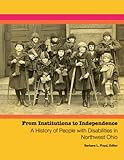
Barbara Floyd, ed. From Institutions to Independence: A History of People with Disabilities in Northwest Ohio. Toledo: University of Toledo Press, 2010. x + 174 pp. $19.95 (paper), ISBN 978-0-932259-07-3.
Reviewed by Geoffrey F. Reaume (York University)
Published on H-Disability (October, 2015)
Commissioned by Iain C. Hutchison (University of Glasgow)
Preserving and archiving disability history is an essential task if the history of disabled people is to be told from the perspectives of those who lived it. Since 2001, the Ward M. Canaday Center for Special Collections at the University of Toledo has been collecting primary sources in its Regional Disability History Archive Project. Focused primarily, although not exclusively, on northwestern Ohio, this effort is an important example of what can be achieved by ensuring that documents that may otherwise be lost, or at best be scattered unsorted in various locales, are instead located in one, purpose-oriented archive where they are accessible, properly catalogued, and preserved for posterity. The existence of such an archive has the potential to save local community histories of disability that may otherwise be consigned to the dustbin or recycling box. At a 2002 conference on this topic at the University of Toledo, which I attended, speakers emphasized how important it is to have such a repository that raises awareness among disabled people about their own history. Part of this includes encouraging the saving of documents gathering dust in the basement about a local disability organization that was (or still is) involved in advocacy of some kind.
As a result of a sizable donation from Toledo’s Ability Center, an historical entity that originated in 1920, in 2001 the University of Toledo established a disability studies program which included in its mandate the creation of an archival collection of locally and nationally significant primary source material on disability history. In 2008, an exhibit based on material in the Regional Disability History Archive Project was mounted from which this book developed. Organized around nine brief chapters highlighting specific themes and disabilities documented in the collection, the book, edited by archivist Barbara Floyd, briefly summarizes local histories addressing topics that include treatments for people deemed mentally ill, supports for people with visual and hearing impairments, educational resources for “crippled” children, eugenics, living with polio, the confinement and deinstitutionalization of people with developmental disabilities, vocational rehabilitation programs, disability activism and independent living, and changing terminology around disability.
Most of the chapters begin with a wider summary of the history of a particular topic before delving into the local history of a given disability or related theme. In doing so, the book does not offer readers a detailed description of the records in the collection, instead providing a chronology of certain institutions, service agencies, charities and organizations, and the local leaders who were involved in their promotion. This information is particularly helpful for people who want an outline of local historical developments for various disability services in northwestern Ohio and thus this book is a valuable resource. Such a narrative, date-based approach also offers a traditional view of a nontraditional topic--the steady growth of varied networks to assist disabled people in their local communities. This could be either top-down through charities and publicly supported agencies or, towards the latter period of this history, disability activist-driven campaigns that promoted social and economic inclusion in society. This approach also leads to a generally uneven, at times surprisingly uncritical, interpretation of this history.
For example, Kimberly Brownlee, in her article subtitled “Care for People with Mental Illness,” mentions quite accurately how conditions had deteriorated in mental hospitals in the United States by the early twentieth century, with overcrowding and use of restraints. A few pages later, however, when writing about local history, she notes that the surroundings of the Toledo State Hospital, which opened in 1888, “were so beautiful that they were frequently pictured on postcards and were often the setting of family picnics and other outings” (p. 8). Rather than accepting these images at face value, as appears to be the case here, this would be a good place to point out how such postcards need to be critically examined by disability historians for their obvious public relations purpose to place the asylum in the best light possible--just as most postcards are intended to do about places depicted. The posed nature of such images says as much about who is left out of the frame as who is included. These documents also raise the question about how “scenic” were the inside of the buildings for mad people during this time? Similarly, a laudatory statement about a retiring administrator and physician by his peers is included which leaves a distinct hagiographical impression. Such statements by fellow doctors and philanthropists deserve further probing as to how this history might be different if we knew the views of disabled people from these same institutions rather than just the views of the operators--a major challenge in disability history where the views of ordinary people are generally undocumented. However, in other places, a more critical perspective surfaces, such as when the unmarked graves of patients are mentioned as indicating the prejudiced treatment asylum inmates had in death, just as in life--something which a cemetery reclamation project is working on to change.
Where this book particularly shows the great importance of its primary source documents is in the references to the daily life of disabled people. John Richey worked in the first sheltered workshop operated by the Toledo Society for the Blind, opened in 1928, where he taught weaving to other blind people. This is described by Jennifer Free in “Services for Vision and Hearing Impaired Persons..” In a chapter about children with physical disabilities, Barbara Floyd discusses Alva Bunker (1901-79), described in 1921 as a “mere stump of a lad” who never left the back alley in Toledo where his family lived until local members of the Rotary Club supported his education (he had never been to school before) and sent him to Detroit, Michigan, where, after a series of operations, he had prosthetic limbs attached (p. 47). A self-congratulatory statement of a local Rotarian about how Alva should serve as an example of self-help to others is included here, though this is quoted without critical analysis of what this might mean from a disability history perspective. Nevertheless, it is precisely these sorts of documents which underline the value of this collection for helping to preserve this past. The challenge of locating the histories of disabled people like Alva Bunker is poignantly underlined by Barbara Floyd’s discussion of how little we know of his adult life with intermittent employment.
The history of eugenics in Ohio is also preserved in these documents, as described by Tamara Jones. She notes that sterilization laws were never passed in Ohio, but, as elsewhere, certain categories of disabled people deemed “mentally defective” were not legally allowed to marry. Perhaps the most revealing sources in this chapter are about a “radical” dean, economist Scott Nearing (1883-1983), at the University of Toledo who lost his job due to promoting socialism in the revolutionary year of 1917. His radicalism, however, had not initially extended to disabled people. Like so many other “progressives” during this period, he had expressed support for eugenics in a 1912 book chillingly titled The Super Race. However, he appears to have moved away from this position by the time he was fired.
Locally preserved documents in this collection also highlight the development of disabled people’s labor history. David Chelminski illustrates this point when he discusses how, during the late 1930s, Josina Lott (1898-1973) began teaching disabled children who had been refused entry to local schools. This enterprise eventually led to a day school and sheltered workshop, with the latter still in existence as Lott Industries. Similarly, “Hire the Handicapped” by Barbara Floyd highlights post-World War Two efforts to employ people with disabilities in the Toledo area. She notes that this was not motivated by altruism, but was intended to remove people from state welfare support. Floyd’s article also discusses a 1962 MA thesis at the University of Toledo written by Shirley Roeger (1935-2011), a graduate student with cerebral palsy, who, uniquely for this time, surveyed the perspectives of seventy-five disabled people for their views on employment prospects, most of whom were unable to find jobs outside of sheltered workshops such as Goodwill Industries. It is in uncovering such valuable nuggets of disability history, preserving the social histories of disabled people, that the Regional Disability History Archive Project proves its worth.
The development of organized activist groups by disabled people in northwest Ohio from 1974 onwards is described in “Overcoming Obstacles” by Barbara Floyd and Tamara Jones. The University of Toledo comes in for particularly strong criticism here for the “university’s ‘meanness’ toward disabled students” during the 1980s (p. 139). This was due to administrative opposition to offering them even basic supports in spite of years of advocacy efforts on campus. Services eventually improved so that the number of disabled students at the university rose from 67 in 1987 to 1,000 in 1994--and double that number by 2010. Given the increasing interest in disabled students’ experiences in contemporary disability studies scholarship, the project’s sources will help to trace the history of advocacy efforts around disability services at postsecondary institutions in earlier decades.
In addition to local history collections, the Regional Disability History Archive Project also includes primary sources from elsewhere, including papers donated by Hugh Gregory Gallagher (1932-2004), disability rights activist and author of, among other books, FDR’s Splendid Deception (1985). Gallagher’s diary about his first experience with polio in 1954 is quoted by Barbara Floyd in the course of her discussion of the impact polio had on services for disabled children in Toledobefore and after the development of the vaccine. The Regional Disability History Archive Project has a rich collection of visual images including photographs, posters, and brochures. Some of these images are included at the end of each chapter, providing further evidence of the wealth of material in this repository. Besides illustrating disability history in various ways, the photos can, like written documents, be used to critique the way in which disabled people are, or are not, represented. One example is a 1956 photo of two car salesmen standing next to a station wagon that they donated to transport children to and from school. On the side of the driver’s door are the words, “Wood County Association for Retarded Children,” with the name of the car dealer below. The image raises questions about how the children felt, and were viewed by passersby in their community, when riding in such a clearly “marked” car. The final chapter asks, who fits the label of disabled? In raising this question, Barbara Floyd refers to the prejudices experienced by people with HIV/AIDS during the late 1980s. A document from the archive’s collection that reflects these prejudices is reproduced in the book, showing again the ways in which disability history can be literally illustrated by preserving such sources.
Questionable claims, however, are made that “polio and HIV/AIDS, along with many mental and neurological illnesses, are no longer seen as disabilities because of advances in medical science” (p. 153). In the same paragraph, the author notes that some people who are regarded as disabled do not want to be identified in this way, while she also writes that the medical model has been critiqued for its focus on “curing” disability. These important points are notable partly due to a general absence of critical interpretations of primary sources in the book, particularly when documents provide a self-congratulatory presentation of a particular person, place, or organization. It could be argued that the book is less about interpreting these sources than in letting people know that they exist, and in this sense this collection does an admirable job. The work in gathering and preserving these documents, and making them accessible, is something which more archives, at the local level and beyond, need to do to ensure that disability history becomes a standard part of the educational and archival curriculum. The book’s editor concludes by writing, “incorporating the historical experience of people with disabilities into our history as a nation will lead to greater understanding among us all” (p. 154). So very true. It is important, when writing about primary sources like those mentioned in this book, that a critical disability history analysis be used to question how these sources were created, by whom, and for what purpose. It is particularly important to ask: What, if anything, do these primary sources tell us about the experiences and views of disabled people and about a history from which they have been largely excluded? Whatever the chapters lack in overall critical interpretative analysis, the primary sources that this book highlights will help to give researchers the tools needed to address these issues. Without collections like the Regional Disability History Archive Project at the University of Toledo, their task would be much more difficult.
If there is additional discussion of this review, you may access it through the network, at: https://networks.h-net.org/h-disability.
Citation:
Geoffrey F. Reaume. Review of Floyd, Barbara, ed., From Institutions to Independence: A History of People with Disabilities in Northwest Ohio.
H-Disability, H-Net Reviews.
October, 2015.
URL: http://www.h-net.org/reviews/showrev.php?id=43488
 | This work is licensed under a Creative Commons Attribution-Noncommercial-No Derivative Works 3.0 United States License. |

