

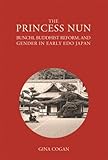
Gina Cogan. The Princess Nun: Bunchi, Buddhist Reform, and Gender in Early Edo Japan. Harvard East Asian Monographs. Cambridge: Harvard University Press, 2014. xvi + 309 pp. $49.95 (cloth), ISBN 978-0-674-49197-7.
Reviewed by Regan Murphy Kao (Stanford University)
Published on H-Shukyo (February, 2016)
Commissioned by Jessica Starling (Lewis & Clark College)
Bringing Women into the History of Edo Period Monastic Buddhism: A Study of a Forgotten Reformer
We all like to hear of radical women who challenged and overturned oppressive social norms, but in reality some of the most powerful and successful women did nothing of the sort. Indeed, upon second consideration, the narrative describing every influential woman as revolutionary can seem hackneyed, predictable, and even an example of wishful thinking. In The Princess Nun: Bunchi, Buddhist Reform, and Gender in Early Edo Japan, Gina Cogan studies a woman who was powerful and successful, and who did things that no one had done for hundreds of years. But Cogan eschews a predictable narrative for her success. The question she brings to her research, which resonates throughout the work, tries less to wow her readers with an idealized story than to get as close as possible to understanding what the nun Bunchi did and how she achieved it. This daunting task should not be underestimated: extant sources give an incomplete picture, many of the primary sources remain in nearly illegible script, and relevant secondary sources are scarce. Despite these challenges, Cogan’s book is remarkable in guiding the reader to understanding Bunchi’s life and work on its own terms.
The book takes a historical approach, following Bunchi’s career from her birth in 1619, through her death in 1697. Cogan examines the rich record of Bunchi’s early life as a member of the imperial family. She discusses her Buddhist mentor’s activities and his influence on her. She tells of Bunchi’s building of a convent, developing a practice that centered on regulations, and creating a precept platform at the convent. The first of its kind in over four hundred years, the precept platform enabled women to undergo the ceremony of ordination without visiting a monastery. What Bunchi achieved is remarkable; how she achieved it is fascinating.
Although scholarship on Buddhist reform is plentiful, Bunchi’s calls for reform have been left out of the historical record. By showing how similar Bunchi’s message was to contemporary male reformers, Cogan suggests that Bunchi used the conservative message of reform to make women’s monastic practice visible to the court and shogunate. She further suggests that studying Bunchi’s erasure from the historical record of Buddhist reformers can help shine light on how that history became a history of male practice.
Cogan’s lens is informed by the theories of Judith Butler, Joan Wallach Scott, Eve Kosofsky Sedgwick, and Saba Mahmood. She follows Scott in particular in examining how difference is constructed and how Bunchi’s practice can be seen in contrast with contemporary courtly Buddhism. Cogan does not ask “whether Bunchi subverted gender norms or patriarchal structures” but rather “how [Bunchi] came into being as an individual who lived within a network of power relationships.” She inquires “how it is possible to examine a life such as Bunchi’s in which the realization of potential lies not in increased freedom from constraint but in discipline of monastic precepts and devotion to the posthumous welfare of one’s family” (p. 19).
Cogan shows that Bunchi’s personal networks were critical in making her achievements possible. Bunchi built her vision of reclusive female monastic practice by making use of her position within various hierarchies—of gender, class, and religion. Cogan uses performance theory to analyze how Bunchi’s “performance” of different roles within contemporary power structures allowed her to achieve her ends.
The outlines of Bunchi’s efforts come into full relief against the backdrop of courtly Buddhism. Far from renouncing ties with the outside world, Cogan shows that courtier-Buddhists maintained these connections, which often determined their position within the clerical hierarchy. This background helps in providing the historical context for understanding how exceptional it was for Bunchi as a princess to choose to establish a reclusive convent, build a precept platform, and insist on precept-based practice at a distance from Kyoto.
A detailed picture of life at court and at Bunchi’s convent emerges from Cogan’s study. She highlights “behind-the-scenes” actors who contributed to the success of Bunchi’s efforts. Several powerful women at court, for example, provided critical financial support for Bunchi’s efforts. By focusing on how events came to pass rather than simply on what happened, Cogan shows the critical roles that female actors played. Further, Cogan gives a surprising glimpse at the concrete workings of a functioning convent. Who did the cooking and cleaning? Were there males working alongside females at the convent? How did the nuns communicate with the outside world? This sort of intimate detail is unprecedented. Concrete, detailed, and exceptional in its attention to overlooked actors in Japanese history, Cogan’s discussion of courtly Buddhism and convent life has much to recommend it.
While there are studies of women in monastic Buddhism during the premodern period and there is scholarship on male Buddhist reformers throughout Japanese history, Cogan’s study is the first to provide an in-depth look at a female monastic reformer from the early modern period. Cogan is exceptional at giving the reader the cues and background needed to understand Bunchi’s words and actions within their historical context. Her attention to the social networks that both enabled and limited Bunchi’s efforts allow her to paint a more complex narrative of Bunchi’s success. The care that Cogan takes to avoid projecting modern expectations onto her subject makes the book a good introduction for upper-level undergraduates and graduate students to the realities of Buddhist practice in Edo-period Japan. The historical detail she provides makes it invaluable for historians of early modern Japanese Buddhist convents and the imperial family. Boldly traditional in format and meticulous in detail, Cogan’s study is an admirable example of careful research.
If there is additional discussion of this review, you may access it through the network, at: https://networks.h-net.org/h-shukyo.
Citation:
Regan Murphy Kao. Review of Cogan, Gina, The Princess Nun: Bunchi, Buddhist Reform, and Gender in Early Edo Japan.
H-Shukyo, H-Net Reviews.
February, 2016.
URL: http://www.h-net.org/reviews/showrev.php?id=43451
 | This work is licensed under a Creative Commons Attribution-Noncommercial-No Derivative Works 3.0 United States License. |

