

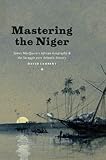
David Lambert. Mastering the Niger: James MacQueen's African Geography and the Struggle over Atlantic Slavery. Chicago: University of Chicago Press, 2013. 318 pp. $40.00 (e-book), ISBN 978-0-226-07823-6; $50.00 (cloth), ISBN 978-0-226-07806-9.
Reviewed by Julian Baker (University of Edinburgh)
Published on H-HistGeog (February, 2015)
Commissioned by Robert J. Mayhew (University of Bristol)
Mastering Trade, People, and Knowledge
My most powerful contact with the history of African slavery came last year in the Foyle Reading Room of the Royal Geographical Society. Laid out across a table (requested by another visitor) were David Livingstone’s effects, including a set of shackles that he had seized off several necks and brought back to Britain. Allowed to don a set of cloth gloves, I held the now rusted iron fetters and discovered that their weight was not so much in the circular clamp but in the chain that strung captives together. For me, David Lambert’s book Mastering the Niger, provides a very different yet similarly compelling inauguration into the links between slavery and geography.
The protagonist of this book is James MacQueen (1778-1870), the Scottish “arm-chair” geographer, slavery apologist, and defender of British colonialism. Using MacQueen’s life and work, Lambert seeks to show that “Atlantic slavery as a practice of subjugation, a source of wealth, and a focus of political struggle was entangled with the production, circulation, and reception of geographical knowledge,” and that the early nineteenth-century “debate over slavery was informed by, and involved the deployment of, geographical discourses, practices, and representational forms” (p. 4). His quarry is locational authority: the literal and figurative locations from which claims were made and made credible. Rather than focusing on the content of debates supporting antislavery, Lambert picks apart the authoritative bulwark that MacQueen and his contemporaries sought to erect around their knowledge of Africa, slavery, and colonialism.
The historical focus of Mastering the Niger runs from the late 1780s to the mid-1840s, thus including three interlocking periods: the birth to maturation of British antislavery campaigns; the escalation of British exploration in West Africa, the resolution of the “Niger problem” (determining where the river terminated), and the subsequent expeditions up this river; and the institutionalization of British geography as a discipline and suite of practices. Lambert relies on a range of records: MacQueen’s books, articles, maps, and bookkeeping and statistical accounts; pro- and antislavery pamphlets and articles; correspondence by or concerning MacQueen; popular and scholarly reviews; travel narratives; Royal Geographical Society articles; and British parliamentary records concerning slavery and West Africa.
Divided into three thematic parts and eight chapters, the book leads us “somewhat anti-chronologically” (p. 23) from MacQueen’s compilation and publishing on the Niger River’s course, to his early career as Grenada plantation manager, to his (mainly) geographical contestations of credibility regarding West Africa and the Caribbean, and finally to commercial, humanitarian, and exploratory expeditions in the Niger basin and elsewhere. Part 1, “Sources,” examines how and why MacQueen “solved” the Niger problem. Throughout, Lambert situates MacQueen’s use of contemporary geographical knowledge within the broader context of Atlantic trade and MacQueen’s specific exploitation of the “captive knowledge” of slaves under his control. To begin, chapter 2 compares MacQueen’s solution to alternative theories by way of a historical contextualization of his sources (the work of the African Association and Mungo Park’s Travels in the Interior Districts of Africa [1799]) and method (synthetic compilation of late modern geography). Chapter 4—meticulous, speculative, and perhaps the book’s most captivating—considers the specific post-revolt conditions of Grenada in which MacQueen worked and the African ethnicities and individuals from whom he extracted geographical knowledge.
Part 2, “Courses,” constitutes the analytical core of Mastering the Niger. It investigates the reception of and responses to MacQueen’s Niger River theory and related African commercial and humanitarian propositions. Chapter 5 takes up essential themes of historical geography and the sociology of scientific knowledge—credibility, authority, and truth making—by examining the relations between MacQueen’s synthetic (or humanistic) method with competing (and increasingly favored) theories of knowledge based on firsthand observation. Chapter 7 follows MacQueen’s Niger solution to its counterintuitive apex: the 1841-42 Niger Expedition spearheaded by Thomas Fowell Buxton and other members of the antislavery movement. Here Lambert examines how MacQueen’s textual, statistical, and cartographic work guided proposals and planning, and how and why his role in the expedition was ultimately sidelined by humanitarians and naval commanders.
Part 3, “Termination,” Mastering the Niger’s effective conclusion, is one chapter in length and covers MacQueen’s later life, including his formal acceptance into the Royal Geographical Society, his correspondence with notable African travelers, and late nineteenth-century use of his geographical work. In this last chapter come my only qualms with Mastering the Niger. It feels somewhat unrelated, as if linked to the preceding pages by MacQueen rather than the thematic and empirical material explored. Moreover, Lambert minutely employs the ethos of historical geography and geographies of science—analysis of claims, credibility, and location (literal and figurative). Indeed, through MacQueen, he hopes to have shown the “the entangled nature of Atlantic slavery, African exploration, and geographical knowledge,” and that the “historical processes, themes, and places too often treated in isolation should be understood together, such as exploration and slavery, the West Indies and West Africa, slave narratives and travel narratives, the ‘problem of slavery’ and the ‘Niger problem,’ and the ‘classic age of exploration’ and the ‘war of representation’ over slavery” (p. 218). Yet Lambert does not return to the geographical topics that he discusses at length in preceding chapters, such as the multi-sited complexities of “arm-chair” geography, the entanglements of (commercial) fields to (scholarly) fieldwork, or the periodicities of early modern synthetic and burgeoning “on the spot” methods. Nor does Lambert theorize an analytical structure of “captive knowledge,” either specifically situated in early nineteenth-century Atlantic-African trade or vis-à-vis postcolonial and subaltern studies.
That said, what Lambert achieves in Mastering the Niger is impressive. Through careful digging, he has illustrated a significant figure of early nineteenth-century geographical, colonial, and abolitionist debates. Lambert produces fine-grained historical reconstructions, such as regarding MacQueen’s Lanarkshire education; Grenadian colonial conditions; and the circa 1810 Glasgow coffee-house, mercantile, and publishing milieu. Also notable is his cross-referencing of sources in MacQueen’s published work and picking apart of contradictions regarding MacQueen’s distanced and sited claims to knowledge. Overall, this history of knowledge demonstrates the role of enslaved peoples to British geography and shows how debates about the Niger River and West African colonialism were based on the intentional authority of fluctuating and rival forms of geography as an emerging discipline.
If there is additional discussion of this review, you may access it through the network, at: https://networks.h-net.org/h-histgeog.
Citation:
Julian Baker. Review of Lambert, David, Mastering the Niger: James MacQueen's African Geography and the Struggle over Atlantic Slavery.
H-HistGeog, H-Net Reviews.
February, 2015.
URL: http://www.h-net.org/reviews/showrev.php?id=43422
 | This work is licensed under a Creative Commons Attribution-Noncommercial-No Derivative Works 3.0 United States License. |

