

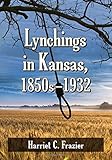
Harriet C. Frazier. Lynchings in Kansas, 1850s-1932. Jefferson: McFarland, 2015. 228 pp. $45.00 (paper), ISBN 978-0-7864-6832-4.
Reviewed by Brent Campney (University of Texas-Pan American)
Published on H-Law (July, 2015)
Commissioned by Michael J. Pfeifer (John Jay College of Criminal Justice, City University of New York)
The History of a Lynching List
In 1933, Genevieve Yost, a cataloguer at the Kansas State Historical Society, published an article in the Kansas Historical Quarterly entitled “History of Lynchings in Kansas.” In addition to her analysis of mob violence, she included an extensive list of the known victims of lynch mobs in the state since the territorial period, including their names and races and the time and place of their execution.[1] Despite her many errors of interpretation and fact--attributable perhaps to her effort to provide a hasty response to a 1932 white-on-white lynching in western Kansas--Yost has enjoyed considerable influence for decades on the scholarship on mob brutality in the state.
In Lynchings in Kansas, 1850s-1932, retired law professor Harriet C. Frazier fact-checks and updates Yost’s list. “My research for this book began shortly after I came across” Yost’s article, “before now the main source of information about lynchings in that state,” she writes. “Throughout my book I compare my data against hers” (p. 1). She finds, for example, some forty incidents that Yost missed and shows that the cataloguer mischaracterized the race of some of the victims. Frazier also scratches from the 1933 list those events that in her view were wrongly characterized as lynchings. “Yost often blunders in her compilation,” she notes. “Throughout my texts and notes, I correct her errors, and I hope that my own are minimal” (pp. 1, 2). In providing an updated and accessible list, Frazier has done an important service for researchers of crime, punishment, and race relations in Kansas and the Midwest more generally. With this book, she establishes herself as a particularly prolific chronicler of death and disorder in this area of the United States, adding it to her four previous books.[2]
Lynchings in Kansas also provides brief but provocative discussions of threatened but prevented lynchings and other suspected or reported incidents for which Frazier could not find sufficient evidence to include in her comprehensive lynching list. In so doing, the study provides a hint of just how frequent lynchings might have been were it not for police officers, among others, who sometimes hurried would-be lynching victims from the area or confronted and dispersed would-be mobs. Building on this theme, the book includes a second list entitled “Falsely Reported, Border or Slavery Warfare, Doubtful, and Foiled Lynchings, 1855-1922” (p. 181). Although Lynchings in Kansas does not actively engage the historiography of mob violence (see below), the book does with this insight build on the work of other scholars who have over the last several decades explored to some extent the significance of threatened mob violence and its prevalence over time.[3]
Despite these contributions to the literature on mob violence, Lynchings in Kansas is neither analytical nor theoretical. (Here it is only fair to state that the reviewer is the author of a forthcoming study of antiblack violence--including lynchings--in Kansas between 1861 and 1927.) Most importantly, the book never grapples with lynching itself. It is instead little more than an annotated list, with every lynching described in roughly chronological order, usually in a paragraph or less. In a representative passage, it finds that “Yost correctly dates the lynching of Dan Adams, her list’s entry 107, as taking place on April 20, 1893. She also correctly identifies him as a Negro and places his mob murder in Salina, Saline County, but she gets his crime wrong” (p. 123). It adds: “The next black victim is Yost’s entry 110, and she correctly dates the event, states his name, his race, the town, county, and crime correctly” (p. 124). In short, Lynchings in Kansas provides little analysis of how or why these episodes were important, how they reinforced or challenged social boundaries, or how they changed over time and space (except in the general sense that they declined over time). Consequently, it strips the story of its drama, tragedy, and fundamental humanity.
In addition, Lynchings in Kansas tends to accept the viewpoint of the mob, assuming the guilt of the lynched person, unless otherwise noted (for an especially troubling example of this, see the discussion of the white-on-black lynching of Hugh Henry in Larned in 1892, pp. 120-121). Furthermore, with the exception of cursory references to the race of the victims, the book spends remarkably little time grappling with the racist implications of the state’s white-on-black lynchings. Indeed, it seems to affirm implicitly Yost’s highly questionable declaration that “the negroes form such a small percentage of the total lynched, a ratio of one negro to four and one-half whites, that the race problem cannot be considered an especially important factor in the state.”[4] Similarly, Lynchings in Kansas fails to link the events which it discusses to the larger historical periods in which they occur, such as the Reconstruction, Progressive, or World War I periods. Its chapter titles reflect its provincial scope: chapter 4 is entitled “Mob Murders Down: Victims likely Include Sons of a Former Illinois Governor, 1871-1875”; Chapter 8 is entitled “Seven Blacks and Nine Whites, 1890-1899.”
Finally, Lynchings in Kansas fails to engage with the vast body of scholarship on lynching, aside from the somewhat dated work of Richard Maxwell Brown in Strain of Violence (1977) and James R. McGovern in Anatomy of a Lynching (1982). It does not incorporate the work of the leading theorists of the past few decades, such as W. Fitzhugh Brundage, William D. Carrigan, Crystal Feimster, Michael J. Pfeifer, Stewart Tolnay and E. M. Beck, Christopher Waldrep, Kidada E. Williams, or Amy Louise Wood.[5] Furthermore, while it does include references to a 2010 article by Christopher C. Lovett on the burning of a black prisoner by a mob in Leavenworth in 1901, the book does not engage any of the numerous other articles on lynchings and racist violence in Kansas published since the 1990s.[6]
Lynchings in Kansas will provide a useful and updated list to the fraternity of scholars exploring mob violence in Kansas and the Midwest more generally, and may be of interest to those readers interested in this aspect of Kansas history.
Notes
[1]. Reflecting the social conventions of the period, Yost designated the race of blacks, Indians, and a single ‘Mexican’; she made no racial designation at all for whites.
[2]. Harriet C. Frazier, Slavery and Crime in Missouri, 1773-1865 (Jefferson, NC: McFarland & Company, 2001), Runaway and Freed Missouri Slaves and Those Who Helped Them, 1763-1865 (Jefferson, NC: McFarland & Company, 2004), Death Sentences in Missouri, 1803-2005 (Jefferson, NC: McFarland & Company, 2006), and Lynchings in Missouri, 1803-1981 (Jefferson, NC: McFarland & Company, 2009).
[3]. For a particularly insightful essay on the significance of prevented lynchings, for example, see Larry J. Griffin, Paula Clark, and Joanne C. Sandberg, “Narrative and Event: Lynching and Historical Sociology,” in Under Sentence of Death: Lynching in the New South, ed. W. Fitzhugh Brundage (Chapel Hill: University of North Carolina Press), 24-47.
[4]. Genevieve Yost, “History of Lynchings in Kansas,” Kansas Historical Quarterly 19 (May 1933): 182-219; 199.
[5]. See, for instance, W. Fitzhugh Brundage, Lynching in the New South: Georgia and Virginia, 1880-1930 (Urbana: University of Illinois Press, 1993); William D. Carrigan, The Making of a Lynching Culture: Violence and Vigilantism in Central Texas, 1836-1916 (Urbana: University of Illinois Press, 2004); Crystal N. Feimster, Southern Horrors: Women and the Politics of Rape and Lynching (Cambridge: Harvard University Press, 2009); Michael J. Pfeifer, Rough Justice: Lynching and American Society, 1874-1947 (Urbana: University of Illinois Press, 2004); Stewart Tolnay and E. M. Beck, A Festival of Violence: An Analysis of Southern Lynchings, 1882-1930 (Urbana: University of Illinois Press, 1995); Christopher Waldrep, The Many Faces of Judge Lynch: Extralegal Violence and Punishment in America (New York: Palgrave Macmillan, 2002; Kidada E. Williams, They Left Great Marks on Me: African American Testimonies of Racial Violence from Emancipation to World War I (New York: New York University Press, 2012); Amy Louise Wood, Lynching and Spectacle: Witnessing Racial Violence in America, 1890-1940 (Chapel Hill: University of North Carolina Press, 2009). The book does make reference to Pfeifer’s earliest article, from 1993.
[6]. For studies on lynchings and racist violence in Kansas published since the 1990s, see James N. Leiker, “Black Soldiers at Fort Hays, Kansas, 1867-1869: A Study in Civilian and Military Violence,” Great Plains Quarterly (Winter 1997): 3-17; Shawn Leigh Alexander, “Vengeance without Justice, Injustice without Retribution: The Afro-American Council’s Struggle against Racial Violence,” Great Plains Quarterly 27 (Spring 2007): 117-133; John N. Mack, “United We Stand: Law and Order on the Southeastern Kansas Frontier, 1866-1870,” Kansas History 30 (Winter 2007-2008): 234-251; Brent M. S. Campney, “W. B. Townsend and the Struggle against Racist Violence in Leavenworth,” Kansas History 33 (Winter 2008-2009): 260-273; Brent M. S. Campney, “‘Ever Since the Hanging of Oliphant’: Lynching and the Suppression of Mob Violence in Topeka, Kansas,” Great Plains Quarterly 33 (Spring 2013): 71-86. For another listing of white-on-black and white-on-white lynchings in Kansas, which included many of the same changes documented by Frazier, as well as some different ones, see Brent M. S. Campney, “‘And This in Free Kansas’: Racist Violence, Black and White Resistance, Geographical Particularity, and the ‘Free State’ Narrative in Kansas, 1865 to 1914,” (PhD diss., Emory University, 2007), 294-297, 331-339.
If there is additional discussion of this review, you may access it through the network, at: https://networks.h-net.org/h-law.
Citation:
Brent Campney. Review of Frazier, Harriet C., Lynchings in Kansas, 1850s-1932.
H-Law, H-Net Reviews.
July, 2015.
URL: http://www.h-net.org/reviews/showrev.php?id=43405
 | This work is licensed under a Creative Commons Attribution-Noncommercial-No Derivative Works 3.0 United States License. |

