

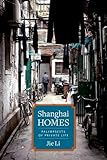
Jie Li. Shanghai Homes: Palimpsests of Private Life. Global Chinese Culture Series. New York: Columbia University Press, 2014. Illustrations. 280 pp. $90.00 (cloth), ISBN 978-0-231-16716-1; $30.00 (paper), ISBN 978-0-231-16717-8.
Reviewed by Preeti Chopra (University of Wisconsin-Madison)
Published on H-Asia (April, 2016)
Commissioned by Sumit Guha (The University of Texas at Austin)
“Excavate Where I Stand”: Whispers from the Lost Worlds of Shanghai’s Alleyway Homes
Shanghai has long been associated with cosmopolitan culture. The city was famously one of the five treaty ports established by the British in China at the conclusion of the Opium War in 1842, and since the 1990s, economic reforms helped to make it the commercial capital of, and largest city in, mainland China. Shanghai has steadily risen in world city ranking, and its transformation has made it a model to be emulated in other parts of the world. For example, in October 2004, India’s prime minister Manmohan Singh advocated the use of Shanghai as a model to make over Mumbai. Given its historic and contemporary prominence, it is thus hardly surprising that there is a rich body of literature on Shanghai, both literary and academic. The city is, for instance, the site of the detective novels of Qiu Xiaolong, whose books showcase modern China. However, as author Jie Li observes, “Since the 1990s, the commercial glamour of Shanghai nostalgia flourished at the expense of the real lives of ordinary citizens” (p. 5). Turning away from the allure of the city’s “commercial glamour,” Hanchao Lu’s Beyond the Neon Lights: Everyday Shanghai in the Early Twentieth Century (2004), for example, presents an important attempt at foregrounding the rich texture of everyday lives in the city. Li’s Shanghai Homes: Palimpsests of Private Life, focusing on the lives of ordinary residents in two Shanghai alleyways, shows Li to be an heir to and innovator in this tradition. While being a moving and engaging account that melds the personal and the academic, Shanghai Homes is a notable contribution to our understanding of Shanghai and Asian cities. Moreover, its rich use of multiple methods provides object lessons for all scholars who write on cities to showcase the private worlds of the everyday lives of its citizens.
Conceptually, Shanghai Homes is based on the old home as a palimpsest of the lives of many families who have inhabited it over decades. Even as significant historical events, such as wars, revolutions, shifting political ideologies, and reforms, importantly influence the private worlds of the home, they are not the entirety of the story. Nor is the past entirely effaced, even when it is not aligned with the dominant ideology of an era. Instead, the past “persisted in the form of artifacts and whispers in domestic realms” (p. 2). In its interaction with the exterior world, the house is always reordered; some old things are discarded to make room for the new. Thus “like a museum of history, it presents a selective assemblage of objects and narratives,” but these selections are rarely “as deliberate and systematic as a curated exhibition. Instead, each house is a palimpsest of inhabited spaces, material artifacts, and personal narratives that evolved over time” (p. 3).
The location of the homes of Li’s research are two alleyways in Yangshupu District, an industrial district located in the eastern part of the area known, prior to 1949, as the International Settlement. Li’s paternal grandparents resided in an alleyway constructed by a Japanese company in 1915. The second alleyway, known as Alliance Lane, was constructed by a British company in 1927 and was the location of Li’s maternal grandparents’ house. Li’s parents grew up in these alleyways, and she spent several years of her childhood here, making this an account that is rooted in the author’s own experiences and family memories. Li calls the approach to the interdisciplinary research and methods she uses in this book “excavate where I stand,” which “can be defined with the key words palimpsest, microhistory, and familial ethnography” (p. 12, italics in original). All alleyway homes were designed for a single family, but with greater migration to the city in the early twentieth century, many tenants subdivided their homes and sublet rooms, acting as “second landlords.” From the 1920s to 1940s, these second landlords were prominent in leasing property, and the variety of residents in the alleyways contributed to the city’s cosmopolitan character. While the 1930s and 1940s have been memorialized in theater, film, and academic accounts, little attention has been given to the 1950s to 1980s. This is the period when the Communist regime brought an end to the real estate market and introduced a household registration system, tying people to place and thus turning temporary city residents into natives who put down roots in the alleyways of the city where subsequent generations were born. In contrast to “work-unit based socialist housing compounds” and more recent constructions segregated by class, alleyways continued to house a real diversity of city residents (p. 9). One of the alleyways was torn down in 2006 and the second was to be pulled down in 2014. Thus this is also a window into a world that no longer exists.
The book consists of an introduction, four chapters, and a short concluding piece. The first chapter, “Foothold,” makes the point that “a home is above all a foothold in the city” (p. 25). It traces change in terms of space, occupancy of two houses, and related alleyways. Li weaves together accounts of the spatial changes of two houses (particularly from the 1930s to 1990s), the histories of their respective alleyways, house design, and the populations that resided there before 1949. Li’s paternal and maternal family histories (and accounts of their close neighbors) are also considered as they gain a foothold in Shanghai. These accounts unfold under the umbrella of three larger historical periods of the Republican era, the socialist Maoist era (after 1949), and the post-Maoist reform era (from about 1978). Li’s maternal grandparents were from the countryside, worked as silkworkers in Shanghai, and after 1949, were seen as a “proletariat family.” In contrast, her paternal grandfather graduated from St. John’s University in 1943 and then worked as a clerk in a bank in Nanjing for two years. Her paternal grandparents came to be viewed less favorably as a “Rightist family” in the 1950s (pp. 44, 76). Thus, through family histories (including those of other residents in these houses), Li concretely demonstrates the varied experiences people had of a given era. She demonstrates how the socialist era came to symbolize opportunities for her maternal grandparents but was a more complicated era to negotiate for her paternal grandparents who became targets of the revolution in the 1950s.
Li shows how some of these political, familial, and economic negotiations resulted in spatial and territorial changes of the home. For example, to demonstrate that his thinking had been reformed, her paternal grandfather gave up his living room, part of his two-story house, to the Housing Management Bureau so that it could be given to another family in need. However, territorial changes in the home were equally dictated by family dynamics, including generational shifts; changing family fortunes; and marital relationships where, for instance, a concubine could be privileged over the wife. Thus we become aware of many different modes of being and living through the tracing of the multiple family trajectories of the residents of these houses. To make her case, Li uses a variety of visual materials, including plans; hand-drawn sketches of scenes by her parents as well as hand-drawn sketches of house cross-sections (with furnishings and people); and historic and contemporary photographs of individuals, families, and other groups. Although a house plan would have been a valuable visual aid for the reader, Li makes good use of the house cross-sections to explain the various spaces in the houses, and the location of individuals and material possessions.
The second chapter, “Haven,” moves away from the focus on housing to examine the emotional resonance of material artifacts in Shanghai homes that made these homes into “psychological havens” (p. 89). Li focuses on specific artifacts: the grain bed in the attic of her maternal grandparents’ home; her paternal grandfather’s writing desk (the scene is sketched out in a drawing by her father reproduced on page 95); her paternal grandmother’s sewing machine; and the radio waves that from the 1930s to 1980s “permeated Shanghai’s alleyways and connected its domestic spaces to a broader world beyond” (p. 105). The grain bed was, for example, part of Li’s maternal grandfather’s paternal grandmother’s dowry. It arrived with rice paddy and was replenished every autumn by tenant farmers. Li uses the grain bed as an entry into family history that shows links to the countryside and unfolds over time and space, as the grain bed is inherited by her grandfather after his grandmother’s death. Moved into the attic of their home in Alliance Lane in Shanghai, this was one of the few treasured pieces of furniture that her grandparents chose to carry with them to their new home after the demolition of Alliance Lane. Subsequent sections of the chapter focus on broader historical changes: the searches of alleyway homes during the Cultural Revolution; greater concern for privacy and material comforts during the reform era and; as people began to move out of Shanghai alleyways from the late 1980s, memories of the world and ways of the alleyway residents even as new modern and comfortable lifestyles were happily embraced in the new settings.
Moving away from housing and material artifacts, the third chapter, “Gossip,” begins beautifully with an evocation of her maternal grandmother’s (Waipo) mouth, where “the wrinkles around my grandmother’s mouth grow outward from her lips like a chrysanthemum,” and we quickly read how effectively her “pout” expressed “pity and envy,” and “life’s delectability and bitterness” (p. 141). Li often accompanied her grandmother on visits to the alleyway homes of neighbors and relatives. There is a marvelous set of four video stills in the chapter from a video made by the author of her grandmother gossiping in the alleyway with her neighbors in 2000 (p. 153). While her maternal grandmother was an accomplished gossip, her paternal grandmother had no great interest in gossip. However, she had ten complaints, which the author lists, against one specific neighbor, Grandma Front Bedroom, who spent her days on the threshold of her home daily keeping an eye on the residents of the alleyway. Truly the neighborhood busybody! Even in the rooms that constituted their homes, residents often spoke in whispers so that their neighbors would not hear what they said as eavesdropping was always a temptation. All the same as the author argues, “As an antithesis to official historiography and the state’s memory of itself, gossip has remained a privileged mode of narrative production in this metropolis from the late Qing to the present” (p. 143). Thus the gossip of the alleyway that we read of in this account is a certain “mode of narrative production,” a certain kind of history of the alleyway of Shanghai.
The final chapter of the book, “Demolition,” sets the stage for the demolition of the alleyways with the chapter opening with an account of the author and her grandmother in 2006, bearing witness to the demolition of Alliance Lane as they come on a visit one day. This demolition followed after a 2005 Shanghai municipal government planned to “‘renovate old neighborhoods’” (p. 193). Even as the chapter outlines the process by which alleyway residents were coerced or forced to move, with some former residents shrewdly negotiating good compensation deals, we hear of “nail households,” those “who refuse to move and are often forcibly evicted” (p. 192). Rather than an exercise in nostalgia, this chapter shows how alleyway residents negotiated and took on the government to move from their homes on better terms but also, in the process, brought about changes in legislation regarding demolition, relocation, and compensation.
Shanghai Homes is a delightful book that is accessible and should be read by scholars from a variety of fields and a broader audience. At heart, it is a human story, both local and global, that concretely shows how life unfolds across generations, over time, and in the space of home and neighborhood, in sharp relief against a backdrop of great historical changes. It is a reminder to each one of us that we too, through our lives and material possessions, as shapers of space in our homes and neighborhoods, and in the stories we tell each other and about each other, are makers and participants in “history” who contribute to “History.”
If there is additional discussion of this review, you may access it through the network, at: https://networks.h-net.org/h-asia.
Citation:
Preeti Chopra. Review of Li, Jie, Shanghai Homes: Palimpsests of Private Life.
H-Asia, H-Net Reviews.
April, 2016.
URL: http://www.h-net.org/reviews/showrev.php?id=43306
 | This work is licensed under a Creative Commons Attribution-Noncommercial-No Derivative Works 3.0 United States License. |

