

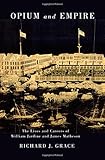
Richard J. Grace. Opium and Empire: The Lives and Careers of William Jardine and James Matheson. Montreal: McGill-Queen's University Press, 2014. 476 pp. $34.95 (cloth), ISBN 978-0-7735-4452-9.
Reviewed by Amar Farooqui (Delhi University)
Published on H-Asia (March, 2016)
Commissioned by Sumit Guha (The University of Texas at Austin)
Opium Smugglers
[Ed. note: This review is based on the unpaginated Kindle edition of the book. References are to Kindle location numbers.]
The role played by opium in the “opening” of China during the first half of the nineteenth century is well known. The first major colonial military onslaught against the Qing empire is known as the First Opium War (1839-42). One could argue that the war inflicted on China was to a great extent the result of aggressive lobbying in London by Jardine Matheson & Co. to protect its own opium enterprise as well as on behalf of the syndicate of smugglers operating in and around Canton. The story of Jardine Matheson, and of its role in precipitating the showdown between Britain and China in 1839, has already been told in considerable detail. The pioneer in the field was Michael Greenberg, whose British Trade and the Opening of China (1951) was based mainly on the letter-books of Jardine Matheson and its predecessor firms. These letter-books and other records were accidentally discovered in a Hong Kong godown in the 1930s by Gerald Yorke, who got down to sorting the papers and writing a history of the firm. Yorke’s unpublished manuscript was used (without adequate acknowledgment) by Maurice Collis for his best-seller, Foreign Mud (1946). However, Greenberg’s work represented the first professional study of the Jardine Matheson papers. Surprisingly, a recent publication sponsored by the British Academy,[1] containing a small selection from the Jardine Matheson archive (now housed in the University of Cambridge Library), states that Foreign Mud was the first study “to make extensive use of the Jardine Matheson Archive,” ignoring Collis’s own statement that “[I] did not consult these papers myself.”[2]
Subsequently researchers, among whom one might specially mention W. E. Cheong, have utilized the archive to provide us more details about opium smuggling in and around the Canton–Macao area, focusing on the activities of Jardine Matheson. Richard Grace’s meticulously researched joint biography of William Jardine and James Matheson does of course draw on the material contained in the records of the firm quite extensively, but in combination with numerous other sources looks at the lives and careers of these two smugglers—for that is what they were—beyond their business operations in China. Nevertheless, these operations are central to the narrative, since they are what give the lives and careers of Jardine and Matheson some historical significance.
Born in 1784, Jardine, the elder of the two Scottish partners, grew up in circumstances of economic hardship. He managed to gain admission to the University of Edinburgh where he studied medicine, obtaining a diploma in surgery. At the age of eighteen he got a job as assistant surgeon on an East India Company ship, Brunswick. He later served as surgeon on other ships of the company. It was during the course of a private voyage undertaken by the Brunswick from Bombay to Canton that he became acquainted with Jamsetjee Jejeebhoy, who would emerge as opium king in western India by the late 1820s and become the leading supplier of the drug to Jardine Matheson for its lucrative narco-trafficking enterprise in south China. The voyage commenced in 1805; we learn of the vicissitudes of its crew and passengers following the capture of the vessel by the French, who were then at war with Britain. Possibly Jardine and Jejeebhoy got to know each other quite well during these adventures. It is likely that Jejeebhoy, who had already traveled thrice between Bombay and Canton, gave Jardine valuable information about the opium trade in conversations aboard the ship.
Matheson belonged to a relatively well-to-do family of southern Scotland. He too gravitated to Edinburgh for higher education, but moved to London before he could acquire a degree. He spent two years in London learning the basics of commerce and then went on to Calcutta, where he spent some time working for his uncle’s agency house, Mackintosh & Co. By the time the Napoleonic Wars came to an end, Jardine and Matheson were thinking in terms of the prospects of business in China, where an entire economy centered on the smuggling of Indian opium was already thriving. The two came together through a series of partnerships in which they were involved and which included several China traders who had connections with Calcutta, Bombay, and Macao. These partnerships were the predecessors of Jardine Matheson; their complicated history was traced by Greenberg from records of the firm going back to at least 1799, when it bore the name Hamilton and Reid. The two immediate predecessors of Jardine Matheson were Yrissari & Co., with which Matheson was associated, and Charles Magniac, with which Jardine was associated. Eventually, when Jardine Matheson was formed in 1832, with Jardine and Matheson as senior partners, it inherited the business of both Yrissari as well as Magniac. Since these two firms were big players in the opium market, Jardine Matheson was able to stay well ahead of rivals, particularly Dent & Co., the other leading agency house dealing in the drug. Jardine Matheson and Dent dominated the trade in the second quarter of the nineteenth century, establishing a virtual duopoly. It is pertinent that Jardine was not keen on the legalization of the opium trade in China, advocated by many of the dealers who entered the trade when the East India Company’s China monopoly ended in 1833-34, as legalization would have resulted in a further increase in the number of small-time speculators whom the big dealers were keen to keep out. It is a pity that the author has ignored some of the published research on the connections of Jardine Matheson with Bombay opium exporters. The difficulties, increasingly insurmountable, faced by Indian dealers in having their earnings remitted from China after 1834 have been highlighted by Asiya Siddiqi in her study of the Bombay–Canton commerce, which was based on the Jamsetjee Jejeebhoy letter-books (these contain copies of the extensive correspondence with Jardine Matheson on the subject of opium consignments.)
Grace’s perusal of source material relating to the First Opium War by and large confirms the conclusion drawn by several scholars who have written on the issue, that Jardine and Matheson pushed for an aggressive policy vis-à-vis China, advocating the use of force to compel the Qing authorities to allow unrestricted access to the Chinese market, and actively assisted the British government in preparing the blueprint for the military campaign. The book states quite categorically that “if we were to ask how much they had to do with the origin of the war, the answer would have to be plenty” (loc.7148). Shortly after the Treaty of Nanjing was concluded Lord Palmerston declared that the “assistance and information” that Jardine (and by implication Matheson too—Matheson was in England between 1836 and 1838; Jardine had returned home at the beginning of 1839) “handsomely afforded us, it was mainly owing that we were able to give our affairs, naval, military and diplomatic, in China, those detailed instructions which have led to these satisfactory results” (loc.8530). During his two-year stay in Britain on the eve of the war, Matheson had among other things circulated an eighty-page tract, Present Position and Future Prospects of the British Trade with China (1836), in which he had strongly urged the British government to commit itself to taking “‘effectual measures’” to protect and promote British commercial interests in China (cited loc.4704). At the same time he evaded the question of opium smuggling, which was the main cause of the conflict. Thus it was through subterfuge that a strong case was built up for military intervention.
Jardine left Canton for good in 1839, before the outbreak of hostilities. The grand farewell function in his honour (vividly conjured up in Amitav Ghosh’s River of Smoke), held in January 1839, was perhaps the last relaxed social event of the prewar era on the waterfront where the factories were located. Matheson was back from England by this time and managed the affairs of the firm while simultaneously rendering assistance to British officials as the military offensive against China was launched. He temporarily lived aboard ships, his personal needs attended to by his “old servant” Ibrahim, an Indian; he was requesting his associates in India to find him a good cook, “‘a first rate Artist,’” whom he was willing to pay a hundred rupees a month (loc.7565). The business continued to prosper, conflict itself making possible large earnings from the sale of opium. Some of these earnings Matheson invested in land for farming and sheep rearing in Australia. The study tells us about the wide-ranging commercial and financial ventures of Jardine Matheson, handling consignments of opium, tea, raw cotton, rice, and silk; shipping; insurance and transactions involving bills of exchange; and speculation in land (additionally in Hong Kong, post-1842). Its operations extended from London to India, Canton, Macao, the Philippines, and eventually Australia. Yet opium remained of critical importance in the years that Matheson resided at Canton, and afterwards as well.
Jardine died in 1843, but Matheson was fortunate to fully savor his retirement from direct participation in the China trade. He lived on for thirty-five years after his return to Britain in 1842, marrying in 1843 (the couple did not have children), and was knighted in 1851. In 1847 Matheson was elected to the House of Commons. He remained a member of Parliament until 1868. As MP was able to use his political influence to advance the interests of the P&O shipping company of which he became chairman, occupying the position for nearly a decade, until 1858. Grace points out that Matheson’s presence as chair of the board of directors was not ceremonial. P&O made good use of his vast experience in shipping and the China trade. The company, one might mention, relied on the shipment of opium from India to China for its profits. Moreover, its contract for carrying the royal mail was vital for its earnings. This contract was granted on the recommendations of relevant parliamentary committees and Matheson would have used his contacts as MP to facilitate favorable recommendations for the company: “For a ‘ceremonial’ chairman, he brought a wealth of experience and a host of connections to the P&O,” spurring the growth of the company during the early 1850s (loc.8792). Other than his numerous business commitments, and his close connection with the financial world of London as a banker, Matheson appears to have invested a substantial portion of his fortune in land, soon becoming the second-largest landowner in the United Kingdom. The book has an entire chapter on his career as the laird of the Isle of Lewis, in the outer Hebrides, Scotland. His management of this vast estate resulted in frequent disputes with the tenants, whose status he continuously sought to depress.
As much of the published literature on Jardine and Matheson has focussed on their lives as China traders, Grace has filled, through his comprehensive research on Matheson, a major gap in our understanding of the place, in British society, of stinking-rich opium smugglers who had made their fortunes in Asia. They were not very different from the nabobs of the late eighteenth century, exposing the predatory character of Victorian Britain. Perhaps Matheson in the later phase of his life, more than Jardine, who died within about four years of his return to Britain, could be seen as an example of the “gentlemanly capitalist” successfully adopting the lifestyle of the landed aristocracy, aspiring to the social status of that class on the strength of wealth earned from commerce and banking. This is an argument that could have been briefly made and did not require the long “Postlude” that seeks to assess the lives of the two partners, separately and together, in terms of the “gentlemanly capitalism” thesis advanced by Peter Cain and Anthony Hopkins.[3]
Grace’s account is occasionally hagiographical, as biographies often tend to be, but in all fairness to him he does not gloss over the more unsavory aspects of the lives of the two protagonists of his tale. For instance, whereas he says at one place that Jardine and Matheson saw opium as a “morally neutral” commodity (loc.9722), he concedes at another that they were fully aware of its “lethal potential” (loc.5983). In their more public utterances they never admitted that addiction to the drug invariably had dreadful consequences, always resorting to falsehoods in the matter. Jardine Matheson & Co. handled a dangerous cargo. This was a cargo that was vital for sustaining empire and yet had to remain hidden. The extent to which we might consider the shady dealings of the firm as respectable business depends upon the extent to which we accord respectability to colonial expansion.
Notes
[1]. Alain Le Pichon, ed., China Trade and Empire: Jardine Matheson & Co. and the Origins of British Rule in Hong Kong, 1827–1843, Records of Social and Economic History Series (Oxford: The British Academy and Oxford University Press, 2007), xi.
[2]. Maurice Collis, Foreign Mud: being an account of the opium imbroglio at Canton in the 1830’s and the Anglo–Chinese war that followed, ([1946]; New York: New Directions Books, 2002), 312.
[3]. Peter J. Cain and Anthony G. Hopkins, "Gentlemanly Capitalism and British Expansion Overseas I: The Old Colonial System, 1688‐1850," Economic History Review 39, no. 4 (1986): 501-525, "Gentlemanly capitalism and British expansion overseas II: new imperialism, 1850‐1945," Economic History Review 40, no. 1 (1987): 1-26.
If there is additional discussion of this review, you may access it through the network, at: https://networks.h-net.org/h-asia.
Citation:
Amar Farooqui. Review of Grace, Richard J., Opium and Empire: The Lives and Careers of William Jardine and James Matheson.
H-Asia, H-Net Reviews.
March, 2016.
URL: http://www.h-net.org/reviews/showrev.php?id=43291
 | This work is licensed under a Creative Commons Attribution-Noncommercial-No Derivative Works 3.0 United States License. |

