

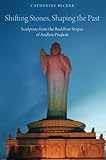
Catherine Becker. Shifting Stones, Shaping the Past: Sculpture from the Buddhist Stupas of Andhra Pradesh. New York: Oxford University Press, 2014. 352 pp. $99.00 (cloth), ISBN 978-0-19-935939-4; $35.00 (paper), ISBN 978-0-19-935940-0.
Reviewed by Padma Kaimal (Colgate University)
Published on H-Asia (August, 2015)
Commissioned by Sumit Guha (The University of Texas at Austin)
Buddhist Stupas in Andhra
In this study of Buddhist sculptures in southeastern India’s Andhra Pradesh, Catherine Becker challenges the scope and structure of what an art history book can be by weaving together an impressive range of disciplinary perspectives. She anchors this in a chronological flow, sequencing the chapters to march toward our present moment. They begin with archeological and visual analysis of the stone reliefs carved during the second and third centuries to adorn stupas along the banks of the Krishna River. That close study of how objects look, a method she returns to in every chapter, lets her deduce what those objects did to people and what people have done and continue to do to them. This takes her into rhetorical analyis of the most recent century’s politics of postcolonial identity and the branding efforts of the state tourism office. The book’s final chapter centers on participant observation of a 2006 festival at Amaravati, where the ghost of a great stupa has inspired utopian globalism and plans for a theme park.
Chapter 1 focuses on reliefs that once decorated the stupa with representations of stupas, a representational doubling that previous scholars have used primarily to reconstruct the appearance of stupas that have deteriorated. Becker invents the term meta-stupa for these reliefs and asks for the first time why people needed them when the stupa mounds remained intact. She concludes that the stupa and the meta-stupa could catalyze in viewers the urge to donate (prasada) to the sacred site and its residents, thus maintaining the site and ensuring the donor’s eventual escape from the chain of rebirth (samsara).
Chapter 2 enters the literary and art-historical conversation about narrativity, an analytical approach to the huge variety of forms available for story-telling and the possible effects of each. Becker walks her readers through multiple images of Buddha’s renunciation, demonstrating how different visual representations of a single subject achieve distinct experiences. She does this with Werner Wolf’s idea of “degrees” of narrativity, a device not for judging the quality of images but for prying the concept of narrative apart from the chronological linking of events.[1] The relief in figure 2.1, for example, articulates a clear sequence among multiple scenes (“strong” narratives in Wolf’s terms) which can lead visitors around the monument in circumambulation, an important mode of worship. The relief in figure 2.17 makes it more difficult to map out chronology (making its narrativity “weaker” in Wolf’s schema), but its radial organization of later episodes around the moment the Buddha leaves his princely comforts behind can effectively articulate the connections between cause and effect, a fundamental principle of Buddhist teachings. If the first organization of forms could teach visitors how to practice ritual, the second could teach them ethical reasoning.
These readings of subtle thought in visual form are part of Becker’s resolution to a lively scholarly debate about the visuality of stupa sculptures and, by extension, of all visual art associated with devotion. Becker agrees with Robert Brown that cultural differences must separate second- and twentieth-century ways of seeing, and she finds that Amaravati sculptures were designed for a devotional gaze quite unlike the distinterested gaze of modern scholarship. But she believes that devotional gaze was close and sophisticated. The visuality of those sculptures was fundamental to their successful operation as agents of inspiration and transformation. This rejects Robert Brown’s suggestion that sculptors had intended visitors to experience stupa sculptures as icons manifesting the Buddha’s presence rather than to “read” them so analytically.[3] Joanna Williams had challenged Brown with evidence from stupa sculptures at Sanchi, and Becker builds on that challenge even as she acknowledges the iconic function of Buddha figures.[3] Her move is to frame the iconic as a complement rather than an alternative to narrative: sculptures could manifest the Buddha’s presence through visual storytelling. In verbal sources, the Buddha narrates stories that effect spiritual progress in the listener; in sculptures, sight itself of the story can effect spiritual transformation. Thus the stupa, the original site of these narrative sculptures, could serve as a functional equivalent of the much-loved, much-missed, didactic narrator himself, the Buddha.
In the face of Bernard Faure’s dismissals of visual analysis as useless aestheticization, Becker’s first two chapters make a forceful case for visuality as a productive way of knowing, and she exemplifies how contemporary scholars may undertake the task with humility and respect. That kind of looking rewards her, and therefore us, with a rather ethnographic hypothesis about the emotionally committed and intellectually agile devotional gaze as an ancient dynamic of thought for ancient Andhra’s worhshippers and artists among artists. Becker makes the case that looking matters now too, if we are to comprehend sacred and ritual information that enabled the monument and its community to function.
Chapter 3 begins with “Andhra’s Statue of Liberty,” the colossal stone Buddha which has stood since 1992 on an island in a lake in Hyderabad called Hussain Sagar. Becker notes this figure’s antecedents from third-century Nagarjunakonda, and she goes on to explore potential connections in Sri Lanka and Sravana Belagola and even parallels on the American frontier, where the gigantic has expressed a desire for change. In the Hussain Sagar pedestal, Becker finds citations of Ashoka’s lion capital from the third century BC, of fifth-century Sarnath, and of arches and lions common to temples in the Tamil region, all alongside ancient Andhra’s sculptural tradition. As a series, these signs collapse multiple golden ages of India (assembled through the filter of Heinrich Zimmer’s textbook on Indian art, Becker discovers) into a smoothly integrated frieze in the state capital, positioning that city as a cultural as well as political center. The chapter then maps out tensions around attempts by N. T. Rama Rao, then Andhra’s chief minister, to cast this colossus as an emblem of his anticorruption campaign; as an appeal to Dalit support; as a unifier of the inland regions with coastal Telangana into a single Andhra; as a symbol of relationship of that state to the nation of India; and as a beacon of urban renewal and new technologies mastered in the contemporary state. But when eight people died and the statue sank to the lake floor during the first attempt to transport the figure to its island pedestal, this would-be paragon gained inauspicious connotations that eventually allowed it to become a site of resistance for protests against rhetoric that inspired the image.
In chapter 4, Becker again finds efforts to define Andhraness through visual symbols, this time in marketing by Andhra Pradesh Tourism (AP Tourism) of the region’s ancient Buddhist remains “as a unique and unified category” (p. 195). It will come as no surprise to anyone that tourist brochures distort the objects they advertise, but Becker performs a more interesting dissection on these documents guided by the critical apparatus of tourism studies. (This chapter and the readings she cites there could inform an excellent seminar on tourism and art.) She frames AP Tourism’s project as a search to identify a “core product” to draw investors and “Buddhist sympathizers” (p. 231) from around the world. She notes uncertainties about the nature of religion itself as well as about precisely how “core benefits” such as promised links between past and present might be effected. One brochure uses relics and monuments no longer on site to promise visitors experiences of enlightenment and historical journeys. Becker analyzes five tourist brochures from the late 1990s to 2009, tracking the fluffy promises of spiritual transcendence, offers of historical education and knowledge production, assurances about state government’s good stewardship of the past, invitations to comfy hotels, and a welcome to the convergence of global Buddhism upon the site to effect personal change and world transformation.
In chapter 5, Becker explores how alive ruins can be even as their broken pieces bespeak deaths, and how the loss of a past opens up possibilities for new inventions of the site’s meanings. Becker describes a six-day festival she attends called by the Dalai Lama in Amaravati around the stump of a grand third-century stupa. Rooting her observations in three spots within the grand campus that grew up for this festival, she discerns the overlapping projects of Tibetan Buddhism and the Andhra state government as both seek to engage the past to shape the present and future. The lost stupa reincarnates in contradictory reconstructions on tote bags and as scale models even as the monument’s ruination provides inclusivity by freeing the site from any specific community. The stupa’s absence enables the site to function as a Tibetan holy site or gnas, where sacrality inheres not in built forms but in the very earth of the site. People ascribe healing powers to the stupa’s traces. Rising on an adjacent field is a brand new colossus of Dhyana Buddha designed by an amateur artist who was also a state official. Unmoored by iconographic strictures, a pastiche of signs from Buddhist monuments in Maharashtra, Bodh Gaya, and Japan as well as ancient Andhra, this Buddha too might serve as everybody’s Buddha by being nobody’s in particular. Becker wonders how it will gain the positive spiritual associations that the Husain Sagar colossus has not.
Throughout this book, Becker invites us to rethink our relationship to time. Her own is distinctly critical of modernity’s dichotomy between glorious present and dismal past. She makes a strong case in every chapter that past and present continually reshape each other. She opens the book with confidence in the “optimism” (p. 1) of the communities who created Andhra’s Buddhist sculptures about the possibility of transforming people and the world for the better. The period when these these sculpture were carved was not a single past but many moments of rethinking and reform of ritual and objects. By the turn of the twenty-first century, these ancient objects became critical to constructing contemporary state identity and a global Buddhist community of the future.
Becker engages the important claim, put forth by Igor Kopytoff and so effectively advanced by Richard Davis, that the various “lives of images” may be as rewarding to study as the moment of their creation. While acknowledging the usefulness of that work, she reminds us that the social identities of images can also be continuous across time. Later lives may not be only different from that first life. This does not take her back to older modes of art history, however. She resists the project of virtually reassembling ancient monuments from their now dispersed fragments, and she lays out the insurmountable obstacles to the goal of actual reassembly that the Archaeological Survey of India has lately pronounced (chapter 5).
This is a superb book that offers important contributions to many of the most compelling conversations in the field of South Asian studies and of art history more broadly. The only feature of the book I can get cranky about is the confusing labeling of figure numbers (references to figure I.1 from the introduction are difficult to distinguish from those to figures in chapter 1 which are labeled with an ever so slightly smaller Roman numeral “I”), but this is hardly the author’s fault. Because the book engages at such an ambitious level with theory, it may be difficult for undergraduates to follow. I needed to reread each chapter a few times, even though Becker’s writing is flowing, unpretentious, and at points mischievously funny. But the profundity of her contributions deserves that level of attention. Each chapter can stand on its own as a reading, so readers from any of the theoretical inquiries she engages can find their sweet spot. I personally find the first two chapters of the book more compelling than the rest but that is surely because I am fascinated by the ancient world. Most readers will probably have the reverse preference. I stand firmly behind the principle, moreover, of including those later chapters in this study and attending to the many ways the past and present slice through each other.
Notes
[1]. Werner Wolf, “Narrative and Narrativity: A Narratological Reconceptualization and Its Applicability to the Visual Arts,” Word and Image 19, no. 3 (2003): 180-197.
[2]. Robert L. Brown, “Narrative as Icon: The Jataka stories in ancient Indian and Southeast Asian architecture,” in Sacred biography in the Buddhist traditions of South and Southeast Asia, ed. Juliane Schober (Honolulu: University of Hawai'i Press, 1997), 64-109.
[3]. Joanna Williams, "On Viewing Sanci,” Archives of Asian Art 50 (1997-98): 93-98.
If there is additional discussion of this review, you may access it through the network, at: https://networks.h-net.org/h-asia.
Citation:
Padma Kaimal. Review of Becker, Catherine, Shifting Stones, Shaping the Past: Sculpture from the Buddhist Stupas of Andhra Pradesh.
H-Asia, H-Net Reviews.
August, 2015.
URL: http://www.h-net.org/reviews/showrev.php?id=43286
 | This work is licensed under a Creative Commons Attribution-Noncommercial-No Derivative Works 3.0 United States License. |

