

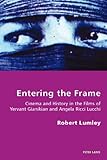
Robert Lumley. Entering the Frame: Cinema and History in the Films of Yervant Gianikian and Angela Ricci Lucchi. Oxford: Peter Lang, 2011. xix + 192 pp. + 16 pp. of plates. $51.95 (paper), ISBN 978-3-0343-0113-8.
Reviewed by Emiliano Perra (University of Winchester)
Published on H-Italy (January, 2015)
Commissioned by Matteo Pretelli (University of Naples "L'Orientale")
Violence and Beauty
Over the years, experimental filmmakers Yervant Gianikian and Angela Ricci Lucchi have established themselves as important filmmakers internationally, as well as in their native Italy. The subject of Robert Lumley’s book is the work produced by the pair from the beginning of their career in the mid-1970s to 2009. The volume is structured in six chapters. The first five are roughly organized chronologically, whereas the last one is a discussion of some recurrent themes in the filmmakers’ work.
In the first part of their career, discussed in chapter 1, Gianikian and Ricci Lucchi’s films were mostly performance-based and used scents. These early works display an interest for memory that is a key theme of their work and of this monograph. The discovery in 1982 of a collection of filmic material belonging to early twentieth-century documentary filmmaker, explorer, and staunch nationalist Luca Comerio opened a new phase in the career of Gianikian and Ricci Lucchi. The first major product emerging from this collection is Dal Polo all’Equatore (1986), which is the subject of chapter 2. As Lumley aptly notes, working with and against Comerio’s archival footage, the film reworks his colonial gaze to analyze “how the movie camera functioned as a weapon in the hands of European colonialists before it became a weapon in the war between Europeans” (p. 54). A key role in Gianikian and Ricci Lucchi’s film is played by images of cruelty to animals. The hunting of a polar bear is reworked to emphasize the display of power and brutality represented by the hunter’s gaze. However, we as viewers are also questioned. The use of shot-reverse shots combined with the slowing down of the images “forces the viewer to contemplate the act of looking as an integral part … of the act of killing” (p. 56). By relentlessly dwelling on scenes of gratuitous violence and cruelty to animals, the film powerfully shows the ideology of conquest and domination that lay at the root of colonial genocides and oppression, and which later resulted in the violence of the First World War.
Chapter 3, titled “Armenia,” analyzes works dealing with Yervant Gianikian’s origins and family history. By engaging with images providing visual evidence of the genocide and its immediate aftermath in Uomini anni vita (1990), or with Gianikian’s own father’s survivor experience in Io ricordo (1997) and Ritorno a Khodorciur: Diario armeno (1986), this body of works provides, in the words of the filmmaker himself, an homage to a “cultura cancellata” (p. 65).
Chapter 4 discusses the so-called trilogy of war centered on the suffering caused by the First World War: Prigionieri della Guerra (1995), Su tutte le vette è pace (1998), and Oh! Uomo (2004). The book rightly situates Gianikian and Ricci Lucchi’s uncompromising determination to show images of violence and suffering, resulting from what they see as the “moral obligation to look horror in the face” (p. 93), against Susan Sontag’s equally uncompromising but opposite view that watching images of suffering without being able to do anything to alleviate it automatically transforms viewers into voyeurs. It is an ethical dilemma that is as unsolvable as it is necessary to engage with.
Chapter 5 picks up from where the previous one has left, and discusses three strands of Gianikian and Ricci Lucchi’s work: Fascism, the imperial imaginary, and the war in Yugoslavia. They all offer different takes on recurrent themes in the filmmakers’ work. Lo specchio di Diana (1996) reworks the footage of the emptying of the lake of Nemi, originally a piece of Fascist propaganda, to directly comment on the unleashing of destructive forces used by Fascism against human beings in the 1926 campaign of Tripoli seen in the second part of the film. Nocturne (1997) and Inventario balcanico (2000) are films as much about the present as they are about history: they are about the world of coexistence swept away by the war in Yugoslavia, and about affirmations of life even during the conflict. The third part of the chapter looks at Gianikian and Ricci Lucchi’s work on empire. In fourteen extremely rich pages (pp. 112-126), Lumley discusses the two filmmakers’ unflinching look at Western imperial imaginary developed in works like the installations La Marcia dell’uomo (2005) and Terra Nullius (2002), and the films Frammenti elettrici (2002) and Images d’Orient--tourisme vandale (2001). In different ways, all these works engage with colonial violence, either physical or that of the colonial gaze that exoticizes and transforms the Other into reified tableaux vivantes.
The final chapter is a synoptic analysis of the entire work of Gianikian and Ricci Lucchi. It is a demanding task, considering the complexity of their work, but one accomplished with lucidity by Lumley, who discusses three recurring themes in Gianikian and Ricci Lucchi’s work: history and memory, the body and embodiment, and death and cinema. The intellectual figure at the center of these sections, and an avowed influence of the filmmakers, is Walter Benjamin. The German intellectual is a key influence not only for his urge to “brush history against the grain,” but also for the fact that his way of working (cataloguing, collecting, archiving, constructing) shares many resemblances to that of Gianikian and Ricchi Lucchi themselves. They share Benjamin’s mistrust of historicism: history in their work is never presented “as it really was” and is not narrative, but tries to seize “hold of a memory as it flashes up” (pp. 136, 130). One important point made by Lumley is that Gianikian and Ricci Lucchi use past images to illuminate the present, and what Dal Polo all’Equatore shows is that Europe’s history of colonialism continues to shape identities in the present. The violence of history also informs the second theme discussed by Lumley. Gianikian and Ricci Lucchi show time and again that “the history of modernity and its notions of the body cannot be separated from Western conceptions of colonised subjects and non-Western peoples as ‘Other’ [and] as ‘primitive’” (p. 148). Considering the nature of these first two themes, it is easy to understand why death is the third main area of enquiry explored by Lumley.
It is extremely difficult to synthesise in such a brief review the wealth of themes covered by the monograph. Lumley does an excellent job of presenting and engaging with Gianikian and Ricci Lucchi’s lifelong intellectual and artistic endeavor. This engaging and important book and its subject will hopefully find the broadest possible audience, as it is a volume that should be read by scholars in many fields.
If there is additional discussion of this review, you may access it through the network, at: https://networks.h-net.org/h-italy.
Citation:
Emiliano Perra. Review of Lumley, Robert, Entering the Frame: Cinema and History in the Films of Yervant Gianikian and Angela Ricci Lucchi.
H-Italy, H-Net Reviews.
January, 2015.
URL: http://www.h-net.org/reviews/showrev.php?id=43254
 | This work is licensed under a Creative Commons Attribution-Noncommercial-No Derivative Works 3.0 United States License. |

