

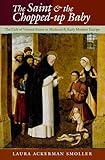
Laura Ackerman Smoller. The Saint and the Chopped-Up Baby: The Cult of Vincent Ferrer in Medieval and Early Modern Europe. Ithaca: Cornell University Press, 2014. Illustrations. 368 pp. $45.00 (cloth), ISBN 978-0-8014-5217-8.
Reviewed by Brian N. Becker (Delta State University)
Published on H-Italy (June, 2015)
Commissioned by Brian J. Maxson (East Tennessee State University)
Sainting Vincent Ferrer and Gauging His Social and Spiritual Value to Later Generations
Saint Vincent Ferrer has been and continues to be a popular subject of scholarly inquiry. Laura Ackerman Smoller has been one of the leading scholars in the study of this Dominican saint from Valencia, publishing numerous interesting and informative articles on Ferrer, while other scholars, such as Philip Daileader, have biographies in the works on him.[1] In this book, Smoller takes the study of Ferrer in a new direction by focusing very little on Ferrer himself, but instead on how others (whether wealthy and powerful lay locals, ordinary town dwellers, or the invested religious) made a saint out of him and crafted his image in such ways as to further their own agendas. She tackles this task head on, demonstrating an enviable ability to work in multiple disciplines and with numerous types of sources in several different media, while communicating her research results through the graceful and lucid prose her readers have come to expect from her work. Simply put, Smoller has produced an entertaining, educational, and highly original piece of scholarship that will serve as a model for religious historians to follow for some time to come.
Smoller makes it clear from the outset that this book only secondarily concerns Vincent Ferrer himself. Her book focuses primarily on an idea: how people have used Ferrer and a particular miracle story associated with him to shape their personal worlds, and also how the image they created of Ferrer was shaped by these worlds. The first half of the book is based on the voluminous canonization records involving Ferrer’s case for sainthood. Chapter 1, “The Situation,” examines the major backers of Ferrer’s canonization and their peculiar reasons for desiring it, which generally led to the appropriation of the putative saint’s image for their own agendas. The Dukes of Brittany and Aragon, for example, saw Ferrer’s canonization as a way to legitimize their fledgling dynasties and help them to compete with more established institutions, such as the Kingdom of France. The Dominicans pushed intensely for the canonization of one of their own in order to counter the 1450 canonization of the Franciscan Bernardino of Siena. Chapter 2, “The Process of Canonization,” analyzes the legal proceedings leading to Ferrer’s canonization in 1455, drawing on the records of three inquests held in Brittany, Toulouse, and Naples. Smoller reveals that local organizers of these inquests also attempted to shape Ferrer’s image to achieve desired ends, such as increased popular devotion to the putative saint by emphasizing his holiness, tying him more firmly to their region through ceremony, and ensuring a speedy canonization proceeding before the papal curia. Chapter 3, “Shaping the Narratives of the Saint,” examines the testimonies given by ordinary people at the canonization inquests, which the author argues was a moment during which these witnesses could use their stories about Ferrer’s saintly deeds to define their own religious identities by emphasizing their personal contact with the holy. Smoller’s enthusiasm in relating the stories of these witnesses indeed shines through when she comments that “for a brief, wonderful moment, we glimpse Vincent as a symbol up for grabs, without a stable meaning or hagiographic emblem. At the moment of his canonization the official image making began. But in the canonization inquests, we experience the lived religion of the late Middle Ages as the multivoiced, sometimes raucous conversation that it was” (p. 120). One of Smoller’s major contributions in this first half of the book is that her reading of these canonization records leads her to dispute the traditional argument made by André Vauchez in his magisterial Sainthood in the Later Middle Ages (1987) that canonization inquests operated according to streamlined ecclesiastical control. Smoller argues that the process was one not simply orchestrated by inquest procurers whose goal was to produce a predetermined portrait of a hoped-for saint, but instead functioned as a two-way conversation during which witnesses learned from procurers (and also each other) what the latter expected from their testimonies and shaped their narratives to enhance their own social/spiritual worth. It is thus no surprise that the case built in favor of Ferrer’s canonization paints a picture of not just one but many Vincent Ferrers, each of whom represents one particular group’s reasons for why he should be sainted.
While the first half of Smoller’s book traces the many ways in which interested parties shaped the image of a putative Saint Vincent Ferrer both to facilitate his path to sainthood and to further said parties’ various goals, the second half of her book examines the initial efforts of papal and Dominican leadership to construct the official image of the actual Saint Vincent Ferrer post-canonization, as well as the ways in which this image was reconstructed, deconstructed, and otherwise altered in subsequent competing narratives down to the early eighteenth century. Here again the author acknowledges that she is challenging the approach of Vauchez and other scholars, who have rarely extended their research beyond saints’ canonizations, “as if the papal ceremony marks somehow the end of the story” (p. 12). Chapter 4, “Creating the Official Image of the Saint,” examines the first official hagiography of Saint Vincent Ferrer by the new saint’s fellow Dominican, Pietro Ranzano, who, by May 1456, had completed the task at the request of both Pope Calixtus III and Dominican Master General Martial Auribelli. Smoller’s analysis makes clear that Ranzano was careful to include much of the positive and omit much of the negative surrounding Ferrer in order to create an image of the saint that would match up well with issues concerning the church at the time. Ranzano’s Ferrer is thus not a stubborn supporter of deposed schismatic Pope Benedict XIII or a false predictor of the Antichrist’s arrival, but instead a model of Christian piety, a converter of Muslims and Jews, and a healer of schisms. Especially illustrative for Ranzano in this last regard, as Smoller points out, was one particular miracle story involving Ferrer’s restoration of a baby chopped up and cooked by its mother as a symbol of his ability to make whole again what had been in pieces; this story is a theme to which Smoller returns often in these later chapters of her book. Chapter 5, “Competing Stories: Whose Vincent Ferrer Is It Anyway?,” then traces the portrayal of Ferrer in art and text from the time of Ranzano’s Vita to the early sixteenth century. The evidence reveals that artists and authors alike during this period struggled to define which qualities it was that made Ferrer a saint (was it his miracle working, his adherence to strict Observant Dominican discipline and obedience, his extraordinary preaching and conversion abilities, his healing of division, or some combination of these elements?). Ranzano’s Vita had thus been unsuccessful in establishing a singular, stable image of the new saint, but it did succeed in popularizing the chopped-up baby miracle story to the point that it became a symbol almost universally associated with Ferrer. Smoller continues her analysis of the development of Saint Vincent ’s image into the period following the Protestant Reformation in chapter 6, “The Afterlife of the Chopped-Up Baby: The Sixteenth Century and Beyond.” She here demonstrates that the intense challenge of Protestant polemicists to the Catholic faith altered how artists and authors of the latter religion appropriated Ferrer. These artists and authors used the image of Saint Vincent as affirmation that their faith’s values, in this case Catholic saints and their miracles, still had great power in the face of Protestant challenges. Yet, as powerful monarchical states subsumed such proud, previously independent regions as Aragon and Brittany, locals still found stories involving Ferrer’s saintliness useful as assertions of their regions’ distinct identities. Smoller notes that European authors and artists were consistently adopting Ranzano’s portrayal of Ferrer as charismatic preacher, converter of souls, and untiring healer of the Great Schism by the late seventeenth century, but her epilogue, “Saint Vincent Ferrer in the Spanish Americas,” reveals that when missionaries brought the saint’s cult to Spanish America, it was predominantly the winged image of Vincent as the angel of the apocalypse and his miracle-working prowess that they emphasized. Smoller’s thorough investigation of the development of Ferrer’s image post-canonization thus ultimately reveals, just as with the extant inquest records, “a plethora of differing Vincent Ferrers produced for a variety of contexts, occasions, and audiences” (p. 13).
Smoller’s book is indeed an impressive and admirable scholarly achievement. Her monograph exemplifies how a historian can delve deeply into a wide-ranging variety of sources (including manuscripts, hagiographies, liturgical offices, sermons, drawings, paintings, frescoes, etc.) in order to build a nuanced, interdisciplinary historical interpretation of great subtlety. The author’s demonstration that every phase of Ferrer’s canonization process was a never-ending negotiation among numerous local elements and/or church officials, and also that the various groups which later used his image did so in accordance with their own respective agendas, will undoubtedly lead other historians to explore similar lines of investigation in their future studies of other saints. Beyond this, Smoller’s sophisticated readings of her sources, especially the images and stories involving the chopped-up baby incident, provide readers with insightful interpretation as to why this theme persisted well beyond Ferrer’s lifetime. Yet the author reminds her readers that it is not only the accumulation of evidence that constructs the image of a saint; the erasure, omission, and loss of evidence are also sometimes necessary components in the construction of a saintly image. Smoller draws attention to this fact by citing numerous examples in the case of Saint Vincent, including lost inquest records, the voices of Prouille’s female Dominican house that were omitted from the Toulouse inquest by a discriminating procurator, the popularity of Laurentius Surius’s polemicized hagiography over Vicente Justiniano Antist’s more accurate and completely documented account, and even the translation of the saint’s bones from the Vannes cathedral to Valencia to protect them from Protestant desecration. It is thus as important for historians to account for the invisible as it is for them to account for the visible.
Also of note is the well-devised interpretive framework of Smoller’s book, which situates the story of Ferrer’s canonization and the subsequent appropriation of his image within the context of larger cultural and political movements. In this way, the reader benefits from informative discussions on a multitude of interesting topics, and also learns that becoming a saint requires much more than merely living a model Christian life. The author is effective in arguing that sanctity is in fact a construct, whether achieved from the top down, the bottom up, or both. Indeed, knowing the circumstances surrounding someone’s canonization means understanding numerous historical threads wrapped around said circumstances. In the case of Saint Vincent Ferrer’s canonization, for example, it is useful to understand how the history of the Montfort dukes of Brittany’s relations with French kings motivated the former to fight for Ferrer’s canonization as a way to prove their equality with the latter. An understanding of traditional rivalries among religious groups such as the one existing between the Franciscans and Dominicans moved the latter to work for Ferrer’s canonization as a way to equal Franciscan Bernardino of Siena’s recent sainting (1450). Knowing that Ferrer played a significant role in bringing the Trastámaras dynasty to the Aragonese throne helps to explain why this dynasty’s kings lobbied for Ferrer’s canonization so as to provide them with a source of sacred legitimacy. Readers also learn much about more general topics, such as the intricacies of the papal canonization process; for example, they learn that, although it was an established juridical process, human actions, divine will, and local variation had an enormous impact on its outcome. Ferrer’s Brittany inquest, for example, was larger, more expensive, and more closely attended by its presiding subcommissioners than those of Toulouse and Naples, and local procedural differences among them yielded different images of the saint (Brittany concentrated on collecting miracle stories associated with Ferrer; Toulouse made Ferrer’s holy life its main focus; Naples portrayed him as a converter of Jews, Muslims, and lax Christians, as well as a healer of grave divisions). Beyond this, Smoller adds even more depth to her work by recognizing that Saint Vincent’s story does not neatly conform to the traditionally accepted chronological boundaries of historical inquiry. To account for this, she skillfully spans the divide between the medieval and the early modern, her writing flowing seamlessly from Ferrer’s canonization to the later appropriation of his image by diverse groups to illustrate well how the image and purpose of a saint can change over time.
There is very little to dislike about Smoller’s monograph, but this thorough treatment of Ferrer’s canonization and subsequent image creation does leave her reader wishing that certain questions had not gone unaddressed. Perhaps it is a matter of insufficient evidence, but it would have been interesting to see Smoller address the question of dissent. Were there those who disputed Ferrer’s sanctity because of his apocalyptic preaching and/or his unwavering loyalty to Pope Benedict XIII during the Great Schism? Is there any evidence of people objecting to Ferrer’s preaching, and if so, who were they and what were their objections? Saint Vincent’s case is a bit too early to have been reviewed by the “Promoter of the Faith,” an officer not created by the Catholic Church until the late sixteenth century, but one wonders if there was any curial mechanism to play the “devil’s advocate” when the push to canonize Ferrer was at its height, and did it record anything? Are there any humanist critiques of Ferrer’s preaching? It would also have been interesting to see Smoller delve a bit deeper into Saint Vincent’s cult in Spanish America. Her discussion of Ferrer’s symbolic importance to Dominican missionaries in the New World, popular devotion to Ferrer emphasizing his preaching and miracle-working abilities, the dedication of a novena to him, and his visual representation as the angel of the apocalypse make for fascinating reading, but it is reading extremely heavy on the European perspective. Does any evidence exist that reveals how indigenous peoples understood and interpreted the saint’s preaching and artistic portrayals?
The volume itself is a physically handsome one, with equally handsome illustrations, and also comes equipped with useful teaching aids, such as a chronology, “Events Relevant to the Canonization of Vincent Ferrer.” It is an important, thought-provoking, and entertaining monograph. Indeed, Smoller’s enthusiasm for the subject radiates from the text, and she expresses her refreshing brand of humor on many occasions throughout the book. For example, while discussing how local personalities and interests often affected a canonization inquest, she notes: “Although judicial procedures dictated every step of the canonization process, the resultant product was not a transparent, ‘just the facts, Ma’am’ narrative. From the number and types of witnesses called (just which Ma’am are we talking about?) to the sorts of questions each one was asked (which facts?), the canonization inquest was the product of a series of decisions taken by the individuals entrusted with its completion” (p. 76). Smoller furthermore describes the chopped-up baby appearing in one particular version of the story as “more Valencian paella than enfant à la Bretagne” (p. 148). Irreverent and slightly morbid humor aside, Smoller’s rich and complex treatment of Saint Vincent Ferrer’s canonization and the subsequent development of his cult(s) will undoubtedly appear on the syllabi of religious studies, history, anthropology, and other disciplines’ courses for years to come. It is simply an admirable book, and represents how entertaining and effective a transnational religious history can be in the right hands.
Note
[1]. According to Smoller, Daileader’s biography on Ferrer is forthcoming from Cornell University Press (p. 1).
If there is additional discussion of this review, you may access it through the network, at: https://networks.h-net.org/h-italy.
Citation:
Brian N. Becker. Review of Smoller, Laura Ackerman, The Saint and the Chopped-Up Baby: The Cult of Vincent Ferrer in Medieval and Early Modern Europe.
H-Italy, H-Net Reviews.
June, 2015.
URL: http://www.h-net.org/reviews/showrev.php?id=43191
 | This work is licensed under a Creative Commons Attribution-Noncommercial-No Derivative Works 3.0 United States License. |

