

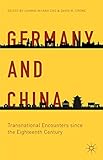
Joanne Miyang Cho, David M. Crowe, eds. Germany and China: Transnational Encounters since the Eighteenth Century. New York: Palgrave Macmillan, 2014. 304 pp. $90.00 (cloth), ISBN 978-1-137-43846-1.
Reviewed by Dirk Bönker (Duke University)
Published on H-German (October, 2015)
Commissioned by Nathan N. Orgill
Sino-German Studies
The calls for transnationalizing and globalizing German history have proved enormously productive. Sustained by what Michael Geyer characterized already in 2006 as “the new consensus” about the limits of nation-centered history, an ever-proliferating and interdisciplinary body of scholarship has been exploring German entanglements with the world from a wide range of directions. Most of this work has focused on the mutual imbrications of German, European, and North Atlantic histories, and on the worlds of German colonialism, of both continental and overseas empire. But scholars invested in situating Germany in the world have also turned their attention to other sites and regions, as the fast-developing fields of German-Asian studies and Sino-German studies demonstrate.[1]
It is the needs of “students and researchers” in these fields that the editors Joanne Miyang Cho and David M. Crowe want to meet with their multidisciplinary collection of essays on transnational Sino-German encounters since the eighteenth century (p. 15).[2] Published by Palgrave Macmillan, this valuable collection features fourteen intriguing chapters devoted to a diverse set of topics and spread out over three chronologically arranged parts. Part 1 contains five essays on the period from the eighteenth century to World War I. Peter Park surveys the views of China held by two early German Enlightenment thinkers, Gottfried Wilhelm Leibnitz and Christian Wolf. Nicholas Germana turns to Georg Friedrich Wilhelm Hegel and his discussion of the familial constitution of the Chinese state. Martin Rosenstock analyzes the writings on China by prominent German missionary Karl Gützlaff (1803-51). Coeditor Crowe provides a general overview of Sino-German foreign relations from 1871 to 1917. Lydia Gerber focuses on one Western-trained Chinese physician by the name of Li Benjing and his interactions with German officials in the German colony of Kiachow.
Focusing on the period from 1918 to 1945, part 2 consists of five essays. Christine Swanson and, again, Crowe present a summary of Sino-German foreign relations from 1918 to 1941. Shellen Xiao Wu writes about a group of Chinese intellectuals associated with the journal Warring States Policies, published in the early 1940s, and their embrace of the study of geography and geopolitics under the influence of German Geopolitik. Volker Wehdeking offers a reading of Chinese motifs in the writings of Hermann Hesse. Coeditor Cho directs attention to the privileged place of China in Albert Schweitzer’s civilizational thinking. Lee Roberts introduces the reader to the prevalence of Yellow Peril discourse in interwar Europe and its presence among the Jewish Germans and Austrians who fled Nazi Germany to the city of Shanghai.
The four essays of part 3 are devoted to different aspects of Sino-German relations since 1945. David Tompkins charts changing representations of Communist China in the public culture of East Germany in the 1950s and 1960s. Sebastian Gehrig traces the place of China in the imagination of West German politicians and radical left-wingers in the middle decades of the Cold War. Min Zhou probes the travel writings of prominent authors Max Frisch, Günter Grass, and Adolf Muschg, who visited China in the 1970s and 1980s. And, last but not least, Michael Mayer sketches the diplomatic relations between the People’s Republic of China and East Germany and West Germany in 1989-90.
The merits of the volume are obvious. It provides an illuminating introduction to an important historical topic and field of study. Its many fascinating essays cover a broad (if disparate) range of topics and deepen our understanding of Sino-German encounters in the modern age. Comparable volumes are rare. In short, the book will be of great value to anyone interested in exploring Sino-German histories.
On the other hand, the volume works less well as a primer in transnational history, its promises, analytics, and challenges. Several essays, including the two surveys coauthored by Crowe, for example, follow well-established paths of foreign relations history or intellectual history. Most of the chapters offer valuable contributions through the exploration of their particular historical topics, not through theoretical or methodological innovation. The editors present an emphasis on the multi-directionality of transfers and encounters as the key conceptual insight informing their volume, as if this insight were particularly new or unproblematic. They would have done well to deepen their discussion by offering thoughts on the scales, asymmetries, and uneven power relationships that lend shape to multi-directionality.
The book raises bigger questions concerning the writing of Sino-German histories. The essays emphasize, as the editors point out at the beginning, “contact zones, negotiation, and bi-directional cultural transfers” and direct attention to such areas as politics, literature, philosophy, and religion (p. 15). Yet I wanted to know more about the kind of analytics and narratives that scholars use or ought to use to make sense of the entanglements of Chinese and German histories, beyond the question of empire, which runs through many of the chapters. Furthermore, several essays (for example, the one on the German missionary Gützlaff and the one on Chinese scholars of German-style Geopolitik) highlight the limits of any attempt to study Sino-German transnational encounters in isolation. They remind the reader of the imbrication of these encounters with other national histories (British, Japanese, American, and so on) as well as their embeddedness in particular spatial configurations of power and knowledge beyond the nation (global, regional, local). The question then becomes how best to write and conceptualize Sino-German histories, if we cannot disentangle them from other histories, and how to delineate the field of Sino-German studies (or, for that matter, German-Asian studies) if its boundaries cannot be easily marked. These questions may speak to the limits of the bilateral vision that guides this collection of essays; yet it is also to the volume’s great credit that it provides the materials to pursue such questions.
Notes
[1]. Michael Geyer, “Where Germans Dwell: Transnationalism in Theory and Practice,” German Studies Association Newsletter 31, no. 2 (Winter 2006): 29-37; and Michael Geyer, review of Transnationale Geschichte: Themen, Tendenzen und Theorien,” ed. Gunilla Budde, Sebastian Conrad, and Oliver Janz, H-Soz-Kult (November 10, 2006), http://www.hsozkult.de/publicationreview/id/rezbuecher-8227. On transnational history and German-Asian studies, see also the forum “Asia, Germany and the Transnational Turn,” German History 28, no. 4 (2010): 515–536.
[2]. Cho has coedited a comparable volume on German-Indian encounters: Transcultural Encounters between Germany and India: Kindred Spirits in the Nineteenth and Twentieth Centuries, ed. Joanne Miyang Cho, Eric Kurlander, and Douglas T. McGetchin (London: Routledge, 2013). She is currently working on a collection of essays on German-Japanese encounters in the modern age.
If there is additional discussion of this review, you may access it through the network, at: https://networks.h-net.org/h-german.
Citation:
Dirk Bönker. Review of Cho, Joanne Miyang; Crowe, David M., eds., Germany and China: Transnational Encounters since the Eighteenth Century.
H-German, H-Net Reviews.
October, 2015.
URL: http://www.h-net.org/reviews/showrev.php?id=43158
 | This work is licensed under a Creative Commons Attribution-Noncommercial-No Derivative Works 3.0 United States License. |

