



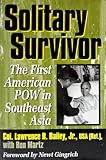
Col. Lawrence R. Bailey. Solitary Survivor: The First POW in Southeast Asia. Washington, D.C., and London: Brassey's, 1995. xxi + 214 pp. $23.95 (cloth), ISBN 978-1-57488-004-5.
Reviewed by Robert C. Doyle (Independent Scholar)
Published on H-PCAACA (May, 1996)
POW Experience and the Dark Night of the Soul
Among the large corpus of American captivity narratives that stretch from the Indian wars to the recent hostage experiences in the Middle East, Solitary Survivor is one of the few written long after the event, where the author focuses his attention not on the resistance of a captive community, heroics, or escape attempts, but on the human response to extreme solitude. (For a similar, and far more bizarre exploration of solitude, see Brian Keenan's An Evil Cradling [1992], an introspective hostage narative of great merit.)
After his traumatic bailout from a doomed C-47 aircraft on 23 March 1961 (everyone else died in the crash), subsequent capture and incarceration by the Pathet Lao, a severely wounded Major Lawrence R. Bailey, Assistant Attache at the American embassy in Vientiane, was swallowed by darkness and taken to the village of Sam Nua, where he became the first secret prisoner in a secret war. Unlike the many others with gruesome stories to tell about captivity in Southeast Asia during the war years, Bailey was never tortured or intentionally maltreated by his captors. Instead, his world became ever smaller and ended in his cell, alone for over a year, where he became suddenly closely acquainted with his own complex, inner self. His mind took charge over the needs of his body, a Bildung process that solved the conflict of sanity in an interesting dialectic that captures the reader's attention throughout the book.
After his release on 17 August 1962, along with Special Forces Sergeant Orville R. Ballenger and reporter Grant Wolfkill (see Wolfkill's Reported to Be Alive [1965]), and others held by the Pathet Lao, Bailey remained a prisoner in his own mind for the next thirty years. His adaptation to life alone in Sam Nua became a devil which chased and haunted him thereafter. Mistakenly, perhaps, he decided that a return trip to his personal battlefield might relieve this madness. Other soldiers have returned to their Asian battlefields; why not Bailey? "Unless I saw the cell again in the clear light of freedom and washed it clean of memories of me, I would never be free of it," he wrote (p. 184).
Wrong. During the trip back, nothing looked the same: much was destroyed and rebuilt; local Laotians refused to discuss American POWs held during the war, and the author leaves us with a very revealing lament: "The cell is gone, but it will stay with me...a prisoner forever (p. 200). For this reason alone, Solitary Survivor must have been difficult to write.
If one seeks the kind of closure one finds in fiction, Solitary Survivor is difficult to accept. Although he survived the physical ordeal --the body's wreckage--Colonel Bailey's experience approaches a holocaust of the mind. Aside from its brutal honesty, concern for fallen and missing comrades-in-arms, and critical reflections concerning the American secret war in Laos, its value consists in giving a glimpse into the complexities of human aloneness--how a man can tumble into a pitch-black hole and never really come out again--something many of us fear without ever admitting it. To his credit, the author clambered back out into the light.
This review is copyrighted (c) 1996 by H-Net and the Popular Culture and the American Culture Associations. It may be reproduced electronically for educational or scholarly use. The Associations reserve print rights and permissions. (Contact: P.C.Rollins at the following electronic address: Rollins@osuunx.ucc.okstate.edu)
If there is additional discussion of this review, you may access it through the network, at: https://networks.h-net.org/h-pcaaca.
Citation:
Robert C. Doyle. Review of Bailey, Col. Lawrence R., Solitary Survivor: The First POW in Southeast Asia.
H-PCAACA, H-Net Reviews.
May, 1996.
URL: http://www.h-net.org/reviews/showrev.php?id=431
Copyright © 1996 by H-Net and the Popular Culture and the American Culture Associations, all rights reserved. H-Net permits the redistribution and reprinting of this work for nonprofit, educational purposes, with full and accurate attribution to the author, web location, date of publication, originating list, and H-Net: Humanities & Social Sciences Online. For any other proposed use, contact P.C. Rollins at Rollins@osuunx.ucc.okstate.edu or the Reviews editorial staff at hbooks@mail.h-net.org.

