

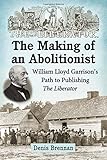
Denis Brennan. The Making of an Abolitionist: William Lloyd Garrison's Path to Publishing _The Liberator_. Jefferson: McFarland, 2014. 224 pp. $35.00 (paper), ISBN 978-0-7864-7425-7.
Reviewed by Lorenzo Costaguta
Published on H-Socialisms (August, 2015)
Commissioned by Gary Roth (Rutgers University - Newark)
Abolition and The Liberator
William Lloyd Garrison was one of the most important American antislavery activists of the nineteenth century. The successful history of his newspaper, The Liberator, a weekly that in 1831 started to advocate immediate emancipation for all African Americans and was closed when slavery was abolished in 1865, is still an exemplar of radical thought positively improving mainstream society. The story of Garrison’s life and thought raised immediate interest among historians. Between the late nineteenth century and the present, more than ten biographies have been dedicated to Garrison’s abolitionist efforts. Denis Brennan’s The Making of an Abolitionist: William Lloyd Garrison’s Path to Publishing the Liberator joins the likes of Henry Meyer’s All on Fire: William Lloyd Garrison and the Abolition of Slavery (1998), Enrico Dal Lago’s William Lloyd Garrison and Giuseppe Mazzini (2013), and W. Caleb McDaniel’s The Problem of Democracy in the Age of Slavery: Garrisonian Abolitionists and Transatlantic Reform (2013) in recent attempts to reinterpret Garrison’s impact and importance.
The Making of an Abolitionist sets out to investigate the early life of the American abolitionist, exploring Garrison’s experience as a printing apprentice. Brennan himself sets the main objective of his analysis, claiming that biographies of Garrison so far have steadily recognized “the centrality of newspaper publishing to abolitionism,” yet overlooked or downplayed “Garrison’s contributions to American journalism or effective manipulation of 19th-century journalism” (p. 18). He locates his argument within the historical study of journalism in the United States, explaining that the radical abolitionist started an innovative trend in the relationship between the press and political activism. Brennan maintains that the early nineteenth-century American press was divided between a group of newspapers structurally connected to political or mercantile interests, i.e., journals which actively and openly promoted the interests of specific political or economic factions, and the so-called penny press, a group of newspapers that was expanding in the 1830s and reported local news and sensational occurrences, which, with prices six times cheaper than the norm, openly targeted nontraditional press readers. Brennan contends that Garrison, mostly during his time with the Liberator but also with other early publishing attempts, favored the creation of a new type of press, strongly detached from traditional political and economic groups but devoted to grand moral and political objectives, in his case the abolition of slavery. According to Brennan, Garrison’s originality stems from the fact that the radical abolitionist had already at the end of the 1820s reached the conclusion that both ecclesial authority and political power as social forces needed to lead the moral enlightenment of American society; however, they were too corrupt to commit themselves to this task. Garrison’s sole remaining “bulwark of liberty,” concludes Brennan, was the “printer’s stand.” Garrison and his press “must do more than provide support in the battle, but must lead” (p. 5).
Brennan’s argument is framed in a compelling fashion. It integrates the already abundant literature about Garrison and puts forward an original way to clarify a key moment in the history of US journalism. Given these aims, however, one would have expected an analysis of Garrison’s professional career that focused on the exceptionality of Garrison’s work compared to that of his contemporaries and his unprecedented use of journalism as a means to raise awareness about the issue of slavery. Conversely, most of the book is dedicated to analyzing the content of all the material published by the abolitionist, from his first steps as an apprentice printer in 1822 to the foundation of the Liberator in 1831. In most cases, this material allows Brennan to demonstrate the main premise of his argument—namely, that early in his life Garrison lost faith in the possibility that the political and religious establishments of the country could work for the moral improvement of American society. Brennan convincingly brings this premise home, mapping in detail the progressive evolution of Garrison’s thought. But the author rarely ventures outside the narration of Garrison’s life and the immediate historical details surrounding it, often giving the impression of remaining trapped within it. The piecemeal reconstruction of every single circumstance mentioned by Garrison in his articles unwittingly casts aside the big picture, undermining the potential strength of Brennan’s analysis. Broad tendencies of the time, such as the moral Second Great Awakening or the progressive industrialization of the North, are rarely mentioned, let alone transatlantic or transnational intellectual trends. Moreover, there are some parts of the book whose presence is quite hard to justify: to give some examples, most of chapter 5 is devoted to explaining Garrison’s sudden change of strategy in 1828 from advocating progressive emancipation and colonization to embracing immediate emancipation. Similarly, chapter 6 is centered on the radicalization of Garrison’s thought and his imprisonment of 1830. Both these ample sections are related to the task of explaining Garrison’s progressive distrust towards American public and religious authorities. However, it is difficult to understand why such a significant amount of attention is dedicated to these issues, if one recalls that the book purports to explain the role of journalism in Garrison’s early life.
Yet, some parts of book stick to the author’s commitment to using the role of the press as the key analytical lens for viewing Garrison’s life. For example, in chapter 3 Brennan reconstructs the importance of Garrison’s seven-year apprenticeship as a printer in the studio of Ephraim Allen, the editor of the Newburyport Herald. Despite the relative absence of primary materials on this aspect of Garrison’s life, Brennan undertakes careful research to explain in detail the experience of apprentice printers, the skills involved in the job, and the apprentices’ social role within early nineteenth-century American society. Furthermore, Brennan persuasively demonstrates how Garrison’s apprenticeship worked as his primary and secondary education—namely how it provided the young New Englander with the cultural and intellectual foundations of his future career as an abolitionist. However, the more one reads, the more the book moves away from its original task of positioning Garrison within the history of US journalism and closer to a straightforward biography of the early American abolitionist. If read in these terms, the book perfectly fits within the description given by its title: The Making of an Abolitionist. William Lloyd Garrison’s Path to Publishing the Liberator. In other words, Brennan explains adequately the historical, social, and cultural circumstances that led the American abolitionist to devote his political career to the abolition of slavery, and how he did this through a newspaper. Crucially, however, this is altogether different from using Garrison as a foundational example of a new model of journalism that took root in the United States in the first half of the nineteenth century. On this, despite his claims, Brennan’s book remains mostly silent. Arguably, this limitation would be less problematic if Garrison were a secondary figure in the history of American abolitionism or if details of his life were still obscure. If that were the case, then Brennan’s book would be a groundbreaking addition to the literature on early nineteenth century abolitionism, which could help to reconstruct details on the social and political environment of early antislavery activists. But unfortunately this is not the case.
As recalled above, the life and thought of this radical abolitionist have been thoroughly investigated over the decades. Incidentally, the two most recent monographs on the topic reflect the pressing need to find radically innovative approaches to the subject. The first (Dal Lago’s) puts forward a comparative analysis of Garrison and Giuseppe Mazzini; the second (McDaniel’s) investigates Garrison’s and the Garrisonians’ thought within a transnational context. Brennan’s work, with its sophisticated approach halfway between pure biography and the history of journalism, undertakes an equally innovative path, but unfortunately several parts of the book only partially muster all this analytical potential. Despite these limits, The Making of an Abolitionist provides a carefully researched history of Garrison’s early involvement with the printing profession and the press, and shows the persistent vitality of the study of early American abolitionism as a strand of radical thought in the United States during the nineteenth century.
If there is additional discussion of this review, you may access it through the network, at: https://networks.h-net.org/h-socialisms.
Citation:
Lorenzo Costaguta. Review of Brennan, Denis, The Making of an Abolitionist: William Lloyd Garrison's Path to Publishing _The Liberator_.
H-Socialisms, H-Net Reviews.
August, 2015.
URL: http://www.h-net.org/reviews/showrev.php?id=43059
 | This work is licensed under a Creative Commons Attribution-Noncommercial-No Derivative Works 3.0 United States License. |

