

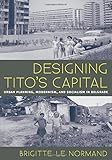
Brigitte Le Normand. Designing Tito's Capital: Urban Planning, Modernism, and Socialism in Belgrade. Pittsburgh: University of Pittsburgh Press, 2014. Illustrations. 320 pp. $27.95 (paper), ISBN 978-0-8229-6299-1.
Reviewed by Tijana Stevanović (Newcastle University)
Published on H-Urban (August, 2015)
Commissioned by Alexander Vari (Marywood University)
The Freedom to Choose: The Housing Question and Self-Managed Urban Planning in Belgrade
A single-family house is today a burning topic for everyone, buyers, renters, landlords, banks, and (to a lesser extent but still as potently) architects and urban designers. However, to imagine it as the most pragmatic manner of housing for an urban population and as an implicit metropolitan feature may not have been a historical inevitability for urban-planning practice half a century ago, least of all, in the socialist world. It is precisely around this form of dwelling that many metaphorical battles have been fought as a subject of Cold War competition. Today, its ascension as an imperative is supported by many, primarily globally linked, financial factors, but it would be incongruous to assume that it was urban planners’ own favorite proposal as the form most suitable for dwelling in contemporary cities. Although not stated explicitly as its primary research purpose, Brigitte Le Normand’s book unpacks the reasons why the ideal of a single-family house came to influence urban-planning practice in Belgrade, the capital of socialist Yugoslavia, and ultimately influenced the division between the professions of urban planners and urban designers.
Designing Tito’s Capital: Urban Planning, Modernism, and Socialism in Belgrade is a volume situated chronologically between the end of World War II and 1972, with a focus on urban-planning practice, the necessary institutional negotiations surrounding it, housing policies, and consultations of myriad intermediaries involved in the negotiations (mostly on the municipal level but also within their various federal dependencies). The book sets out to study the motivations and ambitions that shifted the content and aims of urban design and urban planning in Belgrade: from openly political ambitions immediately after the war, to deliberate disconnection from such aims by the end of the 1960s, when, appropriating explicitly scientific discourse and methods, urban design sought to prove itself apolitical. For those who still situate socialist Yugoslavia behind the Iron Curtain, this book is one more well-crafted example proving not only that this is simply not true, since the Yugoslav state broke off its close relations with the Eastern bloc by 1948,[1] but also that Yugoslav urban-planning policies drastically changed with the new geopolitical relations facilitated by the expulsion of Yugoslavia from the Comintern shortly after World War II. Although curiously not mentioned until page 74 of the book, the new policies of workers’ self-management, introduced as early as 1950, especially affected the handling of the housing shortage in the case of the rapidly growing Belgrade. One important part of Le Normand’s argument subtly explains how non-prescriptively the practice of Yugoslav self-management unfolded for Belgrade urban planners. While the planners were taught by and also practiced in the realm of the modernist architectural tradition—some of the architects even worked in Le Corbusier’s office—the Yugoslav interpretation of socialist equality, coupled with the belief in citizens’ “freedom to choose” their most desirable form of dwelling, Le Normand suggests, represented a challenge to the modernist mind-set.
Le Normand’s research is fascinating for its depth and for the scope of the local resources read and analyzed: from daily newspapers, books, and journals to minutes from numerous meetings and internal committees and interviews, in the original Serbo-Croatian and not previously discussed in English. Set in chronological order, the text aims to follow the change in attitudes of urban planners regarding the scope of their interdisciplinary tasks, and indeed, the interaction with and participation of citizens in voicing their preferences. Already in chapter 1, “Modernist Functionalist Planning in Global Context,” Le Normand describes users of the newly built housing as consumers, by drawing parallels with the recent historical research on consumerism and tourism.[2] This, we are told later, produced a shift in planning practice toward accommodating consumers’ own wishes.[3] But the author stresses an important detail less clearly: that the flat was not so straightforwardly understood as a commodity in socialist Yugoslavia—especially in newly designed New Belgrade, where most citizens did not directly own the property they lived in.[4] Quite in accordance with the above-mentioned belief in the absolute correctness of consumers’ demands, the text aims to render citizens’ viewpoints and emphasize differences related to their material situation and the unequal positions of various Yugoslav workers. It is explained in chapter 2, “A Blueprint for Modernity,” that, consonantly to this inclination to understand users as consumers, planners almost from the beginning adopted a pragmatic attitude, rather than putting forward utopian plans. The author here also introduces us to the formation of some important institutions for the progress of urban-planning practice on the federal level, such as the office of Belgrade’s Main Architect later to become the Town Planning Institute and Standing Conference of Cities in Yugoslavia. She devotes a chapter to the material from an exhibition, A Dwelling for Our Conditions (1956) held in Ljubljana, though it is not clear whether this exhibition was aimed at, or had the same impact on, the wider audience and Belgrade urban planners. Through a detailed account of various unpublished municipal committees’ meetings and published specialized urban-design material, the reader can realize how difficult it was for urban planners throughout the first decade of Yugoslav socialism to balance long-term investment and the need for immediate results. This drove them toward initially adopting a plan that was as flexible as possible, and that could, avowedly, be improved if the financial situation changed for the better.
Le Normand reveals right at the beginning of the book that there were certain shared characteristics of urban planning between the specific Belgrade practice and what we usually call modernist urban planning in the West, such as: “a new interventionism on behalf of the national government, modernist architects asserting their expertise in town planning, a consensus that the state had a responsibility to care for the welfare of its citizens, and a desire to build rationally to redirect scarce resources to other economic purposes” (p. 29). The motivation behind this claim may be to explain modernism as a global movement. But more important, it wishes to emphasize the importance of the Athens Charter as the role model for the first Belgrade master plan, mainly through analyzing the new settlement across the river Sava: New Belgrade from 1948 onward.[5] In chapter 1, the author argues that although the demise of social housing in Western democracies was soon accompanied by inflation and rising rents, which paired together, encouraged home ownership, the situation in Belgrade was different, yet not entirely unaffected by this trend. While this chain of events meant that, for example, social housing in France was increasingly the place for immigrants and the socially deprived, unable to secure home by other means, the newly designed and built apartment blocks in Belgrade never turned into similar “social housing,” since they were inhabited by the most diverse social strata, like doctors, army officials, or unqualified workers. Those who were housed in such housing were part of a privileged rather than unprivileged social group, partly due to contradictions of the presence of elements of the real-estate market in parallel to the Yugoslav self-managed socialism and the vagaries of the construction industry. This, for Le Normand, is the first clear sign of an unequal society, despite all Yugoslav ambitions for a self-managed and thus more humane socialism.
While the text on the one hand has the ambition to show that socialist realism was not very important in the context of Belgrade planning and architecture, on the other hand little is done to tackle with the same sharpness the unsupported belief that Tito as the powerful leader of Yugoslavia had an important influence over urban-planning matters. Indeed, although Josip Broz’s nickname, Tito, figures in the title of this book, this seems an unusual choice, given that in this volume he appears only marginally, often in the “Tito-Stalin split”[6] or cameo-like when swiftly reviewing Belgrade’s 1950 master plan. The focus on Tito in the book’s title is thus less helpful for the reader and falsely directs attention to issues that the author, in fact, is not interested in discussing nor agrees with. The main focus of this study is the diversity of voices in the urban-planning discipline that have been present from the start of the process of rethinking the urban development of postwar Belgrade, which is far from the stereotype of an authoritarian hand driving obedient urban planners. On a similar note, if more attention had been devoted by the author to explaining that the self-management shift marked the decision to drop the ideologically tinted goal of state ownership in order to embrace “social ownership” (društvena svojina) of both enterprises and housing, the reader would be in a better position to understand that when Le Normand talks about “state firms,” she probably means “socially owned” enterprises. These were not always without management conflicts,[7] but were effectively governed by workers’ councils. Although we read repeatedly about the development from the late 1950s of the local residential community (mesna zajednica) mostly as a concept in physical urban planning (prescribing the numbers of inhabitants, the functions that it should provide, etc.), the reader would get a clearer explanation of it as a contested attempt to design the political—territorial unit for self-governance in Yugoslavia if the concept was more consistently analyzed on its own, in a separate chapter’s subdivision.[8] This would bring some clarity to understanding the ambition to raise the importance of the local residential community in overall governance, as well as the powerful intertwining between politics and the new housing concepts. Moreover, this would further help us understand why a historian invested so much interest in urban-planning practice rather than architects’ practice in this study.
The further we delve into the book, the more we are presented with challenges to the usual idea of a European socialist capital being built and developed by a logic contrary to the real-estate market. Firstly, the post-1965 market reform deeply contradicts this assumption. We are told that this is the moment when the “state loosened the control of economy and freed firms to compete openly on the domestic market” (p. 104). Even before this explicit turn, we learn that in 1958-59, 4 percent of self-managed enterprises’ employers’ wages were already invested into the housing sector by deposing the funds into specialized joint funds for housing construction—one of those intermediary steps introduced to bring a better practice of self-management into action. In 1964, the citizens of Belgrade could already circumvent this and were granted an option to individually buy the flats before construction started through a bank-crediting system, effectively a mortgage. This further sets the scene for the financialization of Yugoslav socialism, a bizarre hydra signaling that the banking sector and insurance companies were equally encouraged and supported by the policies that were intended to assist self-management. This argument allows scholars to assume that construction companies thus had an incentive to start marketing their buildings to inhabitants. In a state of affairs where the state withdrew from the provision of housing and rather created a situation where socially owned enterprises had to compete by their investment, and construction firms had to follow the logic of the open market, it was a question of time before the single-family house arose as an always-already proven “cheapest option.” From this we might say that the question “For whom (and on which terms) is the single-family house the cheapest option?” is the one that Belgrade urban designers kept debating about, and which Le Normand follows in the second half of her study.
In the following chapters, chapter 5, “Planning Undone,” and chapter 6, “Modernism under Fire,” the concentration of the research is strongest when Le Normand carefully charts the split between the previously combined interests of social scientists and urban planners. Social scientists developed a niche through which to voice criticism of the designers’ and planners’ failures to provide models to satisfy need for housing by using surveys. Surveys are implicitly a method that caters to citizens’ own wishes and desires. This is not urbanization seen as the artificial movement of scientific-design committees in white lab coats, but urbanization understood as a process that encompasses different narratives, interests, and ultimately, the role of individual choices in the development of the urban realm. In such a wide understanding of what urbanization encompasses, arguably, the users’ own design and self-building practice is not seen as the intolerable, unsanitary, ugly growth of the city, but is rather used as the evidence that could question what kind of limitations had both the Yugoslav state’s turn to deregulation and urban planning produced. Therefore, what the author decides to call “rogue building” instead of “illegal” or “wild construction” is explained as the practice born out of pressure exerted mostly on Belgrade as the federal capital, created by the search for jobs in the city by the provincial and peasant population (p. 148). The figures that social scientists provide show that the majority of self-building citizens were not originally from Belgrade.[9] Readers later learn that there were no mechanisms to tackle this problem, but they are not reminded that the municipalities that had the actual jurisdiction over the land and planning where these “incidents” happened to sprout were by this time not equal participants in Yugoslavia’s incongruous socialist-turned-capitalist trio of planning: economic, social, and urban during the 1960s. Price deregulation unleashed lucrative disciplines like finance and insurance systems to full market freedom (with certain restrictions), which municipalities could not compete with. There was a simple discrepancy between the traditional viewpoints of the designers to cater for the well-being of the whole society, while Yugoslav society with the decentralized system of decision-making process had difficulty satisfying all the diverse sets of interests registered. The author even explains that it was public transport firms or similar Belgrade municipal public service offices that participated to the least in the joint construction funding bodies. Hence, public sector employees were those who most often decided to self-build houses and draw the attention of the urban planners to their unflattering situation.[10]
Another important idea is communicated in chapter 5. Because the specificity of Yugoslav socialism meant that real estate was never completely abandoned or eliminated, peasants could capitalize by selling their privately owned agrarian land. This land would witness extensive housing construction once partitioned into smaller parcels and sold off, easily becoming part of the city agglomeration only a few decades later. One would think this renders rogue builders more as a product of open-market policies lingering on from the prewar Kingdom of Yugoslavia, rather than socialist bad governance. Socialism in this case was not implicitly determining illegal construction of single-family houses on its own, nor was this issue ever publicly addressed as such. But I would go even further to suggest that this problem only starts to surface because of the discrepancies introduced by the open market and the blind retreat before the freedom of individual choice, without any questioning of the factors that may manipulate consumers’ desires or lucrative financial mechanisms that primarily rely on profit, not social equality, and that further disturbed the ideal of workers’ self-management. This would seem to imply that these individual constructions testify to the Yugoslav dream becoming more of an individual pursuit, rather than being the product of a collective. Yet it would be interesting to read about the wider sociopolitical changes, which rendered some decentralized actors, like municipalities, increasingly helpless in sanctioning practices, which worked directly in opposition to the first postwar master plan, while others became more powerful in supporting it, as in the example of bank loans.
In chapter 6, Le Normand explains how, gradually, all the other urban-planning alternatives seemed to disappear while the single-family house (and importantly, coupled with it, individual property ownership!) in metropolitan Belgrade seems to flawlessly reflect the beginning of the crisis of Yugoslav self-managed society, with state austerity concerns under way. Most of the wider political standpoints seemed to present the single-family house as the most rational (presumably meaning low price and fast construction) way of representing the democratic will of the individual citizen, which Yugoslav self-management would ideally embody. We are not introduced in detail to the remarkable voluntary work of the youth brigades that participated in the building of New Belgrade, although it was perhaps the most utopian element among the pragmatic aims of Belgrade urban planners. This youth mobilization may be merely anticipated through the explanation in text that the temporary barracks used by the voluntary brigades were later abused and inhabited temporarily by the citizens in order to pressure the authorities to get the flat easier. Only quite late is it explained in the chapter that this collective and voluntary endeavor was later shown to have incurred more expenditure for the country than profit. Thus, in comparison to the later pragmatic approach claiming eviction from the “rogue construction” as too expensive for local municipalities, only some different kind of evaluation or symbolic value of these collective efforts could validate such an expensive project for the state. This example of quantifying the social investment summarizes well the change of climate, signaled by debates about individual construction as the cheapest option, and the roots of the turn toward the approach “small is beautiful” in the later Yugoslav period. The heated debates over similar calculations not only became a historical trend in the 1960s urban-planning revision but also paved the path toward quantification in Belgrade urban planning rather than dwelling on design quality.
Faced with the uncontrollable growth of rogue-building practice in different forms (from inhabiting old barracks to building houses on agrarian land), city institutions together with urban planners considered a loan (again, a financial product) for the builders. Such a loan, they hoped, would help incorporate rogue builders into the taxation system and, to a lesser or greater extent, facilitate the planned and foreseeable vision of the future city’s development. But this once more proved to be mission impossible in Belgrade. Fragmentation of housing provision may have at first proven statistically cheaper for the decentralized Yugoslav state, but urban planners were warning that this approach may have been more expensive in the long run. If some costs (landscaping, electric and telephone installations, etc.) were not involved in the cost-efficiency study of the single-house neighborhoods, single-family housing would appear cheaper at first, but one would need to expect the costs to rise in long-term planning. While some architects could pursue their new interest in prefabricated single-family houses (so-called catalogue homes) to accommodate this trend and align themselves with rationalization at the same time, the urban planners’ stance was inherently shaken. A part of their vocation in any political system (but interestingly more often attributed to socialism because of the planned economy’s trio: social, economic, and urban) is to think of the general society’s well-being over individual interests. In this Yugoslav setup curiously, the wider, collective well-being proved often to appear too expensive for decentralized actors to favor.
As Le Normand puts it, Belgrade urban planners believed they knew better than the citizens what the citizens wanted. Curiously, in parallel, urban planners started to become interested in the “ambiance” (p. 199), a vague concept that, Le Normand proposes, reflects the late TEAM 10’s concern for the heart of the city, mostly through return to Yugoslav republics’ diverse cultural inheritance comprising rich variety of historical building typologies. When finally in 1972, aided by Wayne State University researchers, the Town Planning Institute embarked on planning the city’s projection for the year 2000, the fragmentation within the discipline itself would be revealed as a side effect of the myriad of previously non-combatted proliferation of ideologically unstable and contradictory convictions. When summed up, they accumulated doubts for the design approach. Even though this ambitious master plan encompassed numerous meetings with citizens and their comments and discussions on various matters, according to Le Normand, much of this did not seriously affect the previously IBM-software modeled study. An apolitical stance became desirable and legitimated by the latest currents in technology, which, rather than offering a mighty design vision, withdrew into the sphere of predicting the rather less-tightly controlled growth of the city. Rather than one, the city would have multiple centers, for which the urban planners could follow the approximate trends via the infrastructural network, not, from the position of designers, prescribe the forms of the buildings or even their use. Interestingly, Le Normand does not mention the study of Miloš R. Perović (Iskustva Prošlosti [1986]), who was at the time working for the institute and later had his work widely disseminated. In his criticism of New Belgrade, a study arguing for a “humane” scale of blocks and streets, he partly owed his inspiration to Colin Rowe and Fred Koetter’s ideas on city in fragments and the impossibility of conjuring them up into a coherent whole (Collage City [1978]). Perović’s study exemplifies even a clearer domination of the single-family house fantasy over professional urban planners’ confusion of concerns. Although the author does not dwell much on this issue, I would insist that the latter planning process exemplifies the decisive moment of the ultimate split between the disciplines of urban planning and urban design, or simply the former’s splintering into small-scale ambitions, as well as responsibilities. Interestingly, though, this splitting on both sides testifies to the fragmentation over the treatment of individual, not collective, matters: either by focusing on representation of the urban growth understood as unconditional in miniscule, technical details, or, on the other hand, designers’ vision that was rather applied to the individual buildings than on the level of residential community.
In the last chapter, “Modernity Redefined,” the author describes the initiatives of the citizens who actually participated in the many debates when the new master plan was conceived as not expressing much of an interest in matters wider than their immediate neighborhood or other than things that concerned them directly. This should markedly explain the absence of citizens’ interest for the welfare of the wider society. But the fragmentation of the public sphere was not a one-way process. Earlier in the book, Le Normand explained particularly well why self-management’s complex bureaucratic procedures as practiced on the decentralized level of companies and residential units could not best manage the idea of “building collectively” through joint funds and imposed quite regular delays on the achievement of consensus. But one would have to take into account the fact that contractors functioned effectively like the construction sector in the open-market economy, thus ultimately profiting from delays and speculation over the funds they would be in charge of, too. This is, for example, beautifully portrayed in The Dilapidated Dwelling (2000), Patrick Keiller’s essay film on British housing problems, showing how, in relation to these speculative delays housing became less attractive for architects. Fragmenting individual interests into the shapes of individual houses does not simply come as a desire of the consumer, but is shaped by delays in the building industry and the liberal treatment of such misconduct by municipal authorities. For all these reasons, as Le Normand chronicles, although the 1972 master plan relied on quantitative tools to present itself as an “objective” stance, attempting to disavow the political position of high-social responsibility does not prove to be apolitical after all. The narrowing down of their area of interest or indeed, jurisdiction, voluntarily did not make urban planners automatically less accountable for the rapidly declining standard of urban conditions in Belgrade, affected by the uncontrolled spreading of the logic of single-family houses everywhere from agrarian land to garages and rooftops.
If the architect Nikola Dobrović criticized Branko Petričić’s 1956 plan for losing the bigger picture in the amount of technical detail and information, we can ask whether this is similar to what Belgrade urban planners experienced, too. As the author repeatedly explains, Yugoslav self-management put the worker at the center of public attention, but its byproduct was to make the worker at the same time a neglected part of society. In the late 1960s, urban planners clearly wanted to align themselves with cybernetics, which at the time was popular in the United States. This was a kind of self-managing pursuit of the Belgrade-based Town Planning Institute in order to reroute urbanization as an outcome of a broader sociological process, rather than urbanization as the strict task of the planners. In a bizarrely resonating feedback loop, the fragmentation of the housing produced the division between the previously sister discipline of social science and urban planning. On the other hand, “feedback loop” theory would suggest that while individuals could profit from the disjointed fragmentation of the decision-making process of self-management, this, in turn, informed urban-design practice, too. Citing Belgrade architectural historian Ljiljana Blagojević, the author charts Dobrović’s loss of his position in the city-planning discipline as the start of the period for “deindividualization of authorship” in urban planning (p. 37). Implicitly or not, the book exemplifies the fact that the belief in the individual’s unrestricted and unmanipulated freedom of choice continuously challenged urban designers’ wishes for their own larger degree of individual authorship in practice, be it through scientific methods or control over the single-house design.
This book will be an especially impressive resource for scholars not reading Serbo-Croatian language; a great deal of the resources analyzed in the volume have not been discussed before in any similar piece of academic research, although a few architectural historians (whom Le Normand read and credits with some ideas) worked with similar material, in a different, often architectural, but not urban-planning context.[11] Regardless of the criticism that I presented, the book is a valuable and very detailed piece of research, which will be a good reference for anyone researching postwar Belgrade in such disciplines as history, architectural history, and the history of urban planning, as well as background for urban sociology-oriented research. More broadly, since it deals mostly with self-management and the paradoxes arising from the economic situation of socialism meeting reforms toward open market economy, both the research of urban planning in the context of the Western welfare state and socialist, state-controlled urban development will benefit from this work. Although it sits best within the body of literature broadly belonging to the history of Eastern European cities, scholars in cultural studies, sociology, and urban planning will also find it useful for comparative or in-depth exploration.
Notes
[1]. It was popularly called the “Tito-Stalin split” and this is how Le Normand addresses it most of the time. Compare the identically titled entry in this book’s index on page 298.
[2]. The author uses the explanation by Patrick Hyder Patterson of “Yugoslav Dream” in the 1960s as a version of the American original. See Patrick Hyder Patterson, Bought and Sold: Living and Losing the Good Life in Socialist Yugoslavia (Ithaca, NY: Cornell University Press, 2011).
[3]. Explained in more detail in chapter 4, “New Belgrade, Capital of Yugoslav Modernity” (pp. 116-117, 137, 146).
[4]. Rather, in New Belgrade, work organizations, which the workers owned nominally among themselves after 1950, joined funds to build the new apartment blocks.
[5]. See, for example, Ljiljana Blagojević, “Strategije Modernizma u Planiranju i Projektovanju Urbane Strukture i Arhitekture Novog Beograda: Period Konceptualne Faze Od 1922. Do 1962” (PhD diss., University of Belgrade, 2004); and Miloš R. Perović, Iskustva Prošlosti (Belgrade: Zavod za planiranje razvoja grada Beograda, 1986)
[6]. This is another popular phrase representing the 1948 expulsion of Yugoslavia from Comintern and often deemed to be a simplification explaining the event in relation to the leaders only, thus suppressing any understanding of this development outside of a narrow political elite’s circle.
[7]. An in-depth ethnographic study of these self-management’s inner contradictions is Sharon Zukin, Beyond Marx and Tito: Theory and Practice in Yugoslav Socialism (Cambridge: Cambridge University Press, 1975).
[8]. See, for example, how the ideologue of Yugoslav self-management, Edvard Kardelj, situates mesna zajednica (local housing community) in relation to the citizens, but also their work organizations and local community in Edvard Kardelj, O komuni (Belgrade: Radnička štampa, 1981).
[9]. Le Normand chronicles this as findings of one of the studies by the Federal Institute for Communal and Housing Questions produced for the Standing Conference of Yugoslav cities that took place in Split in 1967 (p. 178).
[10]. The numbers shown suggest that 68 percent of all self-builders were workers and 70 percent of them moved to the capital from elsewhere.
[11]. For example, see Vladimir Kulić and Maroje Mrduljaš, Modernism In-Between: The Mediatory Architectures of Socialist Yugoslavia (Berlin: Jovis, 2012); and Ljiljana Blagojević, Novi Beograd: Osporeni modernizam (Belgrade: Zavod za udžbenike i nastavna sredstva, 2007).
If there is additional discussion of this review, you may access it through the network, at: https://networks.h-net.org/h-urban.
Citation:
Tijana Stevanović. Review of Le Normand, Brigitte, Designing Tito's Capital: Urban Planning, Modernism, and Socialism in Belgrade.
H-Urban, H-Net Reviews.
August, 2015.
URL: http://www.h-net.org/reviews/showrev.php?id=43040
 | This work is licensed under a Creative Commons Attribution-Noncommercial-No Derivative Works 3.0 United States License. |

