

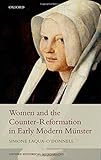
Simone Laqua-O'Donnell. Women and the Counter-Reformation in Early Modern Münster. Oxford Historical Monographs Series. Oxford: Oxford University Press, 2014. Illustrations. 240 pp. $99.00 (cloth), ISBN 978-0-19-968331-4.
Reviewed by Jay Goodale (Bucknell University)
Published on H-German (September, 2015)
Commissioned by Nathan N. Orgill
Trent and Its Limitations
In this interesting and important work, Simone Laqua-O'Donnell offers a new and challenging view of how the Tridentine decrees that explicitly affected women were received, understood, challenged, manipulated, negotiated, and implemented in Münster, over the course of roughly one hundred years, from the conclusion of the Council of Trent in 1563 until the mid- to late seventeenth century. This thought-provoking study makes a valuable contribution to current scholarship in several areas and topics of early modern studies, including women's and gender studies, urban history, the history of the Counter-Reformation, historical anthropology, confessionalization, and social disciplining. Although Laqua-O'Donnell's arguments are complex and will challenge the specialist, this book is so lucidly written that undergraduates being introduced to these themes and concerns will also be able to profit from it.
Laqua-O'Donnell first focuses on convents and their reaction to the Tridentine reform that sought to enclose them. This intended reform antagonized Münster's numerous convents for a variety of reasons, not the least of which was the fact that the decree ordering enclosure used a disciplinary language that implied a retroactive punishment for the nuns' past moral faults. Enclosure would also destroy the foundation on which the city's nuns, in general, fashioned their religious identity, one that was based on a pragmatic piety defined by direct engagement with the community and involvement in secular life, and would thereby deprive them of the very means by which they sought personal grace and salvation. Enclosure, moreover, was expected to have a deleterious effect on recruitment and donations. Laqua-O'Donnell never relies on generalizations to make larger points; her overall conclusions, valid and extremely insightful, emerge as a consequence of her appreciation for nuance and specificity. In the first chapter, for example, her micro-historical analyses reveal the distinct ways the negotiations undertaken by the various convents were resolved, and judge how effective the various agents' strategies were. Thus the Benedictine convent of Überwasser relied on the high social position of its nuns and their noble backgrounds to forge a successful alliance with the cathedral chapter, a body whose members stemmed from similar noble families, and which identified, in terms of social status, with the nuns of Überwasser. Supported by the cathedral chapter, the Überwasser Convent, through persistent negotiation, reached a compromise regarding enclosure, and partially retained some privileges. In contrast, a female teaching order, the Congrégation de Notre-Dame, had arrived in Münster only in 1644, and lacked the local influence and prestige of Überwasser. But it too entered negotiation with the church and the city's elites. While enclosure forced the congregation to increase its rates and become more exclusive than it had intended to be, a different compromise was nonetheless achieved.
One of the strengths of Laqua-O'Donnell's method—and one that is brought to the fore in her analyses of the various convents' responses to intended reform—is her ability to situate her analyses within and against the complex social, political, economic, and religious contexts of Counter-Reformation Münster. Thus, the prescriptive source is apprehended in the context of its implementation, the convents are treated uniquely, and the processes of negotiation are foregrounded. A further strength of Laqua-O'Donnell's work lies in her ability to identify the multiple identities of her subjects and to take their occasionally conflicting agenda into account. For example, the magistrates and guild members not only appreciated the nuns' great service to the city and community—for example, offering prayers, caring for the sick, preparing the dead for funerals, offering alms and food to the local poor, teaching young girls, and producing and vending handicrafts—but also valued the convents as safe and respected havens for their daughters, a recognition that inclined these elites to champion the convents' rights and traditions. But many of these same male elites might just as easily have opposed existing convents, and opposed the entry of new convents to the city, as the nuns could deprive citizens of jobs; they created commercial competition, their property was tax exempt, and the property of religious houses was held inalienably and was therefore permanently removed from the secular community. Throughout the book, Laqua-O'Donnell's interpretations are made richer by her consideration of these sorts of complexities.
After exploring convents, Laqua-O'Donnell turns her attention to the impact of the Counter-Reformation on laywomen's piety, their relationship with God, their charitable initiatives, and their methods of obtaining grace and salvation. Laqua-O'Donnell utilizes a wide array of sources in this book, and for this chapter, she concentrates on wills, although she also examines epitaphs on graves, memorial monuments, forms of service laywomen undertook in their parish churches, women's involvement with confraternities, and women's participation in poor relief. The Counter-Reformation provided a number of ways for Catholic women to participate in their religion, and, in particular, its emphasis on caritas and memoria presented women with means to express their piety through personalized bequests and memorial art. As Laqua-O'Donnell demonstrates with the convents, women in Counter-Reformation Münster were far from passive subjects, and, through their giving and their funerary expressions, they played a significant role in determining Münster's social and religious environment.
Marriage—people's thoughts about it and expectations of it—is the next subject covered, and in this section Laqua-O'Donnell relies on council protocols, criminal records, wills, and records of the city court. She reveals how and why Münster's "secular authorities emphasized cooperation and compromise over the strict enforcement of the Tridentine marriage decrees" (p. 105). In general, marital discord originated in disagreements about money and possessions, over rights and duties, and about power within the household. The city court, in particular, held a view of marriage distinct from that promoted by the bishop and the church, one far less determined by considerations of discipline. The ecclesiastical authorities' ability to impose a strict Tridentine view of marriage on the city was also curtailed by Münster's proximity to Protestant territories where alternate understandings of marriage were evident. But changes deleterious to women were nonetheless introduced. Of interest in this chapter is the discussion of women "who sued their former lovers for defloration, a broken promise, or non-marital impregnation" (p. 96). In the post-Trent world, such women could no longer be regarded as duped victims; by initiating litigation they necessarily indicted themselves.
Utilizing visitation transcripts, court records, and the Jesuits' annual reports, Laqua-O'Donnell next analyzes deviant women. Comparatively based, her investigation centers on the community's distinct perception and treatment of unmarried servant girls as opposed to women married to citizens. In this section, she examines how society determined attitudes toward deviancy, how gender informed understandings of deviancy, and how the community acted against deviant women. Developing fascinating micro-historical cases of sexually assaulted servants, mothers who committed infanticide, a termagant, a lonely married woman who entertained her neighbors, victims of slander, and those accused of witchcraft, Laqua-O'Donnell focuses on comprehending the social context of the perceived deviancy and understanding the dynamics by which the accusations were made and the cases played out. Like the women in the other chapters, even those accused of deviancy had some room to maneuver, albeit with care, and within a narrowly prescribed "negotiated space" (p. 133).
Throughout the book, Laqua-O'Donnell's analyses are preceded by an assessment of scholarship for other regions, such as Bavaria, Italy, and Spain. Her clear and concise engagement with the findings of scholars who work on other regions provides the reader with an informative, if cursory, knowledge of the existing historiography on a given topic, and serves to establish an interesting comparative framework, one that contrasts Münster's experience with those of regions also affected by Counter-Reformation initiatives. Laqua-O'Donnell profitably engages important works written about early modern and Counter-Reformation era Münster that do not share the exact focus as hers, such as those by Ronnie Po-chia Hsia and Andreas Holzem. And her work benefits from her consideration of Münster's history prior to the Counter-Reformation. The recent infamy of the Anabaptist Kingdom of Münster (1534-35) must not have been easily forgotten or ignored, and Laqua-O'Donnell's analyses, given the foci of her study, are also served by her well-placed reminders of Münster's unique, problematic past regarding religious reform, gender relations, and sexual practices.
The final chapter, and the one I found the most complex and interesting, concerns clerical concubinage. Laqua-O'Donnell sees this practice as deeply interwoven within a network of relations of power, dependencies, friendships, and animosities, and as one whose practice and acceptance was a constant source of conflict and renegotiation between the bishop and the cathedral chapter, on the one hand, and officials and lower clergy, on the other. Moral and theological arguments proved inefficacious, and the bishop lacked the means necessary to unilaterally eradicate this practice. The imposition of fines to penalize clerics who would not obey Tridentine decrees produced unintended results, as the clerics transformed an ostensive punishment into a market for bargaining and negotiating. Through a complex analysis, Laqua-O'Donnell reveals how the bishop's desires in this area collided with existing patronage networks involving the canons, in particular, and she examines how these networks safeguarded the canons from having to make concessions. I found her exploration into the concubines' self-perception, and her analyses of how and why they viewed their place in society as they did, both fascinating and of critical importance. In contradiction to the church's views, many concubines felt that their long-term cohabitation accorded their relationship legitimacy. Although they were not officially married, they seem to have regarded their sexual behavior as honorable, and, in fact, many believed their social status had been improved by a long-term and committed relationship to a respected cleric. In the struggle against clerical concubinage, like the conflicts over enclosure, marriage, and sexual deviancy, the decrees of Trent imposed limitations on women's choices and agency, but women's choices and agency also exposed the limitations of Trent's decrees.
If there is additional discussion of this review, you may access it through the network, at: https://networks.h-net.org/h-german.
Citation:
Jay Goodale. Review of Laqua-O'Donnell, Simone, Women and the Counter-Reformation in Early Modern Münster.
H-German, H-Net Reviews.
September, 2015.
URL: http://www.h-net.org/reviews/showrev.php?id=42917
 | This work is licensed under a Creative Commons Attribution-Noncommercial-No Derivative Works 3.0 United States License. |

