

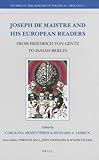
Carolina Armenteros, Richard Lebrun, eds. Joseph de Maistre and his European Readers: From Friedrich Gentz to Isaiah Berlin. Brill, 2011. pp. (cloth), ISBN 978-90-04-19394-9.
Reviewed by Thomas Kselman (University of Notre Dame)
Published on H-Catholic (April, 2016)
Commissioned by Matt Vester (West Virginia University)
What is the legacy of Joseph de Maistre? In an influential essay Isaiah Berlin answered unequivocally that the Savoyard diplomat and conservative philosopher was a forerunner of fascism who glorified authoritarian regimes based on the violent suppression of all dissent.[1] This interpretation bears little resemblance to the portrait that emerges from the essays in Joseph de Maistre and His European Readers, whose editors and contributors take aim at Berlin for presenting a misleading caricature of their subject. Although they acknowledge Maistre’s contribution to the conservative political tradition, these essays see him as a complex and paradoxical figure whose works resonated with thinkers as diverse as Friedrich von Gentz, Auguste Comte, Walter Benjamin, and Herbert Marcuse.
The essays began as papers delivered on a conference on Maistre held at Jesus College, Cambridge, in 2008. Some of them still bear the traces of an oral presentation, and as is common with such collections the essays vary in quality. The editors Carolina Armenteros and Richard Lebrun open with an introduction in which they link a revival in Maistrian scholarship to contemporary anxieties about the status of religion in the modern world. From their perspective Maistre is a significant figure because he grasped both the horror of revolutionary terror, and understood that the world had changed because of it. Far from being a reactionary who looked to the past, Maistre “used the modern philosophy he decried” (p. 7) to defend Catholicism and monarchy as the basis for a renewed social order. In a short essay that serves as a preface Jean-Louis Darcel highlights the use of manuscript sources from family archives as crucial evidence that fueled a revival of interest in Maistre in the 1970s.
The frustration of Maistre scholars with Berlin’s influence is most clear in Cyprian Blamire’s essay, an extended critique of his former dissertation adviser. Blamire makes some telling points, emphasizing Berlin’s inattentiveness to the religious dimension of Maistre’s thought, and his advocacy of universal values as the ground for a united Europe, rather than the nationalist visions of Hitler and Mussolini. In making his case Blamire employs very strong language, concluding that “for anyone who is to any degree acquainted with the literature of fascism, Berlin’s attempt to connect Maistre to it can only be regarded as absurd” (pp. 54-55). There is a Maistrian quality in such invective, which seems informed by an ideological as well as a scholarly agenda.
Keith Erwin and Tonatiuh Sandoval explore the influence of Maistre on nineteenth-century French intellectual life, focusing on Jules Barbey d’Aurevilly (1808-89) and Auguste Comte (1798-1857). The connection between Maistre and Barbey d’Aurevilly is familiar from the work of Pierre Glaudes, but Erwin emphasizes here their common historical sensibility, based on an insistence of God’s providential command of past, present, and future. Barbey d’Aurevilly saw in Maistre an alternative to the empiricism and rationalism of the historical profession as it developed in the work of Leopold von Ranke and Ernest Renan, an approach that would “evacuate the sacredness of history and ... disassociate the ethical and moral dimensions from historical writing” (p. 71). In his essay on Comte, Sandoval picks up a theme announced in the introduction, seeing Maistre’s Du pape (1819) as concerned not “with the [Pope’s] relation with God, but rather … to his various relations with European society” (p. 80). Comte took from Maistre, and also from Felicité de Lamennais, the need for spiritual unity that would transcend and control disruptive individualistic aspirations. But the decadence of the Catholic Church evident in clerical concern with material interests meant that a new spiritual elite deriving its legitimacy from science was needed, a process Sandoval describes as the “de-Christianisation of Catholic Spiritual Authority” (p. 87). Sandoval’s essay points up a paradox that informs many of the essays in this volume, for Maistre’s functional defense of the value of Catholicism and monarchy as the only possible sources for political and social order was vulnerable to a counterargument, that they had not and could not perform the tasks assigned to them by conservative theorists.
At the heart of this volume are four essays on Maistre’s influence on German intellectuals. Raphaël Cahen’s contribution explores the role Maistre played in the career of Friedrich von Gentz, the German translator of Edmund Burke, and the secretary to Clemens von Metternich. As with Comte, Gentz was especially drawn to Du Pape, which led him in the 1820s towards Catholicism both as personal belief and political solution. But in the end Gentz never converted, and thus exemplifies the complex ways in which Maistre’s thought was absorbed by his readers. Adrian Daub argues that Maistre, along with Louis de Bonald, was an important source for a shifting view of the relationship between family and state in German Romanticism. While early romantics, most notably Novalis, emphasized mutual love as the bond that would link families and states together, later romantics, such as Friedreich Schlegel and Franz von Baader, used the patriarchal family as a model for monarchical regimes that would reestablish political authority in Europe. Daub makes a brief reference to the importance of this idea in the general history of political theory, and acknowledges as well that Bonald may have been a more significant source for its resonance in German Romanticism. These qualifications raise the question of whether, in their enthusiasm for establishing Maistre’s legacy, the authors sometimes overreach. This seems to be the case with Ryohei Kageura, who acknowledges that tracing the influence of Maistre on Walter Benjamin is “not an easy task because Benjamin never devoted any work to Maistre” (p. 151). To overcome this problem Kageura reads Maistre’s influence on Benjamin through the intermediary of Charles Baudelaire. His essay offers a dense but insightful reading of Benjamin’s analysis of Baudelaire, presenting modernity as a site where alienated humans struggle to establish connections with each other. But doesn’t the Romantic tradition offer other sources of such an idea both to Baudelaire and Benjamin? Michael Kohlhauer approaches the relationship between Maistre and Herbert Marcuse through contextualized readings of the latter’s two editions of an essay on counter-revolution. Kohlhauer interprets its first appearance in 1936 as a critique of the bourgeoisie, which appropriated Maistre’s defense of authoritarianism in order to protect itself against revolutionary threats. Published again in 1969, the essay serves a different purpose, with Maistre now informing a critique of the habits of materialist consumption that define late capitalism. Kohlhauer’s prose is often obscure, but his essay illustrates how Maistre’s legacy extends to those who rejected as well as those who accepted his ideas.
Three closing essays explore the influence of Maistre in Italy and Russia, and the reception of his Consideration sur la France in France. Marco Ravera focuses on the presence of Maistrian themes--the explanation of evil and the need to choose for or against Christianity--in recent work on the philosophy of religion in Italy produced by scholars associated with the University of Turin, where the author is currently a professor of moral philosophy. Ravera’s essay offers a fascinating introduction to philosophers little known in the Anglophone world--Guzzo Mazzantini, Augusto Del Noce, Luigi Pareyson, and Giuseppe Riconda. Ravera does not document direct connections between Maistre and these thinkers, arguing instead that they are “more hidden and vague,” but also somehow “robust and very strong” (p. 201). Armenteros has no such trouble in linking Maistre to the Russian Sergei Uvarov, an important figure in the Russian educational system. Drawing on an extensive collection of letters from Maistre to Uvarov from 1810 to 1814, Armenteros demonstrates their mutual fascination with the Oriental sources of European civilization and their concern with educational reform. Uvarov may have drawn on Maistre’s ideas in shaping the Russian educational system around the humanities. Armenteros closes her essay with the interesting speculation that this choice “produced the class of unemployed intellectuals trained in theology, literature, and the classics who eventually constituted the disaffected base of the Revolution of 1917” (p. 248). In a final essay labeled as an epilogue José Soares catalogues the uses made of Maistre’s Considerations sur la France by nineteenth-century French historians. He makes no argument to tie together the numerous citations, other than to propose that Maistre’s interpretation of the Revolution drew attention throughout the century.
In their conclusion Armenteros and Lebrun see their volume as supporting an assessment of Maistre’s legacy that overturns the harsh judgment of Berlin. In making this argument they emphasize Maistre’s reflections on religion more than his political theory. Like all their contributors the editors are generous towards their subject, a position that straddles a border between neutral analysis and positive assessment, without falling into overt advocacy. Overall these essays succeed in suggesting the richness and significance of Maistre’s influence, although in some cases the argument depends on problematic assertions about indirect rather than direct contact with his work. After reading this volume I went back to Berlin’s essay, which certainly does not pay enough attention to the religious dimension in Maistre. But does Maistre’s critique of the right of individuals to reason for themselves and his defense of authoritarianism deserve a place in our understanding of how the horrors of the twentieth century unfolded? The Maistrians represented in this volume would reply in the negative, but their insistence on the multiple ways in which their subject has been read could allow for a conclusion in which Berlin’s argument was revised but not reversed.
Note
[1]. Isaiah Berlin, Joseph de Maistre and the Origins of Fascism, in The Crooked Timber of Humanity, ed. Henry Hardy (New York: Vintage, 1992), 91-174.
If there is additional discussion of this review, you may access it through the network, at: https://networks.h-net.org/h-catholic.
Citation:
Thomas Kselman. Review of Armenteros, Carolina; Lebrun, Richard, eds., Joseph de Maistre and his European Readers: From Friedrich Gentz to Isaiah Berlin.
H-Catholic, H-Net Reviews.
April, 2016.
URL: http://www.h-net.org/reviews/showrev.php?id=42707
 | This work is licensed under a Creative Commons Attribution-Noncommercial-No Derivative Works 3.0 United States License. |

