

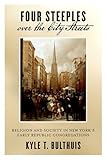
Kyle T. Bulthuis. Four Steeples over the City Streets: Religion and Society in New York's Early Republic Congregations. New York: NYU Press, 2014. 320 pp. $39.00 (cloth), ISBN 978-1-4798-1427-5.
Reviewed by Jessica M. Parr (University of New Hampshire)
Published on H-War (January, 2016)
Commissioned by Margaret Sankey (Air University)
What did it mean to be Anglican in New York? Was there a cohesive Anglican identity? In Four Steeples, Kyle Bulthius explores this question, comparing four New York City congregations against the backdrop of changing politics, economics, and social dynamics. These parishes included the elite Trinity Church, John Street Church (Methodist), Mother Zion (African Methodist Church), and St. Phillip’s Church (African American Episcopal). As society changed, so to did its expectations of the role of the church, and also the religious experience. But what did that mean for Anglican unity?
Religious establishment began in New York City in the late seventeenth century. The first Anglican church was Trinity Church, established in 1698 under a charter by William III. Bulthius’s narrative begins in 1766 with the consecration of St. Paul’s Chapel, a second daughter chapel of Trinity. The consecration meant that Anglican churches in New York City now equally matched the Dutch Reform Church. Although the religious establishment these chapels confirmed did not survive the American Revolution, it did provide a persistent cultural and social model for churches.
Although Samuel Auchmuty, Trinity Church’s rector, was a stalwart proponent of Anglican unity, this dream went unfulfilled. During the imperial crisis, the church’s allegiance to the British Crown made it a target for “disaffected patriots” (p. 30). The withdrawal of financial support by Society for the Propagation of the Gospel, the 1784 disestablishment of the Anglican Church by New York State, and the removal of King’s College (now Columbia) from Anglican control were all major blows to the church’s prestige and influence. The church also faced racial challenges. Auchmuty had been a proponent of catechizing black congregants. In post-Revolutionary America, the full inclusion of African Americans in New York congregations became more contentious. Racial divisions grew from the 1780s onward. Battles over theology and leadership in the nineteenth century caused further divides.
What Bulthius offers is a careful and sophisticated analysis of four interconnected, but very different Anglican parishes with different levels of influence within the city. He convincingly describes an Anglican community in New York City that clung persistently to the notion of Anglican unity, but a union that was limited in practice. Bulthius’s conclusions are perhaps unsurprising. The four parishes in his study were firsts in the city of their type of congregation--first Anglican Church, first Methodist parish, first African Methodist Episcopal, and the first African American Episcopal parish. They evolved of interconnected social, economic, and political circumstances, yet they came to represent very different congregants, with different views about the role of the church.
Bulthius’s key contributions are twofold. His sustained analysis of the evolution of Anglicanism against a changing city provides important insights into New York City’s religious culture. The connections he draws between institutional history, religious history, and social history are impressive and innovative. Second, his analysis of the development of white and black churches and the politics of race are evocative of Mechal Sobel’s excellent 1989 study, The World They Made Together. There is some attention to the African American church in Milton Sernett’s North Star Country (2002), and particularly on the role revivals played in antislavery movements in the 1820s and 1830s. But Bulthius offers close attention to the religiosity of black city dwellers, and particularly how the interplay between black and white Christians helped to create new religious spaces. In doing so, he provides a promising model for similar explorations in other cities, like Philadelphia, Baltimore, Boston, or Charleston.
If there is additional discussion of this review, you may access it through the network, at: https://networks.h-net.org/h-war.
Citation:
Jessica M. Parr. Review of Bulthuis, Kyle T., Four Steeples over the City Streets: Religion and Society in New York's Early Republic Congregations.
H-War, H-Net Reviews.
January, 2016.
URL: http://www.h-net.org/reviews/showrev.php?id=42660
 | This work is licensed under a Creative Commons Attribution-Noncommercial-No Derivative Works 3.0 United States License. |

