

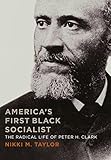
Nikki Marie Taylor. America's First Black Socialist: The Radical Life of Peter H. Clark. Lexington: University Press of Kentucky, March 12, 2013. 308 pp. $40.00 (cloth), ISBN 978-0-8131-4077-3.
Reviewed by Elizabeth Jozwiak (University of Wisconsin)
Published on H-USA (December, 2014)
Commissioned by Donna Sinclair (Central Michigan University)
Ambition First
In this biography Nikki M. Taylor takes on the challenging task of trying to explain nineteenth-century African American activist Peter H. Clark. Taylor’s task is made more difficult by the lack of extant papers of Clark himself. Nonetheless, the author valiantly, if not entirely successfully, attempts to trace and explain Clark’s thought processes over the course of his life using newspapers, convention proceedings, and other sources, and argues that he is a figure who should not languish in obscurity. Readers familiar with the excellent short treatment by David Gerber (“Peter Humphries Clark: The Dialogue of Hope and Despair” in Black Leaders of the Nineteenth Century [1988]) will find more detail here. But this book does not change the impression of a man who, although he may have had ideals, more often than not put personal ambition first.
From his father, a barber who served both black and white customers in the mid-1800s, Clark learned to challenge the status quo. Unsatisfied with the traditional career options available to African Americans at the time, Clark quit the barber business soon after he inherited it from his father. During the 1850s Clark became enamored by black nationalism and even emigration--distinguished from colonization because it would be run by African Americans on their own terms. He bailed out of the movement before any expedition was undertaken, however.
This book adds to the literature on the abolitionist movement, showing Clark to have been a significant abolitionist figure in Ohio. He spent some time in the Radical Abolitionist Party, and based on his friendship with Levi Coffin, Taylor’s conclusion that he had at least some connection with the Underground Railroad is a good one. In this period he was also close to Frederick Douglass (although they did not always agree) and worked for him on Frederick Douglass’ Paper.
This background made it all the more astonishing when Clark joined the Democratic Party. Taylor argues that as someone who had never been a slave, he had less attachment to the Republican Party than other African Americans. His attitude seemed to be, “What have you done for me lately?” He believed Republicans should be pressed to action and if they were not delivering he was willing to shift to the Democratic Party. That may be all well and good, but it seems the motivation for Clark’s shift was also disappointment that the Republicans did not reward him with a job.
Ever ambitious, Clark also sought patronage positions and when one party disappointed him in that area, he was willing to try the next. Many African Americans, not surprisingly, saw him as a traitor for joining the party of states’ rights and slavery in order to get ahead.
He was a nonconformist in religion as well, attracted to Unitarianism for its focus on reason and human agency rather than to more predestinarian traditions. As a young teacher he also lectured on the humanist ideas of Thomas Paine. The mainline Protestant community was appalled by what they saw as Clark’s promotion of the Paine’s “atheist” ideas, and although other teachers came to his defense, his position was not renewed.
In perhaps the strongest section of the book, Taylor showcases the struggles over the integration of Ohio schools in the 1880s. Clark courted controversy by opposing it and lost much support in the African American community when the integration bill failed. What Taylor shows is that Clark and other black educators defended the segregated system in large part over the years because they foresaw that integration would lead to the dismissal of black teachers and administrators. But Clark also recognized that not only was teaching a respected occupation, but black teachers helped guide the next generation toward middle-class opportunities.
Clark worked hard in the 1880s to be a player in the Democratic Party, angling for a patronage plum. He was not above engaging in character assassination to prevent his rival from getting the post he wanted as minister to Haiti. Perhaps in an effort to be a good member of the machine, he even became involved in a bribery scandal attempting to protect a Democrat involved in black voter intimidation. He lost credibility with the African American community and despite his maneuverings, Clark never won the patronage posts he coveted nor held political office.
While Taylor highlights the varied political lives of Clark, she is not entirely successful in arguing that Clark was a socialist. His family members’ brief experience with Fourierism and his early interest in German Turnvereine notwithstanding, it’s hard to see evidence of continued socialist philosophy during his career. Clark appears to have spent a total of three years in socialist parties in the 1870s (the Workingmen’s Party and then the Socialist Labor Party), quitting after losing badly as a congressional candidate. True to form, Clark resisted the push to orthodoxy within socialism, as he did with African American Republicans. As any student of American socialism knows, however, socialists tended to gloss over racial issues in favor of economic arguments and one wonders if that was part of why Clark left. There is little evidence that he continued to speak and write from a socialist perspective as he jumped quickly to first to the Republican and then the Democratic Party. Thus the book’s title is somewhat misleading and disappointing to those expecting a discussion of African American socialism.
Clark spent at least as much time being denounced as admired, so it is somewhat surprising that, as the author notes, in an 1890s Indianapolis Freeman poll he was considered one of the greatest African Americans in history. Perhaps “most controversial” would have been a better designation.
While Clark remains somewhat elusive, Taylor has gone a long way toward enhancing our understanding of him. This work adds a valuable insight into Ohio political history as well as African American history and is worth reading, particularly by students of those fields.
If there is additional discussion of this review, you may access it through the network, at: https://networks.h-net.org/h-usa.
Citation:
Elizabeth Jozwiak. Review of Taylor, Nikki Marie, America's First Black Socialist: The Radical Life of Peter H. Clark.
H-USA, H-Net Reviews.
December, 2014.
URL: http://www.h-net.org/reviews/showrev.php?id=42474
 | This work is licensed under a Creative Commons Attribution-Noncommercial-No Derivative Works 3.0 United States License. |

