

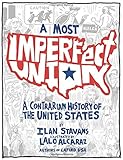
Ilan Stavans. A Most Imperfect Union: A Contrarian History of the United States. Illustrated by Lalo Alcaraz. New York: Basic Books, 2014. Illustrations. 288 pp. $26.99 (cloth), ISBN 978-0-465-03669-1.
Reviewed by Ryan D. Purcell (Law Street Media (TM) @RyanDPurcell)
Published on H-Socialisms (February, 2015)
Commissioned by Gary Roth (Rutgers University - Newark)
United States through the Looking Glass
“Enough with the dead white men! Forget what you learned in school!” (back cover blurb). In their whimsical yet incisive interpretation of American history, Ilan Stavans (author) and Lalo Alcazar (illustrator) attempt to complicate American identity. They follow a tradition set by Howard Zinn’s A People’s History of the United States (1980) and Ronald Takaki’s A Different Mirror: A History of Multicultural America (2008). A Most Imperfect Union: A Contrarian History of the United States presents a critical view of well-worn historical narratives that have established, for a select patriarchy, a hegemony of meanings and iterations. “The true story of the United States lies not with the founding fathers or robber barons, but with the country’s most marginalized peoples,” the book’s back cover declares, echoing Zinn directly. “Many of our myths revolve around famous men (and to a lesser extent women),” Stavans states elsewhere, “swooping in at the last minute to save the day” (p. 3). This thesis, to the extent that it is clear, is not new. The book’s method of analysis, however, departs from the academic monographs laid down by Zinn and Takaki; Stavans and Alcaraz, instead, employ comics to tell their story. In doing so, the authors open historical analysis to a broader audience, making the content—in text and illustration—more accessible than strict academic prose. “To learn from the past, it isn’t enough to study it; it is crucial to reimagine it,” they explain, “and in the modern world there is no better way to do that than by ... creating a cartoon history” (p. 225). A Most Imperfect Union speaks to a wide body of readers, and, because of its unique format, it falls under multiple categories, including comic nonfiction, popular history, and young adult nonfiction. But what separates this book from previous comic histories, such as Zinn’s illustrated A People’s History of American Empire (2008), is the rich background of activist scholarship and academic exploration of identity that Stavans and Alcaraz share. A Most Imperfect Union searches for a new, more inclusive American identity.
A Most Imperfect Union is the latest addition to a long line of scholarship Stavans has produced over the past twenty years, dissecting and interpreting culture and identity. Since 1993, Stavans has held the Lewis-Sebring Professorship in Latin American and Latino Culture at Amherst College, Massachusetts, and has become a leading voice in the study of American identity politics and scholar of the Hispanic experience specifically. Stavans’s first success, The Hispanic Condition: Reflections on Culture and Identity in America (1995), a pioneering psycho-historical profile of Hispanic identity, remains a touchstone in the field of Latino studies. Stavans is the general editor of The Norton Anthology of Latino Literature (2005) and The Oxford Book of Jewish Stories (1998), and author of fictional works that similarly probe the depths of his mixed Mexican Jewish identity. Latino U.S.A.: A Cartoon History (2000), however, was his first experiment with satirical comic history. With equal parts wit, subversion, and celebration, Latino U.S.A. tells the Latino story, the challenges and triumphs of the Latino people, and the historic, if lesser-known, narratives that define Latino culture. Illustrations by Alcaraz, which are inherently theatrical and humorous, add a visual dimension to Stavans’s survey of culture and politics. Mr. Spic Goes to Washington (2008), with illustrations by Roberto Weil, is Stavans’s second, though less successful, foray into comic nonfiction. Here the author riffs off Mr. Smith’s tenure at the Capitol, with a Latino twist; there is no place for a pro-Latino agitator in American politics, and the protagonist’s career is cut short, dismally.
Alcaraz is most well known as a Mexican American cartoonist who, like Stavans, uses his craft to explore Latino identity. Founded in 2002, Alacraz’s “La Cucaracha” was the first nationally syndicated daily comic strip that focused on Latino culture and politics. It has since become one of the most controversial because of its critical stance toward Anglo-American cultural and social norms. Riding on the success of Latino U.S.A., Alcaraz published Migra Mouse: Political Cartoons on Immigration (2004), followed by La Cucaracha (2012), an adaptation of his comic strip. Migra Mouse is a particularly caustic account of the Mexican American immigration experience, based on the author’s childhood; the book explores themes of immigration, cultural assimilation, and the fractured consciousness of a transplanted people. In 2013, Alcaraz released Muerto Mouse, a reiteration of Migra Mouse, as a graphic campaign protesting the Walt Disney Company’s US Patent and Trademark application to secure “Dia de Los Muertos” as a service mark.[1]
A Most Imperfect Union builds on the legacy of political culture produced by Stavans and Alcaraz, but marks a new trajectory in their development as activist artists and scholars. Whereas Latino U.S.A. chronicles a cartoon Latino history, A Most Imperfect Union, much like Alcaraz’s “La Cucaracha,” takes direct aim at the historically Anglocentric politics and culture of the United States. Moreover, it attempts to complicate American historical consciousness by highlighting the stark omission of nonwhite, female, and homo-normative narratives from the national identity.
This is a “contrarian” history, through which Stavans attempts to penetrate “establishments and fabrications” and to uncover historical “truth (or at least what I think is the truth) at the heart of things” (p. xi). The author, however, goes no further to explain this aspect of his thesis except to say that it is “important to take a contrarian’s view [of history], to be wary of what the French call idées fixes—lazy, unquestioned truths” (p. 1). But where do these historical fabrications originate? Who creates and who consumes such “lazy” and “unquestioned” truths? Moreover, what is historical “truth”? This flimsy foundation offsets the integrity of the volume as a whole, which is further troubled by Stavans’s motives and methods of “rewriting” history. “My love for history comes from the movies,” Stavans explains, “and A Most Imperfect Union pays tribute to the cinematic quality of the nation’s past. Of course, what is on screen is never true, because truth, no matter what form it comes in, is never easily packaged” (p. 253). This is exactly the type of “truth” that Stavans attempts to uncover. This story is told from a film production point of view. The use of film as a metaphor for unveiling historical “truth” is problematic because it implies fictionality and the artificial construction of history. In the first illustration, in the foreword, “Plastic Nation,” Stavans reads a cartoon from a script in front of a propped backdrop. “Extras” look on from the periphery, expressionless; a camera and lights protrude from the frame; and a figure seated in a chair labeled “director” watches the story unfold (p. 1). Stavans narrates their comic history as a “straight man,” while a cartoon Alcaraz, from behind a drafting table, quips in a gadfly manner; their dialogue carries the narrative, introducing themes and levying criticism. “CUT!” screams the director. “I want the author of this book fired! The script is wrong. How can you begin a cartoon history of the United States in 1492?” adds Alcaraz (p. 14). Obviously a far cry from Zinn or Takaki, A Most Imperfect Union is a light, expressive, and highly subjective account that falls apart under the least invasive analytical probe. But academic rigor is not its aim.
In its unique format, A Most Imperfect Union democratizes discussion of historical issues by introducing alternative narratives in a way that is at once educational and mildly entertaining. The first chapter includes a nuanced section on the transatlantic slave trade, where Stavans highlights notable early African Americans whose stories have been excluded from the collective historical consciousness. Ayuba Suleiman Diallo, a West African intellectual pressed into slavery in the eighteenth century, occupies a two-page spread, with a detailed cartoon portrait. Diallo’s experience, recorded by Thomas Bluett in 1731, stands as one of the first examples of the slave narrative genre, which explores the evils of the slave trade and galvanized abolitionist movements across the Western world. Less descriptive are the sections concerning gender and sexuality, to which Stavans devotes little more than a page throughout. “The story of America is the story of its coupling.... In short, the nation has become voraciously sexual,” Stavans states citing unnamed “studies” that show an increase in sexual activity in America from 1790 to 1990. “How about transgendered folks, handsome?” an apparently transgendered cartoon asks Stavans who replies, “We’ll have to collect some more data on that” (p. 64). Such cursory explication verges on mockery, another misplaced attempt at humor. However, other themes, such as political economy, maintain strong currents throughout the book.
The theoretical assumption posited in A Most Imperfect Union is based on “creative destruction,” which Stavans defines as “the tension between destruction and rebuilding the forces of order infringing on the forces of chaos and vice versa.” This is the engine that drives historical change. “Things often get destroyed so they can be rebuilt with a different shape.... The movement forward can only proceed by leaving the past in ruins” (p. 4). It is therefore necessary, according to this oedipal logic, to dissolve traditional historical narratives and forge them anew, imprinted with the consciousness of successive generations. But “creative destruction” is quite a loaded term, and Stavans’s failure to acknowledge the political connotations of his theoretical apparatus unsettles the foundations of his larger work. The term was first coined by Joseph A. Schumpeter in his landmark economic text Capitalism, Socialism and Democracy (1942) to describe the unyielding and destructive consequences of the business cycle: “incessantly destroying the old [economic structure], incessantly creating a new one.”[2] Creative destruction, Schumpeter argued, would inevitably lead to the collapse of the capitalist system. During the late twentieth century, free-market champions reinterpreted creative destruction as justification for boosting the power and efficiency of the private sector at the expense of public regulations on capitalist development. Where does Stavans’s account fall along this spectrum of interpretation? Creative destruction is a rhetorical frame for Stavans’s text, though he goes no further to identify its political significance in his analysis. Stavans seems to espouse the neoliberal sense of the term as he equates creative destruction with progress; yet the narratives he chooses are largely left leaning, if not Marxian. Even so, this lack of explication further muddles an already confounding thesis. The term is dropped after the first chapter, and the reader is set on an ambiguous trajectory thereafter.
Chapters are organized chronologically under loosely defined themes. Chapter 1, “The Land Is Ours,” starts with the first contacts between European explorers and indigenous Americans. “Meet Christopher Columbus, the man credited (wrongly) with discovering America and one of our greatest scoundrels,” Stavans beings. “Actually, we don’t know much about him other than what he wrote in his diaries. He was probably a converso Jew, convinced there was an alternative trade route to the Far East—to India in particular” (p. 11). Columbus, characterized as a superhero, looms large in the first frame, while a cartoon Stavans and a director banter below. This playful and irreverent style carries throughout, and sets the tone for the type of analysis that we can expect from a comic history. Yet this brief snapshot highlights larger faults that diminish the integrity of A Most Imperfect Union as a whole.
First, the text does very little to interpret the “myths” in American history that it sets out to deflate. Where are the stories of indigenous Americans? Where are the atrocities committed by the Europeans against the native communities? The book begins with Columbus, the ultimate canonical narrative in American history, and at that, Europeans are depicted as innocuous profiteers, whereas common historical knowledge holds they were much more volatile and inhumane. “Beginning any earlier would be difficult,” Stavans reasons. “The native peoples of what became the United States left no written records of their history. We don’t even know how many people lived in the Americas before the Europeans arrived” (p. 15). This is a weak qualification for glaring shortsightedness, but such issues pervade every chapter. By excluding indigenous narratives from this story—which have been passed to us through indigenous mythology and cultural and oral history—A Most Imperfect Union bolsters the historiographical inequity it claims to rectify.
Second, much of the humor conveyed through text and illustration is irrelevant to the content, or is otherwise confounding. What is the purpose of labeling Columbus a “converso Jew,” a seemingly unnecessary comment that might verge on a disparaging slur? The book wastes space on superfluous material, with ill humor, while paying little attention to developing a holistic narrative. “While America’s political system was taking shape, the country was also indulging in its sweet tooth,” Stavans explains in chapter 2, entitled “Founding Fathers Have a Baby!” (p. 61). A three-page tangent follows, covering a range of irrelevant topics from cocaine in Coca-Cola to the history and culture of chewing gum. “The best thing to do with chewing gum is to stick it under your desk as a memento—Did you know that chewing gum isn’t biodegradable? Who cares anyhow?—Well, the good things in life seldom are” (p. 63). In that same chapter, an entire frame is devoted to a superfluous current pop culture reference. In response to a talking dog that muses on making the state of Alaska an independent republic, Stavans remarks in reference to Michael Chabon’s book, “Actually, I read a novel, The Yiddish Policeman’s Union (2007), in which Alaska was turned into a temporary Jewish state after Israel was destroyed in 1948 by the neighboring Arab nations” (p. 80). What meaningful point do these references serve?
A Most Imperfect Union may seem like a prequel to an earlier collaboration between Stavans and Alcaraz, Latino U.S.A., and to some extent it is. In their retelling of American history, Stavans and Alcaraz disproportionally feature Latino narratives. Chapter 5, “The Progress Machine,” which spans from the Great Depression to the Korean War, focuses on a range of Latino issues during this period. These include: Franklin Delano Roosevelt’s “Good Neighbor” foreign policy, which effectively established exploitative “reciprocal” trade relations with Latin America; and cultural diplomacy via the Disney cartoons Saludos Amigos (1941) and The Three Caballeros (1944), to strengthen ties with Latin America and counteract the global influence of Nazi Germany (“Unregulated capitalism? No Problem!” one of three singing birds chimes sardonically. “Guaranteed: no armed revolution during your stay!” replies another [p. 156]). This section also includes the Mexican Farm Labor Program (also known as the Bracero Program) which sponsored nearly forty-five million border crossings between 1942 and 1946. In chapter 7, “New World Disorder,” in a segment about the September 11 Memorial and Museum, a cartoon Alcaraz posits, “Did you know there are several undocumented Mexicans whose names aren’t included?” Cartoon Stavans replies, “Ah, the illegitimacy of memory!” (p. 227). Stavans’s text is “intimately linked” to his experience as a Mexican-American immigrant. “Immigrants know what it means to be displaced, in transitions, constantly perplexed” (p. i). This might account for his abundant inclusion of Latino history in A Most Imperfect Union, but the end result is an ill-defined smattering of lesser-known facts and caveats rather than a “contrarian history of the United States.” Stavans’s attempt to highlight his own voice and Latino identity detracts from the cohesiveness of the overall narrative, which, to begin with, is unfocused and weak.
In all, A Most Imperfect Union fails to meet the mark it sets. “The history of the United States is one of constant cutting and pasting,” Stavans generalizes in the epilogue (p. 248). But the end result is more of a rambling mess than a chaotic collage. There is no cohesive thesis to tie points together, in text or illustration. In the doldrums of stale humor, Stavans and Alcaraz flounder to make their “contrarian” comic history relevant. If A Most Imperfect Union is an exploration of American identity, its conclusion is solid: American identity is amorphous and relativistic, and must be revised constantly along the lines of “creative destruction.” The execution of this thesis, however, is flawed, or rather, imperfect.
Notes
[1]. Lalo Alcaraz, “Walt Disney, Inc. Wants to Trademark ‘Dia de los Muertos’ toon,” Pocho (May 7, 2013), http://pocho.com/walt-disney-inc-wants-to-trademark-dia-de-los-muertos-toon/.
[2]. Joseph A. Schumpeter, Capitalism, Socialism and Democracy (1942; repr., London: Routledge, 1994), 82-83.
If there is additional discussion of this review, you may access it through the network, at: https://networks.h-net.org/h-socialisms.
Citation:
Ryan D. Purcell. Review of Stavans, Ilan, A Most Imperfect Union: A Contrarian History of the United States.
H-Socialisms, H-Net Reviews.
February, 2015.
URL: http://www.h-net.org/reviews/showrev.php?id=42452
 | This work is licensed under a Creative Commons Attribution-Noncommercial-No Derivative Works 3.0 United States License. |

