

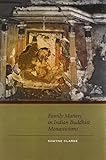
Shayne Neil Clarke. Family Matters in Indian Buddhist Monasticisms. Honolulu: University of Hawai'i Press, 2014. xiii + 275 pp. $52.00 (cloth), ISBN 978-0-8248-3647-4.
Reviewed by Reiko Ohnuma (Dartmouth University)
Published on H-Buddhism (September, 2014)
Commissioned by Daniel A. Arnold (University of Chicago)
In recent decades—thanks in large part to the voluminous and influential work of Gregory Schopen—scholarship in South Asian Buddhist studies has paid more and more attention to the social history of Indian Buddhism, or Buddhism as lived and practiced “on the ground” in India.[1] Shayne Clarke’s cleverly titled Family Matters in Indian Buddhist Monasticisms—a substantially revised version of his 2006 PhD dissertation (written under Schopen’s supervision)[2]—makes a major contribution to this trend and establishes definitively that family did indeed matter, far more than has previously been supposed, to Buddhist monks and nuns in premodern India. Exemplifying the meticulous, multilingual scholarship, the careful argumentation, and the copious footnotes of his mentor, Clarke marshals an impressive body of evidence from all six complete texts of the vinaya[3] (with some support provided by epigraphical evidence), to argue that the common scholarly perception of the Buddhist monk or nun as one who has severed all familial ties is simply “not supported by the preponderance of our premodern evidence” (p. 3).
In chapter 1, “The Rhinoceros in the Room: Monks and Nuns and Their Families,” Clarke first demonstrates the pervasiveness of the common scholarly misperception of an anti-familial monastic through a brief review of early, later, and contemporary scholarly sources. He attributes this scholarly misperception primarily to an overreliance on sūtra sources, which he sees as representing the “public face” of Buddhist monasticism, or “what Buddhist monks told others, particularly the laity.” Correspondingly, scholars have shown a relative neglect of vinaya sources, which Clarke describes as transmitting “an ‘in-house’ vision” of Buddhist monasticism, or “what [monks] told themselves, what monks told other monks about their own institutions and traditions, and how they understood Buddhist monastic religiosity” (p. 11). Particularly insidious, in Clarke’s view, has been the frequent scholarly invocation of the Rhinoceros Horn Sutta, with its strident exhortation that the Buddhist monk should give up “son and wife and money, possessions and kinsmen and relatives” to “wander alone like the rhinoceros” (p. 4). In an interesting thought-experiment, Clarke contrasts this frequently invoked ideal of solitary wandering with three short passages taken from the vinayas—all of which demonstrate close and continuing ties between Buddhist monastics and their families—and then poses the question: “In what directions might the field have developed with these passages as the touchstones of received knowledge of Buddhist monasticisms?” (p. 13). Perhaps the most useful aspect of Clarke’s discussion of sūtra versus vinaya sources is that rather than viewing the sūtras’ depiction of the monk as the ideal and the vinayas’depiction as the reality (which inevitably fails to live up to the ideal), Clarke points to the existence of multiple ideals—including an ideal of settled monasticism in which family ties are fully recognized and ecclesiastically sanctioned—and the need to consider all types of available sources. Two further methodological principles inform his study: the need to consider all six extant vinayas, rather than relying on the Pāli Vinaya alone, “in order to ensure that what we see is not just an isolated viewpoint of a single tradition” (p. 18); and the need to move beyond the decontextualized rules of the prātimokṣa to consider the wealth of narrative details present in the frame stories that contextualize each rule. Arguing for the importance of these principles, chapter 1 thus lays the methodological groundwork for the remainder of Clarke’s study.
Chapter 2, “Family Matters,” draws partially on inscriptions but primarily on vinaya passages to demonstrate, in a general way, the continuing relevance of familial ties for monks and nuns, even after they had, as Buddhists say, “gone forth from home into homelessness.” Clarke’s careful analysis of the sources successfully shows, for example, that monks and nuns continued to identify themselves in terms of their familial relationships even after they had renounced the world; that “going forth from home into homelessness” did not, in fact, necessarily require one to physically leave one’s family at all; that it was taken for granted that monks and nuns might visit their own families for alms, even on a daily basis, or that they might stay with their families for more extended periods of time; and that “co-renunciation,” or the practice of family members becoming Buddhist monastics together and continuing some kind of relationship within the monastery, was an “entirely unproblematic” occurrence (p. 56). In all of these cases, Clarke’s argument is careful and sound.
Perhaps my only criticism here is that it might have been helpful to his readers if Clarke had attempted to distinguish, even in a speculative manner, between those practices that were truly common and ordinary and those practices that were highly exceptional and unusual—even if not necessarily forbidden by the rule of vinaya law. For example, the evidence presented by Clarke seems to show that the practice of monks and nuns visiting their own families was indeed common, pervasive, and completely unremarkable. But what about the practice of monks and nuns renouncing the world and then continuing to live at home with their families? Clarke uses vinaya passages involving the monk Sudinna and the nun Dharmadinnā to argue that “physical separation from one’s family was never made a formal requirement for renunciation”—something that is clear in Dharmadinnā’s case but ambiguous, at best, in the case of Sudinna (p. 50). But while the lack of any such requirement may very well be the case, shouldn’t we also go on to ask how common this practice actually was, and to what extent Sudinna and Dharmadinnā constitute highly unusual exceptions? In fact, considering that Sudinna is “the first monk encountered in all of the Vinayas” (p. 50), that he quickly decides that staying with his family is not conducive to his spiritual progress, and that when he later visits his family, he engages in inappropriate familial relations that result in the promulgation of the very first pārājika rule—shouldn’t his behavior be seen as a precedent-setting example of everything that a monastic should not do, and thereby as a highly unusual case?
Put another way, does the practice of continuing to live at home with one’s family really belong in the same category as regularly visiting one’s family for alms? It seems to me that making some distinction—no matter how speculative—between those familial practices that were truly ordinary and those that were highly unusual (though not outright forbidden) would have helped his readers distinguish between the force of Clarke’s various claims and thereby strengthened his overall argument.[4] Clarke also fails to consider the negative evidence: If the practice of monastics living at home were anything other than highly unusual, wouldn’t the vinayas contain legal procedures for how to deal with such monastics and legislate their proper roles within the monastic community? And if such rules are lacking, shouldn’t we conclude that the cases of Sudinna and Dharmadinnā were, in fact, fairly unusual and lacked the taken-for-granted quality of occasional visits home?
The same criticism might also be leveled against chapter 3, “Former Wives from Former Lives,” which focuses more narrowly on Buddhist monks’ and nuns’ continuing ties to their spouses, even after renouncing the world. Here, Clarke provides ample and very solid evidence that it was completely normal and unremarkable for Buddhist monastics to visit and interact with their former spouses in the lay world, and for husbands and wives to renounce the world together and continue some kind of relationship with each other within the walls of the monastery. Clarke argues successfully that the authors/redactors of the vinayas were much more concerned with negotiating the boundaries between acceptable and unacceptable behavior between former spouses than with preventing any relationship at all. On the basis of Clarke’s analysis of numerous passages from the vinayas, this much seems clear.
I am considerably more skeptical, however, when Clarke extends the argument a step further: “Although aware of legal provisions for the dissolution of marriage,” he states, “Buddhist jurists seem not to have required monks or nuns to dissolve their marriages.” Thus, “it appears that monks and nuns in India may have continued to remain legally married” even after renouncing the world, pointing to “the very real possibility of married monks in India” (pp. 78-79). I find the reasoning here a bit faulty. Clarke enumerates the various types of marriage-dissolution outlined in the vinayas, observes that none of these procedures are required of those who are ordained into the Saṃgha, and thereby concludes that monks and nuns must therefore still be married. But isn’t it at least possible that ordination itself was considered by definition as entailing the severance of marital ties, so that an actual legal procedure of marital dissolution was redundant and therefore unnecessary? After all, the types of marriage-dissolution outlined in the vinayas seem to be for couples who are unhappy with each other—which is a different category than the case of couples in which one or both partners wish to renounce the world. Isn’t it possible that there were several different types of marital dissolution—and that one type was understood as being effected by the very fact of ordination itself, and as therefore requiring no additional procedure? This would certainly seem to be suggested by the vinayas’ frequent references to a monk’s “former wife.” Clarke makes note of this phrase, but opines that “the term translated here as ‘former wife’ … seems to mean, quite simply, a wife from one’s ‘former’ lay life” (p. 81)—effectively separating the meaning of “former” from the object to which it is applied (“wife”). I do not find this argument wholly convincing, and the fact that Clarke’s own language is full of hesitation (monks “may” have remained legally married, married monks are a real “possibility”) makes me wish that he had been more explicit about the relative strength of his various arguments. Nevertheless, the possibility of married monks raised by Clarke is indeed intriguing and certainly worthy of further study.
In chapter 4, “Nuns Who Become Pregnant,” Clarke turns his attention to the neglected topic of monastic motherhood, or those cases in which nuns become pregnant (either before or after being ordained as nuns) and give birth to children. How did the authors/redactors of the vinayas legislate such delicate situations? Here, Clarke’s approach is more systematic and thorough than in the previous chapters, for rather than providing us with a sampling of different cases, he proceeds through each of the six extant vinayas to consider how eachdeals with the questions raised by monastic motherhood. Though each vinaya is slightly different, Clarke succeeds in demonstrating that overall, Buddhist monasticism was far more accommodating of pregnancy, breastfeeding, and motherhood than many of us have previously supposed.
In various vinaya traditions, for example, Clarke demonstrates that the ordination of pregnant women and nursing mothers, although discouraged, was not outright prohibited; that nuns who found themselves pregnant and gave birth to children were authorized (perhaps even “commanded”) to nurse their babies within the monastery until the time of weaning; that the Saṃgha, in some cases, even appointed another nun to serve as the mother’s helper and attendant; that both women were permitted to hold the child and stay overnight in the same dwelling with the child, even if the child was male; that such children may have remained with their mothers to be raised in the monastery for a considerable portion of their childhoods (or, in the case of daughters, perhaps permanently); and that the nun-mother alone was responsible for deciding whether or not the child would join the Saṃgha or eventually leave the monastery to reside with lay relatives. Clarke’s careful analysis of the frame stories surrounding such rules demonstrates that while the monastic jurists, in dealing with such highly fraught situations, were primarily concerned with safeguarding the perceived celibacy of the nun in question, they were also concerned with making a viable place within the monastery for those nuns who found themselves to be pregnant, nursing, or responsible for young children.
In the concluding chapter 5, “Reconsidering Renunciation: Family-Friendly Monasticisms,” Clarke summarizes his findings and again calls for scholars of Indian Buddhism to abandon their romanticized assumption of an asocial and anti-familial Buddhist monastic, as well as the highly selective reading of sources upon which such an assumption is based. He further points out that because Indian Buddhist monasticism is treated as the yardstick for all other Buddhist monasticisms, this romanticized perception of the Indian Buddhist monk leads inevitably to a problematic view of Central Asian, Mongolian, Nepalese, or Tibetan Buddhist monks as “corrupt” versions of the Indian original, when, in fact, they may be much closer to the Indian Buddhist monastic ideal than we have previously supposed. Farther afield, work on comparative monasticisms—between Buddhism and Christianity, for example—can hardly proceed in a fruitful manner until we have a more balanced and comprehensive view of the nature of monasticism in India.
In short, though one might argue (as I have) that Clarke occasionally overstates his case, the case itself is a timely and much-needed corrective to the standard narratives and biases that have hampered Buddhist studies since its beginnings. Family Matters in Indian Buddhist Monasticisms is a meticulous and elegant piece of scholarship that makes a welcome, valuable, and highly accessible contribution to the growing literature on Buddhism and the family.[5] It is suitable for undergraduates, graduate students, and professional scholars, and should be required reading for anybody who works on South Asian Buddhism, Buddhism in other parts of the world, or the comparative study of monasticism.
Notes
[1]. See, e.g., Gregory Schopen, Bones, Stones, and Buddhist Monks: Collected Papers on the Archaeology, Epigraphy, and Texts of Monastic Buddhism in India (Honolulu: University of Hawaii Press, 1997); Gregory Schopen, Buddhist Monks and Business Matters: Still More Papers on Monastic Buddhism in India (Honolulu: University of Hawaii Press, 2004); and Gregory Schopen, Figments and Fragments of Mahāyāna Buddhism in India: More Collected Papers (Honolulu: University of Hawaii Press, 2005). (These volumes were all published in the Studies in Buddhist Traditions series, ed. Luis O. Gómez.)
[2]. Shayne Neil Clarke, “Family Matters in Indian Monastic Buddhism,” (PhD diss., UCLA, 2006).
[3]. That is, the Theravāda vinaya (in Pāli); the Dharmaguptaka, Mahāsāṅghika, Mahīśāsaka, and Sarvāstivāda vinayas (in Chinese); and the Mūlsarvāstivāda vinaya (in Tibetan, with incomplete versions in Sanskrit and Chinese).
[4]. Toward the very end of the book, Clarke partially addresses this objection, stating: “While some may charge that this legislation represents exceptions to the rules, and as such the present study overemphasizes irregularities of the monastic life in Indian Buddhist monasticisms, at what point do the numerous exceptions to the rule in fact make the rule?” (p. 167). What I am objecting to, however, is the failure to offer any comments on the degree of irregularity characteristic of the “numerous exceptions to the rule.”
[5]. See Reiko Ohnuma, “Buddhism and the Family,” Oxford Bibliographies in Buddhism, ed. Richard Payne (New York: Oxford University Press, 2014). URL: http://www.oxfordbibliographies.com/view/document/obo-9780195393521/obo-9780195393521-0201.xml?rskey=qaAVuo&result=1.
If there is additional discussion of this review, you may access it through the network, at: https://networks.h-net.org/h-buddhism.
Citation:
Reiko Ohnuma. Review of Clarke, Shayne Neil, Family Matters in Indian Buddhist Monasticisms.
H-Buddhism, H-Net Reviews.
September, 2014.
URL: http://www.h-net.org/reviews/showrev.php?id=42417
 | This work is licensed under a Creative Commons Attribution-Noncommercial-No Derivative Works 3.0 United States License. |

