

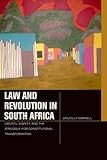
Drucilla Cornell. Law and Revolution in South Africa: uBuntu, Dignity, and the Struggle for Constitutional Transformation. New York: Fordham University Press, 2014. xviii + 210 pp. $85.00 (cloth), ISBN 978-0-8232-5757-7; $24.00 (paper), ISBN 978-0-8232-5758-4.
Reviewed by Anja Henebury
Published on H-Socialisms (June, 2015)
Commissioned by Gary Roth (Rutgers University - Newark)
Interlegality and Policulturalism in South African Jurisprudence
In this collection of essays, Drucilla Cornell examines the role of the traditional ethical ideal of uBuntu within the postapartheid South African democratic dispensation and its constitutional legal practice. Preceded by her UBuntu and the Law: African Ideals and Post-Apartheid Jurisprudence (2012, coedited with Nyoko Muvangua) and a substantial body of works on South African jurisprudence, Law and Revolution in South Africa assembles case studies and reflections on indigenous law formation in South Africa and asks what Africana philosophy can contribute to the struggle for social justice against the background of neoliberal capitalism. It draws on the work of the uBuntu Project that Cornell initiated with others in 2003. This project brought together academics, activists, lawyers, and judges of the Constitutional Court of South Africa to discuss the ways in which the ideals of dignity and uBuntu underpin the South African constitution and dignity jurisprudence. At the same time, it also involved ethnographic research on uBuntu as a living vernacular and, going beyond the divide between academia and activism, actively advocated “for the justiciability of uBuntu as a constitutional principle” (p. 16).
UBuntu is a form of communal ethics that is found among many ethnic groups in southern Africa. The term is derived from the Zulu proverb “umuntu ngumuntu ngabantu,” meaning “a person is a person through people.” Importantly, this is not just merely a descriptive statement but rather a moral obligation: an individual ought to strive for whole humanness, which is something that can only be achieved within communal relations with others. Cornell describes it as an “activist ethic of virtue in which what it means to be a human being is ethically performed, on a day-to-day basis, in a context, in which how we are supposed to live together is constantly evoked and at the same time called into question” (p. 40). The concept made its way into the interim constitution and in the Promotion of National Unity and Reconciliation Act from 1995 that governed the Truth and Reconciliation Commission (TRC) and, as has been argued, informs South Africa’s constitution without being mentioned in it, acting as an African basis for the acceptance of dignity as the Grundnorm of the constitution. In this regard, uBuntu is unique as an African concept that has been absorbed into legal discourse and invoked in a series of judgments in the constitutional and high courts in a way that is indicative of what Cornell, drawing on a concept of Boaventura de Sousa Santos, refers to as the “interlegality” of South African legal practice (p. 12).
Going beyond the confines of the recent body of scholarship on transitional justice that largely focuses on democratic proceduralism and is underpinned by the notion that we live in a postrevolutionary age, Cornell depicts South Africa’s new democratic dispensation as a “substantive revolution” in that it attempts to recouple revolution and law (p. 10). This term by legal theorist Hans Kelsen refers to a revolution that does not involve a complete overthrow of a legal order along with its institutions but rather involves something more limited; namely, it stresses the idea that “no existing law on the books could be enforced unless they were consistent with the right or Recht that undergird and give significance to the meaning of the transformation from the older order to the new order” (p. 11). Against this background, Cornell looks at South African case law of the last two decades. She traces the significance of uBuntu law as a potentially transformative Grundnorm within it and identifies what she calls, with Jean and John Comaroff, its inherent “policulturalism” (p. 12). In doing so, she seeks to challenge criticisms of uBuntu that tend to focus on its vagueness; its lack of attention to individual freedom; and the fact that, as an ethical ideal that evolved within small-scale agrarian communities, it is not fit for purpose in large industrial societies.
In a chapter on socialism and radical democracy, she confronts Ernesto Laclau and Chantal Mouffe’s understanding of the latter with the commons-oriented struggle practices of South Africa’s poor—the uBuntu electricians who reinstall electricity in the houses of the poor and the shack dwellers movement Abahlali baseMjondolo. She maintains that Laclau and Mouffe’s insistence on an anti-universalist politics that does not give precedence to the economy as a “true body of the universal” (p. 44), as a site of struggle, has willy-nilly given up on the socialist project because it fails to challenge the right to private property that movements reclaiming a people’s commons call into question. Instead, Cornell argues, a democratic practice based on uBuntu that she sees realized in these forms of grassroots struggle is democratic and allows for a bridging of the gap between the supposedly fictitious universal and the particular that Laclau and Mouffe take to be a principle of democracy. She continues this line of reasoning in another essay where she argues that, despite obvious differences, there is “an alliance of a Kantian notion of dignity with the intellectual heritage of African humanism” that she sees rooted in the “close connection between freedom and morality” and the status of humanity as a moral ideal (pp. 157, 165, 166).
In one of the central chapters, Cornell reconsiders the Azanian People’s Organization (AZAPO) case from 1996 in which organizations and individuals from a black consciousness background challenged the constitutionality of the far-reaching amnesty provision that undergirded the work of the TRC. The relevant act stipulated that individuals who committed politically motivated acts of human-rights violations under the old order could be granted amnesty if they were to appear in front of the TRC and testify to their wrongdoings. The complainants argued that this amounted to a violation of the interim constitution that guaranteed the right of citizens to seek redress from the courts for justiciable disputes. The Constitutional Court ruled against this complaint, thus effectively undermining individual rights for the sake of a social goal. While Cornell had previously been critical of this decision, she now views it in a more positive light, taking into consideration the ideas of uBuntu that informed the judgment and the wider TRC proceedings. These amount to a dismissal of retributive in favor of restorative justice, bringing to the fore the aspirational character of uBuntu, the transformative potential of which is highlighted throughout the book. From the vantage point of uBuntu, humanity is not something that exists but an ideal that one tries to achieve through “ethical work.” In the context of the TRC, this means that the act of testimony—which was a central pillar of its proceedings and was a precondition for amnesty—was not only for the sake of the victims who heard the truth about the fate of their loved ones and gained a public acknowledgment of the pervasive human rights violations under apartheid. But, as a shared space of communal mourning, it was also supposed to allow the perpetrators to restore their own human being.
The same argument also informs Cornell’s argument in favor of reparations that were, in fact, recommended by the TRC but have never been put into practice. This touches on an aspect of Cornell’s arguments that I would consider a central weakness. While she convincingly shows how uBuntu has been introduced as a legal Grundnorm with transformative potential, she pays little attention to the socioeconomic and political conditions under which it is put into execution. While it is clearly not Cornell’s aim to uncover the “authentic” historical contents of uBuntu but rather to tease out its transformative potential, the social realities of rural South Africans living under traditional leadership and customary law rarely come to the fore. Thus the examples Cornell chooses, such as the lesbian sangoma (traditional healer) who is to represent the humanist, aspirational character of the ethics of uBuntu, are extreme and rare cases that are widely removed from the often violent realities on the ground. This also applies to another case she discusses, of a female hosi (chief) whose legitimacy was confirmed by a constitutional judgment making a case for a flexible living customary law, thus challenging the rule of male primogeniture. It did not challenge, however, the rule of lineage as primary determinant of leadership succession.
One of the defining features of South African society is a social conservatism that sits oddly with a constitution that is often considered exemplary with regard to its incorporation of multicultural provisions while at the same time respecting local custom. In particular, since 2009 and the administration of Jacob Zuma as chief, this fragile equilibrium has increasingly been challenged under the auspices of what is considered African tradition. A Traditional Courts Bill, which has not been passed yet, has strongly been contested by feminists as entrenching male-dominated courts that are able to decide matters of maintenance, dissolution of marriage, domestic violence, and even certain cases of rape. Recent instances, such as the case of the Limpopo chief who charges a special tax to mothers whose children have been born out of wedlock, support these fears. While practices like that are clearly unconstitutional, they will remain unchallenged unless there is a complaint. So even though the Constitutional Court cases that Cornell presents indeed refute premature ideas about the inherently conservative character of African customary law, doubts are appropriate as to the protection of the rights of those without easy access to legal institutions.
If there is additional discussion of this review, you may access it through the network, at: https://networks.h-net.org/h-socialisms.
Citation:
Anja Henebury. Review of Cornell, Drucilla, Law and Revolution in South Africa: uBuntu, Dignity, and the Struggle for Constitutional Transformation.
H-Socialisms, H-Net Reviews.
June, 2015.
URL: http://www.h-net.org/reviews/showrev.php?id=42394
 | This work is licensed under a Creative Commons Attribution-Noncommercial-No Derivative Works 3.0 United States License. |

