

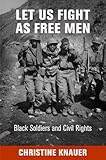
Christine Knauer. Let Us Fight as Free Men: Black Soldiers and Civil Rights. Philadelphia: University of Pennsylvania Press, 2014. 352 pp. $49.95 (cloth), ISBN 978-0-8122-4597-4.
Reviewed by Geoffrey Jensen (Embry-Riddle Aeronautical University, College of Security and Intelligence Studies)
Published on H-War (November, 2014)
Commissioned by Margaret Sankey (Air University)
Image is Everything
A recent entry in the University of Pennsylvania Press’ Politics and Culture in Modern America series, Christine Knauer’s Let Us Fight as Free Men delves into the post-World War II involvement of African American soldiers, citizens, and civil rights leaders in the establishment of an African American historical military heritage, racial integration of the armed forces, and the overall pursuit of racial equality. Her work differs from earlier works, those of Morris J. MacGregor, Bernard Nalty, and Richard Dalifume come to mind, that opt for a “top down” interpretation of the desegregation of the armed forces. There are certainly strengths to her “bottom up” approach as it offers a more nuanced understanding of the African American struggle throughout the first half of the twentieth century to achieve racial parity with whites--a struggle they believed their race could win by continuously sacrificing themselves in the nation’s conflicts. No less patriotic than their white counterparts, African Americans also committed themselves to the cause of the republic in the hope for a better and more equitable tomorrow.
For the better part of the twentieth century, however, the Jim Crow military funneled black soldiers into noncombat support units. The emasculation of black men by white military leadership that segregation from battle and white soldiers caused aided and abetted the racial status quo of the era. Not only did it purloin their masculinity, but it also limited greatly their ability, as a race, to prove themselves to their white counterparts. This proved problematic. As noted, African American soldiers believed that for their race to successfully challenge preconceived racist notions held by the white community, they had to serve in combat, not the motor pool.
The inability to serve equally with whites in battle along with the dismal coverage white newspapers and the War Department afforded their race’s efforts precipitated a rise in insecurity within the African American community. The African American press corps as a result demonstrated a propensity to exaggerate the contributions of all-black support units during the war, Knauer observes. At other times, this sensitivity contributed to a sharp and vocal cacophony of reprisal towards those whose comments threatened the character and image of the African American soldier. Friend or foe, none were sparred. For example, the African American press corps, along with civil rights leaders, decried Truman Gibson’s, an African American aide to the War Department, tough-minded but fair observations of the struggles of the 92nd All-Black Infantry Division, which encountered difficulties while fighting the Nazis in Italy. In their hearts and minds, and importantly in their public observations, his comments amounted to nothing more than the treacherous ramblings of an “Uncle Tom.” Their concern, of course, was that his commentary as an African American male representing the War Department justified the cause of southern segregationists, who would use his statements against his race’s efforts to serve in more combat units in the military. Worse, those words could derail the larger effort for equality.
After the war, this sensitivity only heightened as members of the civil rights leadership and press repeatedly reacted toward statements or failed actions that threatened the image of African American personnel, which as a byproduct, stymied the integration of the military. Examples of this throughout Knauer’s work include, but are not limited to, the aforementioned statements of Truman Gibson about the 92nd All-Black Infantry Division; the ambiguity of the wording of Executive Order 9981; and what was perceived to be the slight of African American masculinity brought about by President Harry S. Truman’s comments about Lt. Leon Gilbert, a black soldier in Korea accused of cowardice in the line of duty.
Let Us Fight As Free Men notes that this behavior also encouraged the African American community, the press in particular, to defend and maintain their military heritage. Through weekly series in newspapers, articles in journals, and even an academic conference, they waged a tireless campaign to preserve the honor and prestige of past African American military veterans—especially the service of black veterans of World War II. Throughout this endeavor, the black press faced a cunning foe in white ambivalence and ignorance to their race’s military record. The underrepresentation of African American personnel, as Knauer demonstrates, in Life’s Picture History of World War II (1950), proved especially galling to those fighting to keep their race’s military history contributions relevant.
As frustrations mounted and time passed, consensus within the black community concerning how to proceed on military service and desegregation of the armed forces proved elusive. The possibility of alternative methods to achieve reform, therefore, emerged. A venerable advocate of racial desegregation of the military, A. P. Randolph, the longtime head of the Brotherhood of Sleeping Car Porters, appreciated the intrinsic value of equal military service to the bolstering of the African American psyche, but also to the pursuit of the end of racial discrimination in the country. At times, his methods, anchored in the Gandhian philosophy of nonviolent protest, however, did not seamlessly mesh with the pre-existing Weltanschauung of his race as it applied to the importance of black service and sacrifice. Indeed, it was a direct contradiction to it. Randolph, in a reversal of strategy, often used gender-based rhetoric to prod male members of his race to reject segregated military service and embrace his nonviolent and confrontational philosophy that he believed would force a solution to the matter sooner rather than later. In other words, an African American male was not a “man” per se by fighting and dying for a segregated army; instead, he was a “man” if he objected to the offensive nature of Jim Crow.
Interesting studies, such as this one, have a knack for creating more questions for readers than they can answer. As I read Christine Knauer’s work, I pondered the issue of African American sensitivity to their public image throughout the era. When the community lashed back at its real critics (southern segregationists and at times, the War Department), and imagined (Truman Gibson and Harry S. Truman), it was out of a desire to protect their race’s image and future. Failure to do so was tantamount to capitulation to over two centuries of racial stereotyping. It was also about a growing frustration with the gradual nature of white liberal reformers' efforts to help their cause. To be sure, white reformers remained sympathetic, but did not or could not always drive the issue onward with the same urgency that blacks did. Political agendas, social obstacles, whether self-imposed or the result of cultural norms or both, and the inability to build a consensus in Congress often betrayed their efforts. What whites may have plausibly chalked up to the nature of the system, or simply stated as the nature of “politics,” was anathema to their African American counterparts, who felt enormous political, but more importantly, social pressure from their own race to achieve success; especially on such matters as the integration of the armed forces, which many blacks believed was the lynchpin to undoing racial segregation throughout the country.
While none of this is particularly revolutionary in our understanding of the civil rights struggle, military and civilian alike, it remains a point of historical contention in our continuing historical reclamation of the subject. It is one that Knauer wades fully into as she examines from “the bottom up” the exasperating nature of the black struggle for equality in the military. What is sometimes lost in all of this is the reality that these struggles were often equally vexing for those whites in and outside of the federal government who sought the same goals as their African American allies. For reasons that are her own, she examines solely the era of World War II to the end of the Korean conflict; this breakdown in communication and perhaps understanding of both sides' point of view, though, was a problem throughout the rest of the twentieth century. I believe she would agree that it indeed continues in some aspects to this very day.
Her discussion of the importance of historical preservation of black military service, reminds us that it remains far too simplistic for those that study this field to home in solely on the importance of equal opportunity in combat to African Americans. There is no doubt that within the African American community great pride and hope was heaped bountifully on the idea of earning a badge of honor from combat that whites could never remove. I am no longer sure, though, that that was enough for a prideful and desperate people who continuously sought proof of their valor and worthiness. When one examines the record of either the Tuskegee Airmen or the 761st All-Black Tank Battalion, both of which are largely overlooked in this volume, it becomes clear that it was not enough. For these men, and others, they believed they had to perform in an exemplary fashion. From preventive maintenance of equipment, to the quality of their uniforms, how they dealt with racial persecution, and certainly their behavior in the combat zone, they understood implicitly that they had to be consistently better than their white counterparts. It was not enough for them to be equal; they had to be better. I believe a discussion of this psychological dynamic would only strengthen her study.
Though I greatly enjoyed Let Us Fight As Free Men, I disagree with the author’s assessment of Harry Truman. Historically, he is considered an important part of the eventual integration of the armed forces, but here he is rendered at best, “cautious”; at worst, she condemns him as “ambivalent” and suggests that “his actions often lagged behind his words” (p. 53). Although she concedes that Truman “managed to create an atmosphere of change that could support the betterment of race relations,” she is of the opinion that it did not matter, as “it did not result in decisive and far-reaching actions on behalf of black equal rights.” To be fair, I do not believe that Knauer finds Truman to be totally unsympathetic, but perhaps a bit too political in his pursuit of election, in his own right, to the presidency. Truman biographers Alonzo Hamby and David McCullough,would certainly agree that the president was cognizant, as was his main consul, Clark Clifford, of the power of the black vote to propel him in 1948 over Thomas Dewey.[1]
Although we should avoid hyperbole when evaluating Truman’s role in it, racial integration of the military, I believe, proved to be the most enduring and perhaps his greatest domestic accomplishment. It must be remembered, as noted by historians Morris J. MacGregor and Bernard Nalty, that although Executive Order 9981 did not directly call for immediate integration, largely as a result of political calculations during an election year, Truman not only reaffirmed his commitment shortly after he was called out by the black press on the issue, but also created a committee, led by Charles Fahy, that worked to achieve that result. Racial integration was not the sprint that all hoped it would be; it was a grueling and admittedly frustrating marathon. To expect it, or the executive proclamation that ordered it, to have been anything else in the mid-twentieth century is groundless and unrealistic. And yet, there were indeed immediate results. The Fahy Committee, with the unwavering support of Secretary Stuart Symington of the newly formed Air Force, began the process of integrating his branch, while racial reforms in the Navy, an organization that had long relied on African Americans, but often did so in a demeaning fashion, began to weed out problems throughout its ranks, especially in the troublesome Stewards Branch. Korea, as Knauer notes, was important to driving integration home in the reticent Army and Marine Corps, but as demonstrated, the wheel of change, though slow, was turning before boots were on the frigid ground of the peninsula. Though Truman was not always active in all of this, he was not an absentee figure, either. The president’s order, his involvement with the Fahy Committee, his defending of the Marshall investigation in Korea, and his ultimate removal of MacArthur, in their own ways solidified his stance on integration and its continuance.[2]
This does not mean Truman’s sagacious political approach to integration does not warrant criticism—I certainly believe it does. Nor can we can afford to ignore the African American citizen’s contribution, whether it be that of “top of the bottom” players such as A. P. Randolph, Grant Reynolds, or Walter White, which Knauer’s study readily employs, or of average black soldiers, sailors, airmen, and Marines, whose struggles and triumphs drove the elite and powerful in their community to demand for more.
What I contend that Knauer has missed is Truman’s dogged belief in the Constitution, something on display in his biographers', including David McCullough, Alonzo Hamby, and Jonathan Daniels, past treatments of the president. It, along with foreign policy concerns during the Cold War, presidential electoral politics, and, I would add, his appreciation for military service, reside at the heart of his actions toward African American personnel from his time as a state senator all the way through his time as a retired statesmen. In 1956, during the Democratic National Committee, Truman-turned-campaigner addressed the Platform and Resolutions Committee, spending several minutes lecturing his party, a party still largely of the South, on the merits of carrying out the Reconstruction-era Fourteenth Amendment, something they largely loathed, but he still believed was “a part of the fundamental law of the land, and it has not been enforced.” He finished his lecture with the importance of “To Secure These Rights,” the report of his Committee on Civil Rights investigation into racial persecution within the United States. “It would do you good to get it [“To Secure These Rights”] and read it. You would find out then that all these proceedings which have taken place, including the decision of the Supreme Court [Brown], about which there is so much controversy, was only an enforcement of the law which has been a part of the fundamental and basic law of this United States since the late 1860’s.” Truman was never the greatest orator or champion for civil rights or for social equality—the latter he struggled with throughout his life as he wondered if anyone could truly legislate the issue—but he remained an advocate for political and economic equality before the law. It motivated him to act, to create committees, and become involved when necessary to continue progress, and he did so before, during, and after his presidency.[3]
Christine Knauer has produced an excellent work that invites readers to grapple at a far deeper level with the obstructions, internal conflicts, disappointments, and victories of an African American community seeking masculinity for its male population, the promotion of their own historical military legacy, and citizenship through military service. It is also an important contribution to the larger historiographical discussion over the integration of the armed forces, a subject, and this is no fault of the author or the goal of her entry, that desperately needs balance.
Notes
[1] See also Knauer, Let Us Fight, 112-113, 121.
[2]. For further examination, see Michael Gardner, Harry Truman and Civil Rights: Moral Courage and Political Risks (Carbondale: Southern Illinois University Press, 2002); Bernard Nalty, Strength For the Fight (New York: The Free Press, 1986); Richard Dalifume, Desegregation of the United States Armed Forces: Fighting on Two Fronts, 1939-1953 (Columbia: University of Missouri Press, 1969); Juan Williams, Thurgood Marshall: American Revolutionary (New York: Three Rivers Press, 1998); and perhaps still the most informative volume on the racial integration of the armed forces, Morris J. MacGregor’s Integration of the Armed Forces: 1940-1965 (Washington, DC: Center of Military History, 1981).
[3]. The most prominent biographies of Truman offer clues into his desire to carry integration out. For more, see David McCullough, Truman (New York: Simon and Schuster, 1993); Jonathan Daniels, The Man of Independence (Columbia: University of Missouri Press, 1998); and Alonzo Hamby, The Man of the People (New York: Oxford University Press, 1995). The president’s comments come from Harry S. Truman, “Address of Former President Harry S. Truman Before the Committee on Platform and Resolutions of the Democratic Nation Convention, 1956,” 7-13, available online at http://www.trumanlibrary.org/whistlestop/study_collections/politicalcampaigns/documents/index.php?documentdate=1956-08-00&documentid=12-3&pagenumber=1.
If there is additional discussion of this review, you may access it through the network, at: https://networks.h-net.org/h-war.
Citation:
Geoffrey Jensen. Review of Knauer, Christine, Let Us Fight as Free Men: Black Soldiers and Civil Rights.
H-War, H-Net Reviews.
November, 2014.
URL: http://www.h-net.org/reviews/showrev.php?id=42375
 | This work is licensed under a Creative Commons Attribution-Noncommercial-No Derivative Works 3.0 United States License. |

