



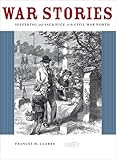
Frances M. Clarke. War Stories: Suffering and Sacrifice in the Civil War North. Chicago: University of Chicago Press, 2011. xiv + 251 pp. $35.00 (cloth), ISBN 978-0-226-10862-9.
Reviewed by Lindsey Peterson (University of South Dakota)
Published on H-War (January, 2015)
Commissioned by Margaret Sankey (Air University)
Frances M. Clarke studies the optimistic tales of suffering told by Northerners during the American Civil War in her book War Stories: Suffering and Sacrifice in the Civil War North. Traditionally Civil War scholarship has broken down patriotic accounts of the war and its brave participants to reveal the war’s inglorious and divisive nature. However, these works have failed to appreciate how Northern tales of exemplary suffering reflected notions of ideal loyalty. Model patriots during the war were those who sacrificed self-interest “in order to uphold the democratic republican system either by suffering on behalf of the nation or by tending to those who suffered” (p. 26). During the Victorian era, suffering was considered essential to growth and moral development, and tales of suffering were crucial to Northerners’ understanding and defense of the Union cause during the war and the postwar years.
During the war, Northerners viewed suffering as a mark of one’s moral fiber, religious faith, and national character, according to Clarke. Influenced by idealistic wartime stories about suffering, soldiers sought to express their sacrifices in genial terms. Clarke analyzed the letters between Nathaniel Bowditch, an enlistee of the First Massachusetts Cavalry Regiment, and his family back home, and they, like many Northerners, believed that soldiers who suffered properly embodied the Union cause. Soldiers were encouraged to keep the Union, God, and home at the forefront of their minds, and voluntary organizations, such as the United States Sanitary Commission, were central to properly responding to sufferers.
In the immediate postwar era, Northerners defended their cause, and thus democracy, to Southerners, the British, and the French by stressing the North’s response to suffering as “uniquely compassionate and resourceful” (p. 115). They saw soldiers’ cheerful responses to their sacrifices and widespread volunteerism in the North as evidence of their civic commitment and strength of character. No one embodied the cause more, according to Clarke, than Union amputees. Relying on William Bourne’s collection of almost four hundred manuscripts authored by Union amputees, Clarke found that soldiers’ wounds served as evidence of their service, affirmed their masculinity, and demanded grateful remembrance, but did not raise antiwar sentiment. Northerners maintained that their positive response to suffering served as evidence that they had emerged from the war as a more “united, virtuous, and religious citizenry” (p. 141).
Suffering during the Civil War was central to Northerners’ understanding of their wartime and postwar loyalty and patriotism, but at the close of the nineteenth century, religious fervor waned and Northerners’ understanding of suffering had changed. War stories began to celebrate rugged soldiers and physicality over the exemplary sufferer. Clarke’s work on suffering and war stories iis well researched and based extensively on primary materials, including numerous manuscript collections from soldiers and veterans. Clarke re-approaches the way Northerners encountered suffering during the war, and War Stories will appeal to historians of military history, the American Civil War, and gender and women’s history alike.
If there is additional discussion of this review, you may access it through the network, at: https://networks.h-net.org/h-war.
Citation:
Lindsey Peterson. Review of Clarke, Frances M., War Stories: Suffering and Sacrifice in the Civil War North.
H-War, H-Net Reviews.
January, 2015.
URL: http://www.h-net.org/reviews/showrev.php?id=42372
 | This work is licensed under a Creative Commons Attribution-Noncommercial-No Derivative Works 3.0 United States License. |

