

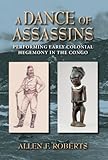
Allen F. Roberts. A Dance of Assassins: Performing Early Colonial Hegemony in the Congo. Bloomington: Indiana University Press, 2013. 311 pp. $85.00 (cloth), ISBN 978-0-253-00743-8; $30.00 (paper), ISBN 978-0-253-00750-6.
Reviewed by Prita Meier (Clark Institute)
Published on H-AfrArts (January, 2015)
Commissioned by Jean M. Borgatti (Clark Univeristy)
The Poetics of Mediation: Between Event and Representation in the Making of African Histories
Allen F. Roberts’s A Dance of Assassins: Performing Early Colonial Hegemony in the Congo, winner of the 2013 Arnold Rubin Prize and a finalist for the 2014 Herskovitz Award, is a deeply engaging account of the complex struggles that connected the lives of Europeans and Africans in the earliest days of the colonial encounter in what is now the Democratic Republic of the Congo (DRC). Elegantly written, this book challenges prevailing thinking about colonization and its effects on Africans and Europeans. Rather than give us a macro history of colonial machinations and the resistance of the would-be “colonized,” Roberts focuses on how specific individuals—including Africans, Arabs, and Europeans— shaped and might have shaped the momentous clashes and socioeconomic revolutions that transformed daily life in central Africa (and Europe) from the 1870s onward.
What separates Roberts’s approach from other Africanist historical ethnographies is his dedication to exploring the “[w]hat-ifs and might-have-beens” of this period and their aftereffects in the present (p. 7). That is, while A Dance of Assassins is informed by almost four years of fieldwork in the DRC and deep archival research, Roberts also considers a range of logical possibilities, or how things might have happened, what they might have meant, and what they might mean in the future. In doing so he shows us how a speculative method can move us beyond conventional ways of interpreting the lives of people in distant times and places. In that sense the book is an analysis of the contradictions and limits of historical interpretation. That is not to say that Roberts simply embraces the postmodernist truism that all knowledge is discursive and constructed. Instead, his account, following the work of James Clifford, John Comaroff, Johannes Fabian, and historian Luise White, challenges readers to ponder how social life engenders, but also sometimes escapes translation and representation.
To explain how silence can become poetry and how the invisible can be made visible, Roberts focuses on the ways in which different visual, performance, and narrative media produce competing representations of one singularly dramatic event: the beheading of the Tabwa warlord Lusinga lwa Ng’ombe by men loyal to the Belgian military official Émile Storms in 1884. Roberts contrasts the basic “facts” of the event—gleaned from written records—to oral narratives provided to him in the 1970s by two Congolese elders named Louis Mulilo and Kizumina Kabulo.
As Roberts explains in his introduction, he deploys “indigenous historiology,” or Congolese oral literatures called milandu and bulozi, as his key interpretive tools for analyzing the memories, artifacts, and records linked to Luzinga’s beheading (p. 8). Both are narrative forms that emphasize the performative and situational nature of knowledge production. In fact, the deadly confrontation between Storms and Luzinga becomes a “dance of assassins” because in Kizumina’s retelling, the incident was very much about a spectacular dance performance that made Luzinga lose his head, figuratively and literally. Considering the beheading and its repercussions through the lens of milandu and bulozi also gives Roberts the opportunity to explore his interest in Tabwa esoterica, since both often focus on cosmological and supernatural matters.
Although from seemingly different backgrounds, Lusinga and Storms had much in common and both believed their ambitions for great wealth, fame, and power would come to fruition in Lubanda, which is located on the southwestern shores of Lake Taganyika. After participating in a ceremony together in 1883 they quickly became bitter enemies because each saw the other as a threat to his authority in the region. For several months “both play[ed] much the same game by many of the same rules” to establish their mini empires in or around Lubanda (p. 21). Both employed a small army of rugaruga, young men who became mercenaries after escaping slavery or war, to do their bidding. Lusinga used them to enslave and brutalize locals and Storms employed them to build a huge fortress and to control the local community through acts of violence, including enslavement. But before long Storms began to work on realizing his dream of attacking Lusinga. That dream became reality in December 1884, when his mercenaries presented him with Lusinga’s severed head and a beautiful sculpture of a male warrior that embodied Lusinga’s life and ancestral matrilineage.
Storms’s other aspiration, to become famous in Europe as a commander of one of King Léopold’s many self-serving colonialist ventures, was never realized. He was already ordered to return to Brussels in 1885, where he quickly slid into obscurity. His only lasting and rather ignominious legacy was that he absconded from Lubanda with Lusinga’s cranium and ancestral figure. By the 1930s both came into the collection of what is now the Royal Museum of Central Africa, where they continue to tell new stories which might inspire locals to reflect on their history of ruthless colonization. (The skull was transferred, along with 650 other human crania, to the Royal Institute of Natural Sciences in 1964).
Throughout the book Roberts interweaves the life histories of Storms and Lusinga with the many afterlives of Lusinga’s skull and sculpture, creating a “contrapuntal” interpretation of the past (p. 144). We therefore learn much about why the sculpture and the skull quickly became more important historical figures than Lusinga and Storms themselves. In Brussels both objects played key roles in the making of Belgian national identity, bourgeois aesthetics, and the disciplines of medicine, anthropology, and art history. The chapters on the “social life” of Lusinga’s remains in Belgium are as richly detailed and masterfully analyzed as those that focus on the DRC. Roberts’s account of the Congolese side of things is characterized by a poignant sensitivity to the complexity of life in Lubanda, where the meanings of the skull and sculpture are constituted by their absence. For Roberts this lack acts as a catalyst for a series of exegeses on how as political and religious objects they would have embodied and distributed the “personhood” of Lusinga, his ancestors, and his descendants in a series of religious ceremonies (p. 204).
In the process of examining the many meanings of interlinked events, artifacts, and lives, A Dance of Assassins becomes a remarkable portrait of places in Africa that are often dismissed as remote and irrelevant. This book argues that it is precisely such seemingly peripheral locales as Lubanda that illustrate the ambiguous and explosive potential of intercultural negotiation during the age of global empire making.
In sum, Roberts shifts our vision of the past by creating surprising juxtapositions between the colonial library and Congolese oral narratives. A Dance of Assassins does not follow the linear logic of normative history, but shows us the absurdity, tragedy, and beauty of lived experience in times of unprecedented change and upheaval. Roberts reminds us that the histories we do know and see are only partial images, narratives, and performances and that many more events are simply not considered because they are not recognized as significant. Creating alternative histories, then, is not only about finding forgotten archives or interviewing more elders. Instead, we must be attuned to the complexity of the interpretive process itself and explore how form—whether visual, narrative, or performative—mediates sensory and affective experience.
If there is additional discussion of this review, you may access it through the network, at: https://networks.h-net.org/h-afrarts.
Citation:
Prita Meier. Review of Roberts, Allen F., A Dance of Assassins: Performing Early Colonial Hegemony in the Congo.
H-AfrArts, H-Net Reviews.
January, 2015.
URL: http://www.h-net.org/reviews/showrev.php?id=42368
 | This work is licensed under a Creative Commons Attribution-Noncommercial-No Derivative Works 3.0 United States License. |

