



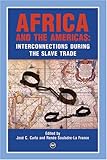
Jose C. Curto, Renee Soulodre-La France, eds. Africa and the Americas: Interconnections during the Slave Trade. Trenton: Africa World Press, 2004. 312 pp. $29.95 (paper), ISBN 978-1-59221-272-9.
Reviewed by Jelmer Vos (National Institute for the Study of Dutch Slavery and its Legacy (NiNsee), Amsterdam)
Published on H-Luso-Africa (August, 2014)
Commissioned by Philip J. Havik (Instituto de Higiene e Medicina Tropical (IHMT))
Circuitous Connections Cut Short
This book, a collection of essays from a conference held at York University in October 2000, sets out to shed new light on the interconnections between Africa and the Americas that grew out of the transatlantic slave trade and were fundamental to the shaping of the Atlantic world. As the editors, José Curto and Renée Soulodre-La France, point out in the introduction, the relationship between Africa and the Americas in the three centuries before 1850 was not constituted solely by a unidirectional traffic of black slaves from the Old to the New World. Another key element in the formation of the Atlantic world was a continuous back-and-forth contact between the economies and cultures of the regions connected through the slave trade.
Highlighting the "interactive linkages" (p. 3)--alternatively called "circuitous exchanges" (p. 5) or "circuitous linkages" (p. 7)--between Africa and the Americas during the Atlantic slave trade, the editors claim this collection to be the latest contribution to a "new paradigm" (p. 3) in the study of the African Diaspora. But regardless of the quality of the individual contributions, I fear that the editors have overrated their assemblage. First, the volume lacks the clear geographical focus that has, at least to a large extent, accounted for the strength of similar collections.[1] On the American side the emphasis is on Brazil, which is justified by the fact that in the history of the slave trade Brazil received by far the largest number of African slaves of all American regions (about 45 percent of the 10.7 million slaves disembarked in the Americas). But Spanish America and the Caribbean are also included, while on the African side the regions range all the way from West to East Africa. Furthermore, only two of the twelve chapters assembled here (those by Soumonni and Capela) deal with influences from the Americas on Africa. Two other contributions (Dale Graden's chapter on the collective action of slaves in the port of Bahia in the mid-nineteenth century and João Reis's detailed analysis of the late nineteenth-century organization of Bahian street laborers in work groups called "cantos") do not really tackle the connection theme at all. The editors claim that all chapters together make "a well-balanced volume on the circuitous linkages between Africa and the Americas" (p. 7) and that with this collection the "new paradigm" in African Diaspora studies "begins to reach its logical conclusion" (p. 3). This reader was rather struck by its lack of unity and purpose.
David Eltis, Stephen Behrendt and David Richardson open the volume with a comparison of the transatlantic slave trade along national lines, building on data provided by the Trans-Atlantic Slave Trade Database published in 1999.[2] Their quantitative analysis is meant to serve as a background for the chapters that follow, although almost none of the latter actually refer to it. In the five years after this paper was presented at York University extensive new research has been carried out to expand the 1999 database. This has resulted in the addition of approximately 7,500 voyages to the 27,233 originally collected, the majority of which were undertaken under Iberian and Brazilian flags. The new information has brought Bahia and Rio de Janeiro to the fore as the leading ports in the history of the Atlantic slave trade and underlined West-Central Africa's position as the largest slave-supplying region.[3] Most of the new data was already at hand by the time this book went into press and it is unfortunate that none of it has been incorporated, as that would almost certainly have strengthened the book's focus on Brazil.
The majority of the remaining articles deal in one way or another with the impact of African cultures on social formations in the Americas. Edward Alpers draws the reader's attention to the process of creolization that led many slaves in Brazil of different East African origins to adopt the "nationality" of "Moçambiques." It must be said, though, that his contribution is more a search for the "specific East African origins of these bonded Brazilians" (p. 49) than an analysis of how the experience of enslavement, both in Africa and Brazil, resulted in the self-identification of people from different ethnic backgrounds as "Moçambiques." Luis Nicolau Parés examines elements of the vodun tradition from the Bight of Benin that were introduced in Bahia by Jeje slaves in the late eighteenth and early nineteenth centuries and became fundamental to the development of the Candomblé religious institution. In a comparative study of religious brotherhoods in Pernambuco, Minas Gerais and Rio de Janeiro, Elizabeth Kiddy tries to capture particularly African influences on community formations in Brazil. Jane Landers does the same in relation to the formation of maroon societies in Spanish America and Brazil. Both Kiddy and Landers commit the error, however, of trying to understand the cultural principles underlying the organization of social life in Africa through concepts so general that they lose all explanatory power, such as African societies' presumed hierarchical nature. Monica Schuler explores African Diaspora accounts of astral and aquatic journeys, with particular attention to the role that the Atlantic slave trade has played in spiritual discourses of various Diaspora groups. Among her most interesting finds are the parallels drawn by African slaves and their descendants between initiation ordeals and the historical experience of the middle passage, which has often been interpreted as a magical passage between the worlds of the living and the dead. Finally, Terry Rey focuses on the impact of Kongolese "root experiences" on religious prophecy in the Haitian revolution, repeating a point made earlier by himself and others about the importance of Kongolese Catholicism in the development of both Voudou and popular Haitian Catholicism.[4]
All these contributions deal with transatlantic connections in unidirectional fashion, with the current flowing from the Old World to the New. In Elisée Soumonni and José Capela the volume has two authors who focus on the flow of people and ideas back and forth across the Atlantic. Soumonni looks at how ex- slaves from Brazil who returned to West Africa in the 1830s integrated in Lagos and Ouidah and compares their situation with that of liberated Africans from Sierra Leone. For the African returnees from Brazil Ouidah provided a more familiar environment than Lagos, largely because it was already home to a significant Brazilian community. In particular Francisco Felix de Souza, a notable nineteenth-century slave trader, facilitated the integration of the so- called Agudas, many of whom, paradoxically, ended up working in the illegal slave trade business. Liberated Africans from Sierra Leone, known as Saros, fared better in Lagos. Most of them were of Yoruba origin, an identity they had cultivated while being housed in villages outside Freetown after their rescue from captured slave ships. This common identity helped the Saros to recreate their lives in Lagos, where some even managed to renew old family ties. For the British they were also, unlike the Agudas, reliable agents in the projected transition to a new social order in West Africa. Soumonni furthermore gives the traditional perspective on religious transformation in the African Diaspora a new twist by showing how a religion brought to and developed in the Americas by black slaves traveled back to the African continent. Many of the African-Brazilian returnees came from Bahia in the aftermath of the 1835 Muslim rebellion. Soumonni argues that the tolerant and accommodating nature of the Islamic faith in Bahia facilitated the integration of the Agudas in West African society, where they had to live alongside people of Christian and African beliefs.[5]
Turning away from the main subjects of the transatlantic slave trade, José Capela traces the spread of liberal ideologies among the commercial and political elite in Mozambique as a result of the traffic. Previously oriented almost exclusively to the Indian Ocean, Mozambique was opened up to Atlantic markets by French slave traders around 1770 and subsequently became a supplier of slaves to Brazil as well as Spanish America. Foreign slave traders, especially from Rio de Janeiro, brought revolutionary ideas from France and Portugal to Mozambique, which supported the local elite in its struggle for independence from the Lisbon metropolis. Particularly interesting is Capela's focus on freemason societies in which slave-trading elites organized to oppose the Portuguese abolition of the slave trade in 1836 and promote the annexation by Brazil of both Angola and Mozambique.
In the concluding essay, Kriger makes a plea for the writing of "culture histories" in Africa as part of wider program to integrate Africa more fully in the study of the Atlantic world. In order to study cultural transformation as an historical process, Kriger argues culture has to be detached from its social carriers and distinguished from language and ethnicity. She finds inspiration in the "encounter model" developed by Mintz and Price for the study of creolization in New World plantation societies.[6] This model accounts for the different institutional contexts of cultural change and thus provides "units of analysis that are more useful than population numbers, ethnic identities, and their movements" (p. 270). What this actually means in the context of African historiography is not very clear as, unfortunately, the points of reference in Kriger's argument largely come from the literature on the African Diaspora. Here her point that cultural history should not be confounded "with demographic trends and patterns" (p. 262) seems valid, however.
The volume would have been stronger if it had paid more attention to American influences on Africa and had a clearer geographical focus. On the American side it could have concentrated exclusively on Brazil, for example. It could also have done with a better editorial check of the chapters, many of which show errors of punctuation. But to end on a positive note, the volume has an extensive bibliography and almost all the contributors have relied on primary sources. Thus researchers with similar interests might be stimulated to consult particular chapters in search of ideas and useful references.
Notes
[1]. See, for example, Matt D. Childs and Toyin Falola, eds., The Yoruba Diaspora in the Atlantic World (Bloomington: Indiana University Press, 2005); Linda Heywood, ed., Central Africans and Cultural Transformations in the American Diaspora (Cambridge: Cambridge University Press, 2002); and Kristin Mann and Edna G. Bay, eds., Rethinking the African Diaspora: The Making of a Black Atlantic World in the Bight of Benin and Brazil (London: Frank Cass, 2001).
[2]. David Eltis et al., The Trans-Atlantic Slave Trade: A Database on CD- ROM (Cambridge: Cambridge University Press, 1999).
[3]. David Eltis and David Richardson, eds., The Transatlantic Slave Trade: Toward a New Census and Fresh Perspectives (forthcoming), introduction.
[4]. John Thornton, "'I Am the Subject of the King of Kongo': African Political Ideology and the Haitian Revolution," Journal of World History, 4 (1993): pp. 181-214; Hein Vanhee, "Central African Popular Christianity and the Making of Haitian Vodou Religion," in Central Africans and Cultural Transformations, 243-264; and Terry Rey, "A Consideration of Kongolese Catholic Influences on Haitian Popular Catholicism," in ibid., 265-285.
[5]. See also Elisée Soumonni, "Some Reflections on the Brazilian Legacy in Dahomey," in Rethinking the African Diaspora, 61-71; and Olabiyi Babalola Yai, "The Identity, Contributions, and Ideology of the Aguda (Afro-Brazilians) of the Gulf of Benin: A Reinterpretation," in ibid., 72-82.
[6]. Sidney W. Mintz and Richard Price, The Birth of African-American Culture: An Anthropological Perspective (Boston: Beacon Press, 1992).
If there is additional discussion of this review, you may access it through the network, at: https://networks.h-net.org/h-luso-africa.
Citation:
Jelmer Vos. Review of Curto, Jose C.; Soulodre-La France, Renee, eds., Africa and the Americas: Interconnections during the Slave Trade.
H-Luso-Africa, H-Net Reviews.
August, 2014.
URL: http://www.h-net.org/reviews/showrev.php?id=42362
 | This work is licensed under a Creative Commons Attribution-Noncommercial-No Derivative Works 3.0 United States License. |

