

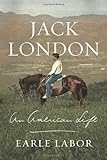
Earle Labor. Jack London: An American Life. New York: Farrar, Straus & Giroux, 2013. 480 pp. $30.00 (cloth), ISBN 978-0-374-17848-2.
Reviewed by James Baugess
Published on H-Socialisms (April, 2015)
Commissioned by Gary Roth (Rutgers University - Newark)
There is no doubt that Jack London is one of the most-read authors in the canon of American literature—especially in high schools and colleges across the United States. Many a youngster has read with angst and wonder London’s short story “To Build a Fire” (1902), and gripped with pleasure and rapidly beating hearts the novels White Fang (1906) and The Call of the Wild (1903). A man of letters who produced prose that has excited readers for over one hundred years is worthy of close examination. Earle Labor, London’s biographer, has captured the essence of London’s short, albeit fascinating, American life.
The highlights of London’s early life are well known: his questionable paternity, his hardscrabble life, his willingness to solve problems with his fists, and his troubled (and ultimately) failed first marriage. He lived a life of excitement, high adventure, and danger. Though Theodore Roosevelt did not always approve of London’s worldview, he praised London’s work. Nevertheless, London lived to the fullest his short forty years of existence.
Labor stands as the acknowledged major authority on the novelist, and has the credentials and publications to merit the assertion. Labor serves as the curator of the Jack London Museum and Research Center in Shreveport, Louisiana, and he is Emeritus Professor of American Literature at Centenary College in Louisiana. Labor has given a life of study and research to London and his era, and his skill in constructing his narrative reveals his expertise and love for his subject. This work is not his first on London. For Twayne’s US Author series, he wrote Jack London (1974) and published a revised edition, which he subsequently co-wrote with Jeanne Campbell Reesman (1994). The author knows his subject.
Labor, like many young boys, became enamored with the literary work of London while in the seventh grade in Oklahoma. He experienced further exposure to London during his undergraduate education, and again when he read Martin Eden (1909) during his naval shore leave in 1948; therefore, this current work is the product of decades of interest and study. Labor wrote his most recent biography of London to set the record straight about all the negative caricatures of London as a drunk, drug addict, brawler, and womanizer, among other sensational faults, that Labor sees as mostly myth. Even so, the previous interpretations of London’s life are not entirely myth, as Labor reveals throughout his work. Some of these views on London's life and character reflect what London himself wanted others to think in reference to his persona. Labor conceded that “London’s vigorous self-promotion was responsible for many of these distortions, and his sensational exploits made him a magnet for the tabloid newspapers” (p. xi). Labor thinks that London was much more complex and that there were logical reasons for his flamboyant behavior: “beneath this persona, however, was a different Jack London: hypersensitive, contentious, moody (possibly bipolar), and mostly medically frail despite his vigorous muscularity” (p. xii). After all, London spent his youth delivering papers, hauling ice, and setting up pins in bowling alleys; he became a “work-beast” in the dangerous factories of the Gilded Age, and later a prisoner. Out of these experiences his legend grew by “means of pluck, luck, and sheer determination,” and for his era, “London’s story is quintessentially American” (p. xii).
Labor enjoyed a relationship with London’s daughters, Joan and Becky, as well as with Anna Strunky’s daughter, with whom London fell in love in his early days. In addition, Labor used a collection of previously unpublished letters to London’s second wife, Charmian, that he acquired at an auction. Believing that accounts of London’s life lacked a complete portrayal of the man, and with additional sources at hand, he wrote this most recent biography because “the world of Jack London is still calling for a reliable account of his life story,” and as a result, “the present volume is a response to that call” (p. xvii). What Labor hoped to achieve was a biography that is “as accurate, fair, and balanced as I can make it, based upon more than a half century of serious study” (p. xviii). Only Labor’s readers can decide if he achieved his goal.
Despite Labor’s lofty goal, readers of H-Socialisms may not be as interested in London’s personal adventures and his stormy relationships with women as they are in his views and work on behalf of the socialist cause in America. London suffered many deprivations in his early years, working painfully long hours with little pay and few safety standards. He also spent time in jail and experienced severe setbacks in his health, adventures, work life, and personal relationships. By 1894, he was a socialist, due to the things he had observed and experienced. In “How I Became a Socialist” (1903), he wrote that he began to view his life as one at the bottom, or as part of what sociologists at the time called the “submerged tenth.” To rise in the world would require education, which he would use to promote socialism. The nation’s social and economic wrongs needed correction and he determined to preach the socialist gospel publicly at every opportunity.
London was a charter member of the Ruskin Club (a group of Oakland intellectuals, mostly socialists, more Fabian than Marxian), founded by Frederick Bamford in 1898, and soon began speaking at various socialist gatherings in the Bay Area. In an effort to supplement his income, he began an extensive speaking tour suggested to him by Upton Sinclair. When several prominent liberals, including Clarence Darrow and Charlotte Perkins Gillman, founded the Intercollegiate Socialist Society, “the ISS needed a president who was a dynamic model of liberal manhood”; hence, “Jack London in absentia, was elected unanimously” (p. 224). In Boston, “upon finishing his socialist sermon,” writes Labor, “the famous activist Mother Jones marched up the rostrum and, to the crowd’s delight planted kisses on both his cheeks” (p. 237). His receptions at Harvard and Yale were equally stimulating. Nevertheless, his relationships with various socialist groups were not always positive. When London published The Iron Heal in 1908, the response of the socialist press was cool at best. According to Labor, the Socialist Labor Party thought it set back the socialist cause, although Labor does not elaborate on their criticisms.
The image of socialists as racially progressive and enlightened does not hold for London. When asked to cover the world championship heavyweight bout between African American Jack Johnson and the former champion, James Jeffries, he took the assignment for one hundred dollars per day plus expenses. Labor suggests of London that, “like the rest of white America, he yearned to see the arrogant black man dethroned” (p. 306).
When Mexico unraveled during the revolutionary wave centered on Ricardo Flores Magón and Emilio Zapata, London’s sympathies were with the Mexican revolutionaries. Over the course of time, however, London’s sympathies took a right turn. This was especially evident in the early days of World War I. London wrote of the “mongrelized” mestizos who were bleeding Mexico dry and wreaking havoc on the land. Oddly enough, Labor interjects, “it was not London’s denigration of mestizos—nor his blatant Anglo-Saxon racism—that infuriated the socialists so much as London’s support of American intervention” (p. 350). The socialists also objected to “his endorsement of the capitalist spirit of enterprise and efficiency, and what they viewed as his subversion of the Marxist spirit of revolution.” For London, the only thing that could save Mexico was the “intervention of American military and industrial power.” “Jack’s split with the party was assured,” writes Labor, “when he came out openly in support of Britain and the Allies in the Great War.” Even more troubling to the Left was the fact that London “felt compelled to carry an automatic pistol to protect himself” (p. 306). His enthusiasm for the Socialist Party waned over time, and when one of his friends resigned from the party, he wrote that the party lacked fire and had lost sight of the class struggle. Despite his socialist sympathies, London was not averse to making big money when the opportunity arrived. On the same day as his resignation, he wrote to his daughters to ask if they liked the furs he had given them.
Despite the efforts of Labor to deny the effects of London’s earlier life on his middle years, his habits eventually destroyed him. The heavy smoking, hard drinking, and general neglect of his health took its toll. London was forty when he died. Jack London: An American Life ends rather abruptly, without a restatement or explanation of London’s literary and historical importance. Labor has attempted neither an in-depth analysis of London’s socialist ideals nor a literary biography or analysis of his writings; rather, the book is exactly what the subtitle promises.
H-Socialisms subscribers may find more about London’s socialist activities and ideas in Carolyn Johnson’s Jack London, American Radical? (1984). Nevertheless, Labor’s work will remain the definitive biography of London for at least a generation. Students and devotees of biography will find much of interest in this sweeping narrative of London as a man of letters who led, as Labor notes, a quintessentially American life.
If there is additional discussion of this review, you may access it through the network, at: https://networks.h-net.org/h-socialisms.
Citation:
James Baugess. Review of Labor, Earle, Jack London: An American Life.
H-Socialisms, H-Net Reviews.
April, 2015.
URL: http://www.h-net.org/reviews/showrev.php?id=42337
 | This work is licensed under a Creative Commons Attribution-Noncommercial-No Derivative Works 3.0 United States License. |

