

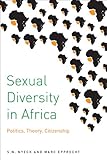
S. N. Nyeck, Marc Epprecht, eds. Sexual Diversity in Africa: Politics, Theory, and Citizenship. Montreal: McGill-Queen's University Press, 2013. 312 pp. $110.00 (cloth), ISBN 978-0-7735-4187-0; $32.95 (paper), ISBN 978-0-7735-4188-7.
Reviewed by Sarah Duff (University of the Witwatersrand)
Published on H-Histsex (April, 2016)
Commissioned by Chiara Beccalossi (University of Lincoln)
One of the most important strands running through the scholarship on sexuality in Africa has been homosexuality. Historians, anthropologists, sociologists, and others have demonstrated that same-sex sexual practices predate colonial conquest, have changed over time, and differ profoundly according to place and context. The editors of this volume succeed in proving that work on nonnormative sexual practices and identities in Africa remains urgent, while at the same time they ask new questions to reshape and redirect these scholarly investigations.
S. N. Nyeck and Marc Epprecht do this partly by including the work of younger scholars, especially those who are African, thereby countering the view that non-normative sexualities is "not a topic of particular interest to African intellectuals or a serious research priority but rather reflects a purely Western-driven agenda or elitist frivolity" (p. 5). The volume is the product of collaboration between activists and researchers; it was conceptualized initially at a workshop held at the launch of the International Resource Network for Africa (IRN-Africa) in Senegal in 2007. IRN-Africa—of which Nyeck is the coordinator—is a "platform to promote further comparative, intellectual, and critical understandings of the often-hidden roles that sexuality plays in shaping ideas and socio-political legal structures in Africa" (p. 4). It is this position—that "research on sexual minorities reveals hidden power dynamics in many spheres of social, political, and intellectual life that are of great concern to Africans, however they understand and express their sexuality or gender identity" (p. 5)—that informs the arguments threaded through this collection.
How do lesbian, gay, bisexual, transgender, and intersex (LGBTI) people view and claim citizenship in countries that promulgate homophobic legislation? How and why do various forms of nationalism still mobilize and condemn particular sexual practices and identities for political ends? How can LGBTI rights be claimed in states that emphasize group over individual rights? How can the experiences and lived realities of LGBTI Africans be reconciled with the aims and agendas of international lobbying groups and donors whose conceptualization of homosexuality differs profoundly from those on the continent?
These questions are raised and probed by the volume's editors and authors, and particularly in the book's opening section. Sexual Diversity in Africa is concerned largely with twenty-first-century Africa, with Epprecht's chapter—discussed below—focusing on a longer time frame, stretching back to the precolonial period. The book is divided into three parts, the first of which provides a framework and context for understanding the subsequent chapters. In "Human Rights Challenge in Africa: Sexual Minority Rights and the African Charter on Human and People's Rights," Olajide Akanji and Epprecht examine the position of minority sexual rights in Africa, in a context where, nationally, group rights often take precedence to those of the individual. Although internationally legislation and policy have moved increasingly to recognize the rights of LGBTI people, these have either been opposed or ignored by African states. For instance, of the six African states that signed the United Nations (UN) General Assembly Declaration on Sexual Orientations and Gender Identity in 2008 (more have subsequently become signatories since then), only South Africa enacted legislation specifically to protect the rights of LGBTI people. The problem with the declaration is that it is nonbinding—and some African nations signed it specifically to ensure a continued flow of aid money. The "bedrock" of the African human rights system, the African (Banjul) Charter on Human and People's Rights (1986), still makes no mention of the rights of sexual minorities (p. 28). How, then, should LGBTI people claim rights in African countries, when, as several chapters in this collection demonstrate, governments identify homosexual people as specific dangers to the stability of the state and to society?
Akanji and Epprecht remain, though, hopeful that a push for recognizing LGBTI rights will become stronger, particularly with the assistance of the African Union and its peer review mechanism. I do not share the authors' optimism—and especially their view that South Africa would be willing to criticize Zimbabwe's persecution of LGBTI people in public. But I do think their point that LGBTI people do not necessarily see themselves as a coherent group—even if some have emerged in activist organizations often in response to state repression—is well made. As Epprecht discusses in his excellent chapter, "The Making of 'African Sexuality,'" while the "idea of African sexuality contains important grains of truth"—similar trends in changes in sexuality, sexual practice, and sexual identity are apparent across the continent—these "commonalities" have also "tended to obscure a great deal of less-visible diversity and change over time" (pp. 65, 66). Africans themselves have been adept at pointing out this diversity through a variety of media, and often in contradiction to international activism—both liberal and conservative—which seeks a single narrative to describe LGBTI experiences.
Both Notisha Massaquoi and Stella Nyanzi tease out the tensions between scholarship developed in the "West" (however we may define that) and its ability to describe the exceptionally diverse experiences of people around the continent—and abroad. Massaquoi's chapter on African LGBTI refugees in Canada elaborates an African queer framework for understanding "the present situation of queer Africans, an interpretation of a queer African past, and movement to involve queer citizens in Africa's future, with Africa conceptualised in an expansive and inclusive way." She is interested in "the process that constructs the collective queer African we" (p. 41, emphasis in the original). For instance, she notes that in the process of claiming asylum, Africans may both "extract queerness from their identity" and learn to perform forms of queerness recognizable as queer for border authorities (p. 50). Massaquoi interviewees, too, hold shifting ideas about Africa—occasionally romanticized from abroad, as they struggle to establish roots in Canada—and their own Africanness.
Nyanzi’s essay on the persecution of homosexuals in The Gambia engages precisely with the relationship between Africanness and queerness. Boldly and persuasively she rejects criticism leveled at African scholars who study in the West, arguing that her education abroad provided her with the tools with which better to understand local contexts. Crucially, she adds: "studying in the West did not first teach me about homosexuality or homosexuals" (p. 71). Indeed, she first encountered these and other identities and practices while enrolled at Gayaza High School in Uganda—an elite institution—where she also witnessed "the ugliness and terror within homophobia," as teachers "bullied and harassed" pupils who were lesbian or who were accused of having "'lesbian tendencies'" (p. 72). As Massaquoi makes the point that scholars need to recognize the fluidity of queer African identities, so Nyanzi persuasively makes the case for historicizing homophobia. The persecution of LGBTI people has changed over time and place: in The Gambia, increased persecution of homosexuals has accompanied the country's attempts to curry favor with Iran for cheaper oil imports, by embracing stricter forms of Islam.
The book's second section focuses on South Africa from the 1970s to the present, reflecting more generally the country's dominance of scholarship on sexuality in Africa. It also provides a useful analysis of shifting forms of homophobia during and after apartheid (1948-94). In "Military Mutilation: The Aversion Programme in the South African Defence Force in the Apartheid Era," Vasu Reddy, Lisa Wiebesiek, and Crystal Munthree describe the ways in which homosexual men and women in the South African Defence Force (SADF), many of them conscripts, were subject to shaming, abuse, and a range of medicalized interventions aimed at "curing" them of a sexual orientation deemed to be both pathological and, crucially, threatening to the patriarchal structure of the military and the apartheid social order. They argue that in making homosexuals "a particular political subject," the SADF inadvertently "engendered a discourse in which the homosexual became a productive subject" who is able to "challenge the oppressive militarised political order of the apartheid state" (p. 93). I would have liked the authors to have elaborated more, though, on the fact that some homosexuals actually "bought into the system" (p. 108)—and particularly because the following chapter, "Constructing the 'Ex-Gay' Subject: Cultural Convergences in Post-Apartheid South Africa" by Melissa Hackman is interested precisely in gay men seeking a cure for being sexuality attracted to other men. This is a topic with a long history.
Indeed, this is a history of which Hackman is well aware: a range of broadly medical interventions—ranging from hormone supplements to the ministrations of sangomas (traditional healers)—have been recommended to gay men and women during the second half of the twentieth century especially. But how are we to understand men who seek "treatment" apparently willingly, and in a postapartheid context where LGBTI rights are enshrined in the constitution? Healing Revelation Ministries in Cape Town—one of several ex-gay churches around the world—locates the origins of male homosexuality in childhood sexual trauma, encouraging their members to enter into a process in which they work through stages of grief, toward healing. Hackman suggests that part of the attractiveness of this process is that South Africans have already become accustomed to discourses of self-making through therapy and confession as a result of the Truth and Reconciliation Commission, the growth of Pentecostal churches, and the popularization of twelve-step programs.
Living in a violently patriarchal and homophobic society, it is unsurprising that some men seek to "become" heterosexual through organized religion. All three chapters on South Africa show how violence—aversion therapy in the SADF, child abuse, the "corrective rape" of gay women, the harassment of LGBTI people—profoundly shapes the experience of nonnormative sexuality. Indeed, Shari L. Dworkin, Amanda Lock Swarr, and Cheryl Cooky's essay on Caster Semenya demonstrates particularly well how even state mobilization in support of a homosexual, possibly intersex, woman was predicated on kinds of violence. Described by senior political figures—many of whom have made homophobic remarks in the past—as "our girl," thus positioning her firmly within patriarchal structures, Semenya became a useful figure around which to mobilize a South African nationalism. In contrast, there was little, if any, official outcry over the murder of Eudy Simelane, a member of South Africa's national women's football team, for being lesbian.
The first chapter in the book's final section—which draws together comparative studies of west Africa—demonstrates particularly well how sexuality becomes useful in political discourse. In "Mobilising against the Invisible: Erotic Nationalism, Mass Media, and the 'Paranoid Style' in Cameroon," Nyeck is interested in what the strategic use of homophobia in political discourse says about attitudes toward the state and institutions. Because in Cameroon accusations of homosexuality in 2005 and 2006 were made by civil society toward the state—and not the other way around, as is more usual—homophobia became a means of expressing dissatisfaction with government. As Nyeck notes, accusing prominent Cameroonians of homosexuality was "not intended to initiate a debate on sexuality" (p. 168), although it did certainly galvanize a police crackdown on LGBTI people; it was, rather, a strategy aimed at delegitimizing the state. It was also a tactic that did little to advance the cause of the political opposition, showing it to be "immature and polemical in nature" (p. 169).
In Cameroon, homophobia becomes one way, then, of manifesting an anti-Western, anti-imperialist politics. As in the case of many essays in this volume, the remaining three chapters in the section all work against a simplistic West/Africa binary: obviously, they are all rooted in a scholarship that has emphasized that nonnormative sexual practices have long histories on the continent, but they also push back against the view that scholars from outside of Africa have little relevance to African research. In "Male Homosexuality in Bamako: A Cross-Cultural and Cross Historical Comparative Perspective," Christophe Broqua uses George Chauncey's Gay New York: Gender, Urban Culture, and the Making of the Gay Male World, 1890-1940 (1994) as a framework for investigating homosexual identities and practices in contemporary Bamako. He argues—drawing on Chauncey's later work—that "homosexual behaviour in Bamako" is best conceptualized "in the form of a plurality of combined models" (p. 218). In other words, although some forms of homosexual practice are consciously modeled on those in the West by men in Bamako, men who have sex with men in Mali do so under circumstances that are specific to Mali. They operate in a context in which same-sex relationships are defined by secrecy and by the need to coexist, often, with existing heterosexual relationships, and where sexuality is closely associated with financial and material support.
Similarly, Serena Owusua Dankwa considers the usefulness and relevance of Judith Halberstam's idea of "female masculinity" to Ghana: does it "translate into an African context where, to quote Halberstam, '"masculinity" without men has been ordinary and part of accepted gender experiences'?" (p. 171). In a society where, historically, "manhood and womanhood are socially achieved positions"—although "transient reproductive capacities" have tended to define particularly women's ability to achieve seniority—for women in same-sex relationships, the role of the "man" means being the senior partner who is, crucially, able to provide materially for her lover (p. 175). However, women in sexual relationships with other women have nonetheless been subject to persecution—from men, from the police—and some connect this to increasing political homophobia, particularly the condemnation of supi ("close girl-friendships that are emotionally and materially significant" [p. 172]). Kathleen O'Mara is interested in the emergence of LGBTI networks in urban Ghana, often in response to rising homophobia. She notes that there is tension "between quietly building community" and "publicly demanding human rights," and this, too, is shaped by "Ghanaian customs of social discretion and suspicions that imported gay models of self-definition might undermine Ghanaian authenticity" (p. 192). One of the consequences of this negotiation is that the process of "coming out" has little or no meaning for people operating under conditions where tacit understandings of individuals' sexual preferences develop over time. Those organizing LGBTI communities develop vocabularies and lexicons relevant to local LGBTI people, incorporate religious and spiritual belief and celebration into networks, and provide support and linkages for men and women—especially the latter—seeking advice and information. This is, as O'Mara writes, a process of domestication of international LGBTI discourses.
This is, as I have tried to demonstrate, an extraordinary rich collection of essays, which are theoretically sophisticated and grounded in fine ethnographic detail. Sexual Diversity in Africa will be of interest to postgraduate students, as well as scholars of sexuality in Africa, and I would strongly recommend that activists and those involved in nongovernmental organizations (NGO) funding read it too. The book is an assertion of the complex politics of LGBTI communities on the continent, complexities too often ignored by international funders, occasionally to the peril of the very people they hope to assist. It is also a profound and important rejection of the unhelpful binary that "Western" scholars and scholarship are either dangerous or not useful to research on sexualities in Africa. Although each essay makes clear that categories, terminologies, trajectories, and experiences of LGBTI or nonnormative sexual practices and identities in Africa differ from other parts of the world—and, indeed, from region to region within the continent—there are remarkable parallels and similarities. Used thoughtfully and sensitively, the work of Judith Butler, Halberstam, Michel Foucault, and many others is vital in helping to make sense of the worlds of LGBTI people in Africa, just as case studies from Africa are important in remaking theory developed in the "West."
The researchers preempt any major criticisms of the book: transpeople are not well represented in it, and work still needs to be done on love and intimacy, and sexual identities and practices in rural areas. Southern and west Africa still dominate the scholarship. I am left with one observation. The book makes a convincing case for continuing to pursue scholarship on nonnormative identities, particularly in a context where state-sponsored homophobia, endorsed by emergent and powerful Pentecostal churches, is on the rise. However, I am interested in what this focus on LGBTI people—in this and many other volumes—suggests about heterosexuality on the continent. Epprecht has addressed this question to some extent in Heterosexual Africa? The History of an Idea from the Age of Exploration to the Age of AIDS (2008), but more work has to be done in historicizing heterosexuality. It is neither ahistorical nor unchanging. Is it possible to speak of multiple heterosexualities? How have some heterosexualities become dominant over others?
If there is additional discussion of this review, you may access it through the network, at: https://networks.h-net.org/h-histsex.
Citation:
Sarah Duff. Review of Nyeck, S. N.; Epprecht, Marc, eds., Sexual Diversity in Africa: Politics, Theory, and Citizenship.
H-Histsex, H-Net Reviews.
April, 2016.
URL: http://www.h-net.org/reviews/showrev.php?id=42322
 | This work is licensed under a Creative Commons Attribution-Noncommercial-No Derivative Works 3.0 United States License. |

