



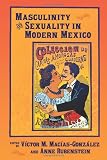
Víctor M. Macías-González, Anne Rubenstein, eds. Masculinity and Sexuality in Modern Mexico. Albuquerque: University of New Mexico Press, 2012. xii + 280 pp. $31.95 (paper), ISBN 978-0-8263-2905-9.
Reviewed by Susie Porter (University of Utah)
Published on H-Histsex (June, 2015)
Commissioned by Chiara Beccalossi (University of Lincoln)
As the editors note in the introduction to this collection of nine essays, anthropologists and sociologists have led the way in masculinity and sexuality studies in Mexico; however, historians have important contributions to make. Scholars informed by feminism, gay and lesbian, and postcolonial studies developed three critiques of approaches to masculinity that emerged in the post World War II era--commonly identified with writer and public intellectual Octavio Paz. The first criticism points out the ways people have collapsed “Mexican” and “male” in ways that have disenfranchised women; the second critique is that discussions of masculinity have remained superficial and do not reflect lived experiences; and the third, that masculinity has been narrowly framed by heterosexuality. As a whole, this collection takes us well beyond such limitations by historicizing both lived experience and representation. As with many studies, the authors refer to “masculinity in crisis” and “modernity,” as if we all agree on what these mean; nevertheless, as a whole the volume delves into the historical specificity of the dialectic relationship between homo- and heterosociability and sexuality; the urban geography of masculinity and sexuality; and the class dynamics of gender identities.
Hetero- and homosociability have had a profound impact on masculinity. Focusing on 1880s Mexico City, James Garza argues for the centrality of homosocial bonds in defining masculinity. Garza unravels the tragic tale of a love triangle involving a man with control of economic and sexual resources, who served as mentor to a young middle-class man and as protector of a woman on her own. In a story of hearts broken and love gone wrong, Garza shows, homosocial networks and fictive kinship relations reinforced masculine norms and friendship, to the peril of the young lady who, by the end of the tale, the younger of the two men has murdered.
Several authors trace how by the 1940s homosociability had ceded to the increasing power of heterosexuality. Jeffrey Pilcher examines the evolution of men’s gender experimentation, from the carpa tradition (tent or circus-like entertainment), through the cinematic productions of avant-garde film director Arcady Boytler and writer Salvador Novo, both of whom created spaces for non-normative gender expression in 1930s Mexican film. Actor Mario Moreno, integral to the evolution of these entertainment traditions, shifted from representing non-normative masculinity to an increasingly narrow model of heterosexuality. Pilcher then contrasts the art of representation with the theatrics of union politics. The actors union became entangled in inter-union conflict during the mid-1940s, and central spokepersons, including Mario Moreno, let loose homophobic epithets in efforts to make political gains.
The gendered dimensions of urban geography come into focus in this collection as well. Bathhouses, brothels, hotels, and theaters all shift from bricks and mortar to places where people construct gender and sexual identities. Víctor M. Macías-González provides a deliciously rich description of the bathhouses that dotted Mexico City in the late nineteenth century and explores the class dimensions of ablutions, morality, and sexuality. While many working-class people were suspicious of bathing and public bathhouses, middle-class Mexicans were eager to wash behind their ears and flaunt their superior cleanliness. A flourishing same-sex bathhouse culture in the 1890s provided opportunities for male intimacy and exploration that, with government regulation in 1905, became morally suspect. Mary Lee Mulholland, in an essay on mariachis and homosexuality, explores the persistence of contemporary spaces of male sociability in, for example, “pulquerías” (bars where pulque, a fermented drink made from maguey, is served). Eric Shantz centers his study on Mexicali (1908-25) to examine the relationship between economic development and narratives of sexuality and morality. Shantz argues that in an effort to promote spaces for vice, narratives of libidinal excess reinforced transnational images of Mexican masculinity.
Theaters, Anne Rubenstein shows, served as spaces where men could simultaneously enact multiple models of masculinity. Upon entering the rowdy, male-dominated theaters, men found entertainment and camaraderie. Whereas some theater managers experimented with enforcing gender segregation of audiences, people themselves also seem to have segregated along gender lines. Rowdy masculinity coexisted with paternalistic forms of masculinity, evidenced in an ethnography of a boy who enacts adult manhood by accompanying his mother and sister to the theater. Like men, women enacted a range of manifestations of gender norms. In contrast to the woman who turned to her eldest son as a chaperone, other women challenged normative femininity by asserting their presence in theaters on their own, and eagerly looked to the silver screen for fashion inspiration. Yet others adhered to a morality that forbade theater attendance at all. Rubenstein argues that very little in the gendered dynamics within the movie theater changed from the 1920s to the 1960s, while the class dimensions of theater going shifted along with urban transformation.
Kathryn Sloan, in an essay based on deflowering testimonies from late nineteenth-century Oaxaca, examines the class dynamics of honor codes. Working-class women had their own conceptions of honor, different from parents, court officials, and elite observers. According to Sloan, some of these women exercised “masculine agency” (p. 73). Sloan, and other contributors, show that scholars have overemphasized virginity as the main determinant of female honor, especially for the working class. Her essay urges us to look beyond dichotomies to consider a spectrum of female honor.
Taken as a whole, the authors suggest intriguing lines of inquiry regarding class dynamics in Mexico. Robert Buffington, for example, calls out scholars for their own class prejudice in explaining male violence. Male desire to dominate women, he writes, is a “deceptively commonsensical explanation … [that] serves to perpetuate and reinforce negative stereotypes of working-class machismo” (p. 188). Indeed, Américo Paredes has shown that the word “macho” came to mean something negative, that is, “the empty bravado of a cowardly buffoon,” only in the 1940s (quoted, p. 217). Buffington deftly teases out meaning from penny press images, verse, and double entendre to identify a “modern sacrificial economy” (p. 188). He argues that shifts in working-class men’s labor force participation, urban migration, and a shift away from homosociability threatened the working-class male psyche. That Buffington identifies the editors and contributors who produced the penny press as primarily of middle-class origins, albeit sympathetic to the working class, suggests there is more to unravel about cross-class relations in Mexico, both among men and more generally.
From the introduction that frames the diverse essay, to the conclusion offered by Ramón Gútierrez, this accessible collection is of interest to both those new to Mexican history and to those eager to delve deeper into the history of masculinity and sexuality in Mexico.
If there is additional discussion of this review, you may access it through the network, at: https://networks.h-net.org/h-histsex.
Citation:
Susie Porter. Review of Macías-González, Víctor M.; Rubenstein, Anne, eds., Masculinity and Sexuality in Modern Mexico.
H-Histsex, H-Net Reviews.
June, 2015.
URL: http://www.h-net.org/reviews/showrev.php?id=42320
 | This work is licensed under a Creative Commons Attribution-Noncommercial-No Derivative Works 3.0 United States License. |

