

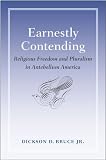
Dickson D. Bruce Jr. Earnestly Contending: Religious Freedom and Pluralism in Antebellum America. Charlottesville: University of Virginia Press, 2013. 210 pp. $35.00 (cloth), ISBN 978-0-8139-3363-4.
Reviewed by Mel Piehl
Published on H-Catholic (November, 2014)
Commissioned by Carolina Armenteros
Faith, Freedom, and Social Order: The Early Republic as Case Study
Dickson D. Bruce Jr.’s Earnestly Contending is an unusual study because it does not readily fit conventional genres of academic writing. Although focused almost entirely on a single recognized period of American history—the antebellum Republic from about 1800 to the 1850s—it is in no sense a “history” of the period, either religious or otherwise. While it is deeply concerned with broad matters of political theory—especially issues of liberty, toleration, and pluralism within a democratic polity—it never addresses these as theoretical questions per se, so it cannot really be called a work of political philosophy. And while it draws on, and indeed insists on, an understanding of religion as a uniquely powerful and pervasive social force in human life, its focus is on a particular problem that religion poses for the modern polity, rather than on doctrinal or other religious concerns themselves, so it is not theology or even religious studies. Instead, Earnestly Contending pursues a distinctive course by using the early American Republic as a kind of case study to test or demonstrate its larger argument that prevalent theories of American liberty and the state are flawed because they fail to take into account religion’s inherent resistance to the relativizing thrust of pluralism. The book is thus perhaps best classified as a historically and theoretically informed study in the political sociology of religion.
Bruce makes his singular purpose clear from the outset. The book, he announces, is “avowedly ‘presentist’ in its concerns.” It is “an attempt to illuminate the kinds of considerations that must be given to religion itself in order to understand its demands on the faithful and to understand the significance of those demands for a society in which religious perspectives conflict ” (p. 1). While many have held that American-style pluralism can effectively deflect religious conflict from the public sphere, Bruce holds that despite widely shared ideals of “liberty” and “toleration,” such intentions are thwarted by certain bedrock qualities of religion. Therefore, understanding the persistence of such hot-button twenty-first-century issues as creationism, abortion, gay marriage, religious tax exemption, and religious monuments on public property requires seeing them as different from more ordinary conflicts over public policy.
Bruce selected the antebellum American Republic for his case study, he says, because that is the time when our contemporary problems originated, because issues of religion and toleration were particularly salient in that period, and because early America represented the first full-blown attempt in history to translate these ideals into a functioning social order. It is by studying the actors and issues of this period, he claims—including their taken-for-granted assumptions—that we can see most clearly what was at stake in the discourse of “religious freedom.” Seeing these matters as they played out two centuries ago may not solve our current problems, Bruce argues, but it enables us to confront head on the “fundamental incompatibility between faith and tolerance that must be confronted rather than evaded in our own volatile religious world” (p. 8). The study itself never supplies a developed rationale for seeing such close connections between the early nineteenth and the early twenty-first centuries, leaving it largely up to the reader to determine whether its premises are persuasive or not.
In keeping with this agenda, then, Earnestly Contending is not chronologically but topically organized. It takes in the antebellum period as a whole, with little attention to change or development over those decades, in much the same way that some historians of slavery treat the peculiar institution in the same period as more or less a static whole rather than as a dynamic phenomenon. This has the advantage of enabling Bruce to keep his crucial theoretical and sociological considerations front and center, though historians might find the inattention to major temporal changes or regional variations in religion during this time somewhat unsettling. (One marker of this non-chronological quality is the lack of dates for much of anything in the text, although the chronology of events and statements can be tracked down in the footnotes.)
Bruce begins by providing an overview of the widespread political-religious assumptions at work in the early United States. These were essentially the principles that had been hammered out in the American founding: freedom of conscience, noninterference of the state in religion and vice versa, voluntarism in church membership, and de facto acceptance of diversity of religious belief and practice. These foundational features of the American order were rooted in both Lockean-Jeffersonian rationalist views of religion as well as the dissenting forms of Protestantism that most Americans shared.
But this at least theoretically paradisiacal American condition of freedom, toleration, and pluralism was soon threatened by two significant snakes in the garden: Catholicism and Mormonism. These two movements and their organizations—one “foreign” and one thoroughly home grown—provided a continuing acid test of the limits of American toleration, as well as challenges to rationalist and individualist assumptions about how faith itself should work. “No religious conflict in antebellum America was to do more to reveal both the reality of a Protestant hegemony and the countervailing tendencies to any broad conception of toleration than that between American Protestants and the Roman Catholic Church,” Bruce says (p. 25). Evidence for this is not hard to find. While some Catholics sought to soothe American fears, others were not shy about fuelling them. Bruce cites New York’s archbishop John Hughes, for instance, who declared that the church’s mission in the United States included converting “the officers of the Navy and the Marines, the commander of the Army, the legislatures, the Senate, the Cabinet, President and all” (p. 27). And Mormonism stirred even fiercer discord by presenting America with a new sacred scripture, a doctrine of continuing divine revelation, and the startling practice of polygamy. This tension that Bruce outlines in his opening chapter—between a theoretical devotion to a political neutrality founded on presumed religious autonomy, individualism, and toleration, and an actual social encounter with alternative religious institutions that seemed to defy these norms—becomes essential to the template that governs the remainder of the book.
In his second chapter, Bruce turns to theorists of religion like Clifford Geertz, William James, and Charles Taylor, as well as historians like Mark Noll, George Marsden, and Nathan Hatch, to probe the assumptions and workings of the era’s widespread creed of autonomy, self-determining individualism, and antiauthoritarianism. He then argues that, despite some contemporaries’ belief, the entire celebratory rhetoric of religious liberty did not at all undermine two essential principles of all religion: universal truth claims and “boundary setting.” These qualities are inherent to religion, he says, because unlike other kinds of political or cultural or ideological beliefs, what gives religion power is its claim to represent and convey a cosmic or divine order, or what Geertz calls “the transcendent forces and purposes governing every aspect of existence ” (p. 32).[1]
This meant in practice, Bruce argues, that despite their theoretical and rhetorical commitment to religious liberty and freedom of conscience, American Protestants were driven to counteract their own factionalism by seeking a common ground of unity, often in the Bible. Similarly, they responded to an intense felt pressure to define and maintain in the United States a common moral core and a source of social authority rooted in religion, natural law, and the Bible. Earnestly Contending then describes the seemingly paradoxical effort to in effect sacralize the supposed American way of religious liberty and individual autonomy itself. When combined with a kind of providentialism regarding America’s unique destiny in the world, these endeavors all amounted to a religiously motivated way to draw boundaries of identity and uphold an authoritative social order, with liberty-loving religious individualists plainly inside those boundaries, and allegedly authoritarian and socially conformist Catholics and Mormons on the outside.
Throughout his analysis, Bruce continuously returns to the point that these emerging American paradoxes, or more bluntly, contradictions, emerged not because of the bigotry, hypocrisy, or blindness of those who promoted them, but because of certain ineradicable features of religion itself. It is important to understand religion’s common characteristics as a cultural system, especially its claims to express ultimate truths, if its unique challenges to political orders based on tolerance and liberty is to be understood. “Religion, by its very nature, may be said to make powerful demands on its adherents, its key functions directing thought, language, and action in ways that clearly work against a universalistic acceptance of differing perspectives—perspectives offering contradictory assessments of God, for example, teaching contradictory views of a proper order, or contradictory understandings of ultimate human ends” (p. 172). Bruce even draws on the contrarian literary critic Stanley Fish’s antiliberal argument that to demand social compromise of faithful believers is to ask them to elevate toleration, fairness, and equal rights above their own religious imperatives.
The unusual approach to this entire subject adopted in Earnestly Contending—using a particular historical period to advance a theoretical argument about the nature of religion and toleration—certainly provokes interest. Bruce is thoroughly familiar with the religious writers of the early nineteenth century, and has read widely in the secondary literature by religious historians as well as influential contemporary theorists of religion. Quotations from religious notables of the period, from Horace Bushnell to William Ellery Channing to Lydia Maria Child, and many more, are cited and interpreted to support Bruce’s argument. And his treatment of religion in the period draws on notable American historians of religion like Mark Noll, Nathan Hatch, Colleen McDannell, Daniel Walker Howe, and others, though often by lifting only particular pieces of their work pertinent to his purposes.
A historian might well complain that this approach provides a rather abstract and bloodless portrait of lived religion in antebellum America. From Earnestly Contending, one could conclude that religious Americans were largely engaged in a fine theoretical and constitutional debate over issues of religious freedom, pluralism, and the limits of toleration. Such phenomena as the fervent camp meetings of the Second Great Awakening, the great evangelical cooperative organizations like the American Bible Society and the American Home Mission Society, and the profound religious and church body divisions over slavery find only occasional or indirect echoes in the book. This is perhaps necessary given Bruce’s purpose, but the approach comes at some cost in conveying the actual workings of faith in this period, or perhaps any period. The specific flavor of religious experience, and religious conflict, is partly dissipated.
Similarly, Bruce’s focus on such visibly articulated ideals as autonomy and voluntarism may partially conceal the extent to which American religious practice still followed deeply communal and involuntary patterns of nurture and commitment. All churches that still practiced regenerative infant baptism, for instance—and these included some liturgical Protestants as well as Catholics—surely understood Christianity as somehow involving more than an autonomous individual choice or personal commitment. And in many parts of the country religious preferences, even if formally individualistic, were continually fostered and reinforced by communal habits and institutions. Rural white southerners seldom autonomously chose to become Congregationalists or Unitarians, nor did New Englanders often rationally decide to become Lutherans or Baptists. In a sense, the limits on the ostensibly libertarian theory of American religiosity supports Bruce’s claim that faith commands a deeper loyalty than other choices or social identities—but it means that most of his case study develops by analyzing liberal or liberalizing strands of post-Calvinist Protestantism. He is convincing in showing that most such Protestants or post-Protestants were far less tolerant and sensitive to freedom of conscience than their rhetoric suggested. But the distinctive “voluntary” hegemony of one broad religious persuasion raises questions about whether antebellum America is really so relevant to twenty-first-century conflicts over church and state, religion and public life, or the contexts in which they are played out. Certainly no American in 1830 would have imagined our current Supreme Court composed of six Catholics and three Jews.
Moreover, in the case of Catholicism, so much has changed in both the universal Catholic Church and its relations to American society since the early nineteenth century that it is hard to draw relevant lessons. Not only was Catholicism then a quite small and—as Bruce affirms—largely despised presence, but Rome also still officially held to teachings that challenged enlightened ideas of liberty and toleration. In our times, Roman Catholicism has vociferously promoted religious freedom and human rights around the globe. But it has done so without relinquishing its core religious claims to transcendence, ultimate truth, and authoritative moral guidance for its adherents. And this stance in turn raises doubts about Earnestly Contending’s case that authoritative religion inevitably—and not just contingently—is a force that runs inherently against the grain of liberal and tolerant pluralist social orders. One can—and many people in the modern world do—believe firmly that their own religious faith is absolutely true and right and best, while at the same time being quite willing to live in peace with others who similarly believe that their own faith is superior and divinely justified. It is certainly a difficult stance to sincerely defend the religious freedom of others who look down on your own faith. But it is a possible one. This in turn suggests that the modern assumption that the only way to promote religious liberty is to relativize or privatize all religions may not be warranted.
Still, even with these criticisms in mind, Earnestly Contending is valuable for the provocative arguments it raises. At some level Bruce is certainly right that religion—at least any religion that makes transcendent truth claims—does not function like other standard social identities or group commitments. And he is also right to assert that even liberal societies where religious belief has been attenuated and substantially “privatized” still have much more trouble with matters of toleration, “freedom of conscience,” and religious practice in the public sphere than they might expect or like. This book is a good antidote to anyone who expects or hopes that clashes over religion in the public sphere will eventually die out in modern America.
In my judgment, however, it is doubtful whether the early American experience can really provide much useful insight or guidance in addressing the multiple issues facing a contemporary America filled with tremendously more religious variety than anything those of the antebellum Republic could have dreamed of. Even though the eighteenth-century constitutional framework regarding religion remains remarkably in place, our twenty-first-century religious social environment—touched by global issues like the rise of militant Islam and the technological manipulation of life—is almost different in kind from anything William Ellery Channing or Lyman Beecher faced. In the end, Bruce’s initial assumption that current struggles can be deeply illumined by examining the antebellum United States is not terribly convincing.
Still, if contentious public conflicts over profoundly theological matters continue or even multiply as the United States grows ever more diverse, it is indeed wise to consider, as Bruce does, some special qualities of faithful belief that do not readily yield to standard solutions. Even if this particular case study of early American religion and society perhaps proves less than it intends, the book as a whole provides a good reminder that faith and freedom are not always bosom companions, and that a deeper understanding of religion is one way to enhance the welfare of both.
Note
[1]. Clifford Geertz, The Interpretation of Culture: Selected Essays (New York: Basic Books, 1973), 90.
If there is additional discussion of this review, you may access it through the network, at: https://networks.h-net.org/h-catholic.
Citation:
Mel Piehl. Review of Bruce Jr., Dickson D., Earnestly Contending: Religious Freedom and Pluralism in Antebellum America.
H-Catholic, H-Net Reviews.
November, 2014.
URL: http://www.h-net.org/reviews/showrev.php?id=42307
 | This work is licensed under a Creative Commons Attribution-Noncommercial-No Derivative Works 3.0 United States License. |

