

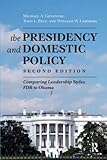
Michael A. Genovese, Todd L. Belt, William W. Lammers. The Presidency and Domestic Policy: Comparing Leadership Styles, FDR to Obama. Second Edition. Boulder: Paradigm Publishers, 2014. 384 pp. $155.00 (cloth), ISBN 978-1-61205-301-1; $35.95 (paper), ISBN 978-1-61205-302-8.
Reviewed by Daniel P. Strieff (London School of Economics)
Published on H-USA (May, 2016)
Commissioned by Donna Sinclair (Central Michigan University)
Playing the Hand One’s Dealt
If Kenny Rogers’s iconic song “The Gambler” teaches us anything, it is that the measure of cardplayers is determined not by the hand they are dealt, but rather by what they do “when the dealing’s done.” “You’ve got to know when to hold ‘em,” he sings, “know when to fold ‘em.”[1] And if any pithy aphorism could sum up the central theme of the excellent new edition of The Presidency and Domestic Policy: Comparing Leadership Styles, FDR to Obama by Michael A. Genovese, Todd L. Belt, and William W. Lammers, it is this: we play the hand we are dealt. Like the gambler in Rogers’s tune, presidents must make do with the conditions presented to them. “Presidents ... face formidable obstacles, but they are not helpless,” the authors write. “A wide range of options and opportunities are available to a politically astute, power-wise leader” (pp. 1-2). Their ability to effect change might be limited by circumstances, but the actions that they take within those bounds should determine how we assess their leadership.
With this new edition, Genovese, Belt, and Lammers make a useful contribution to the voluminous literature on the American presidency. Leadership styles have four specific dimensions, the authors posit: approaches to advisory processes and decision making, administrative strategies, public leadership, and congressional leadership. What distinguishes their approach, however, is that they categorize the presidents by “opportunity level” (high, moderate, and low). That allows the authors to provide “a fairer comparison of their skills within an opportunity level” (p. 27). In addition to this emphasis on context, the authors argue that “the central consideration in evaluating any president’s performance is the strategies that were pursued and the skill with which they were exercised” (p. 11). Just because presidents have no control over the circumstances they inherit, it does not follow that they lack agency after the cards are dealt.
Ever since the publication of Presidential Power in 1960, all subsequent works on American presidential leadership have had to engage with Richard E. Neustadt’s argument that presidential authority stems from public prestige, professional reputation, and—most significantly—“the power to persuade.”[2] Presidents cannot command, Neustadt contended, but they must be effective bargainers who can convince relevant stakeholders, especially in Congress, that they have shared interests. Presidents should only tap this source of power judiciously, however, for otherwise they risk depleting their wellspring. Subsequent scholars have refined Neustadt’s arguments. Fred Greenstein, for example, emphasizes communicative ability and—above all else—“emotional intelligence,” which he defines as “the president’s ability to manage his emotions and turn them to constructive purposes, rather than being dominated by them and allowing them to diminish his leadership.”[3] Samuel Kernell asserts that, as a symptom of an increasingly divided American political system, presidents need to make direct appeals to voters in order to compel Congress to pass legislation. In contrast to Neustadt’s era, Kernell believes the current climate makes bargaining less successful as a strategy, so presidents need to “go public.”[4]. Conversely still, George Edwards III stresses that presidents may find that “staying private”—negotiating behind closed doors with elites rather than making public appeals—offers greater chance of success because leaders rarely change the public’s mind anyway.[5]
The authors of this edition, however, take a different approach. For them, what determines whether presidents achieve the political results their levels of opportunity permit is how “skillfully” they execute their strategies and tactics to achieve the desired goals. Levels of opportunity, which set “reasonable expectations,” are formed by extrinsic factors, including “public demand, pro- or anti-government sentiments, issue ripeness, available resources, competing issues, and the strength of the president’s party in Congress.” Thus, opportunity level provides the structure within which presidents act, while leadership style “helps determine the public face and interactions they present to the people, Congress, and other political actors” (p. 2). Indeed, scholars of the presidency will be particularly interested in this volume’s focus on “style” and its impact on public policy.
The authors grapple with the extent to which style has consequences for policy outcomes—and this is where agency enters their analysis. Mainstream journalists focused on horse race reporting often overemphasize style at the expense of the larger, more prosaic forces at work in day-to-day politics. Yet, the authors assert, scholars should not dismiss style as an irrelevant level of analysis; rather, they should develop a clear, sensible analytical frame that can be applied systematically. To that end, the authors point to the four specific dimensions of leadership styles. Of course, assessing leadership styles across twelve presidents is difficult business, as the authors concede—these styles stem from varying personalities, pre-Oval Office careers, perceptions of the failings of their predecessors, and very particular readings of the histories of the presidents they may wish to emulate. Yet their closer examination of these presidents suggests party differences. Democrats have tended to be “activists,” while Republicans have shown greater variation in styles (p. 355). Democrats have “generally ... been more interested in finding new policies to promote,” while GOPers “have tended to focus on deliberate staff processes” (p. 356). Still, the one consistency across all of the administrations studied was, apparently, inconsistency. Presidents generally remained flexible and displayed a wide range of strategies and styles.
In creating their opportunity-level rankings, the authors placed four presidents in each category. Among high-opportunity presidents, Franklin D. Roosevelt ranks first, followed by Lyndon B. Johnson, George W. Bush, and Ronald Reagan. For the middle-opportunity group, the authors rank Harry S. Truman at the top, followed by Barack Obama, Dwight D. Eisenhower, and John F. Kennedy. In the bottom category of low-opportunity presidents, the book places Richard Nixon, Bill Clinton, George H. W. Bush, and Jimmy Carter. (Gerald Ford is omitted from their analysis because of the brevity and unique features of his unelected tenure.)
Handicapping presidents for their opportunity levels, the authors call Truman and Nixon “the overachievers of the group,” while Roosevelt ranked “very high on the list.” On the bottom end of the scale, they place Reagan, Carter, and both Bushes, “presidents who seemed to squander opportunities,” and call them “disappointments” (p. 368). Echoing Neustadt’s famous assessment that presidents serve as “invaluable clerks” rather than as “leaders,” the authors conclude that presidents are significant in the process of policy change, but as “facilitators rather than directors” (p. 374).[6]
The decision to place Truman and Roosevelt toward the top of the rankings will likely come as no surprise. However, their assessment that Nixon ought to be ranked as one of the most successful recent presidents based on his legacy in domestic, rather than foreign, policy might surprise the public and army of Beltway pundits who may not see past Watergate. Conversely, the analysis that Reagan represented a disappointment will disappoint dyed-in-the-wool conservatives, but the authors present a convincing argument. The relatively low position of George H. W. Bush also indicates that the authors are not in lockstep with historical revision on the legacy of the first Bush presidency.
This valuable work will be of interest to students and teachers more than the lay public. The emphasis on the opportunity levels of the presidents provides a helpful critical framework that political scientists and historians should consider applying in their own assessments. Although the role of the media is addressed, the work could have benefited from a more concentrated look at the way in which the media often amplifies, filters, and distorts presidential messages before it reaches the eyes and ears of the public. It would have been helpful, for example, to learn more about individual presidents’ relationships with the Fourth Estate. Perhaps that is too much to ask in a book that covers quite a bit already. Ultimately, the authors note that reviewing these men “dramatically underscores the extent to which some presidents have had far greater opportunities than others to contribute to fundamental changes in domestic policy.” Indeed, they write, “some presidents have capitalized on their opportunities, while others played their hands rather poorly” (p. 345).
Notes
[1]. Kenny Rogers, “The Gambler,” http://www.songlyrics.com/kenny-rogers/the-gambler-lyrics/.
[2]. Richard E. Neustadt, Presidential Power: The Politics of Leadership (New York: John Wiley & Sons, 1960), 11.
[3]. Fred Greenstein, The Presidential Difference: Leadership Style from FDR to George W. Bush, 2nd ed. (Princeton, NJ: Princeton University Press, 2004), 6.
[4]. Samuel Kernell, Going Public: New Strategies of Presidential Leadership, 3rd ed. (Washington, DC: CQ Press, 1997), 2.
[5]. George Edwards III, On Deaf Ears: The Limits of the Bully Pulpit (New Haven, CT: Yale University Press, 2003), 4.
[6]. Neustadt, Presidential Power, 6.
If there is additional discussion of this review, you may access it through the network, at: https://networks.h-net.org/h-usa.
Citation:
Daniel P. Strieff. Review of Genovese, Michael A.; Belt, Todd L.; Lammers, William W., The Presidency and Domestic Policy: Comparing Leadership Styles, FDR to Obama.
H-USA, H-Net Reviews.
May, 2016.
URL: http://www.h-net.org/reviews/showrev.php?id=42304
 | This work is licensed under a Creative Commons Attribution-Noncommercial-No Derivative Works 3.0 United States License. |

