

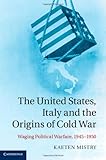
Kaeten Mistry. The United States, Italy and the Origins of Cold War: Waging Political Warfare, 1945–1950. Cambridge: Cambridge University Press, 2014. 308 pp. $99.00 (cloth), ISBN 978-1-107-03508-9.
Reviewed by Wendy A. Pojmann (Sienna College)
Published on H-Diplo (December, 2014)
Commissioned by Seth Offenbach (Bronx Community College, The City University of New York)
Kaeten Mistry’s The United States, Italy and the Origins of the Cold War is a welcome addition to a growing number of recent studies on Italy during the Cold War and should also find an audience among scholars of American foreign policy and the broader Cold War. Mistry focuses tightly on the period between 1945 and 1950, using the Italian elections of April 18, 1948, as the pivotal moment that defined the relationship between the American and Italian governments. Mistry notes that the Americans embarked on a strategy of conducting political warfare to avoid losing ground to the Soviets. Americans utilized covert and overt operations which tipped the Italian elections in favor of the Christian Democrats (DC) and established American confidence in its ability to achieve similar outcomes elsewhere.
Mistry is especially interested in American policies and how they were implemented and carried out in Italy, but he also closely analyzes the Italian response to American interventions. This aspect is less known to nonspecialists of Italy and makes a significant contribution to the historiography of the early Cold War period. The Italian prime minister, Alcide De Gasperi, Mistry successfully argues, responded to the need of the Italians to forge their own path in the postwar era. The author establishes that De Gasperi “was asserting Italian autonomy and insisting that the country did not follow a strict cold war dichotomy of free-market capitalist democracy vs collectivist state communism” (p. 4). The presence of the Vatican and the role of Catholicism in Italy and among members of the DC leadership added a layer of complexity to Italian political life as did the popularity of the Italian Communist Party (PCI), which had been cemented in part because of the party’s contributions to the Italian Resistance. Mistry highlights De Gasperi’s conflicted viewpoint on the Communists and the Marxist Left in general, which the Americans wanted to defeat irrevocably, but who De Gasperi saw as “a legitimate adversary to defeat through the political process but not destroy” (p. 202). Despite the tendency of American political leaders to view foreign leaders in general as lesser partners and Italian leaders in particular as “unreliable and fickle” (p. 204), De Gasperi proved less malleable than predicted. Mistry’s careful treatment of the Italian side of the United States’ use of political warfare thus deepens previous understandings of the responses of America’s allies in the fight against Communism in Europe.
Mistry posits three main arguments that explicate how critical Italy was to the development of political warfare. The first, somewhat ironically, is that Italy itself was not a major U.S. interest. Although Italy was important to maintaining unity in the Atlantic community, it was really a testing ground for a particular conceptualization of the Cold War. Nonetheless, American aid continued to arrive in Italy even when the Italians pushed back on questions of national autonomy because it was critical to U.S. aims in Europe. Second, Mistry argues that bipolarism was more rigid for U.S. policymakers than for private and transnational actors or the Italians, which resulted in alliances made for the sake of convenience rather than because of shared ideology. American leaders, in fact, often had little understanding as to why certain non-state actors worked together against the political Left. Finally, determining whether or not the United States really was successful in waging political warfare in Italy, Mistry shows, matters less than how the perception of American success fueled future Cold War policies. It appeared that the United States was able to win and make the Italian government responsive to the wishes of the Americans. Political warfare could therefore be justified and even expanded elsewhere. Later, when the Americans had difficulty applying the Italian model in other places, especially behind the Iron Curtain, they nonetheless heralded it as a success in U.S. covert actions.
Mistry carries each of these arguments through the eight chapters of the book, which are organized chronologically by a single year to two years between 1945 and 1950. The first three chapters trace the change from a relative lack of U.S. interest in Italy in 1945 to making Italy and France key components of the European Recovery Plan by 1947. As Mistry puts is, “the perception in American circles viewed a collapse in either country as fatal to the broader plan, thereby shaping immediate policy choices” (p. 75). Chapter 4 examines the consolidation of the Christian Democratic-centrists in 1947. DC-centrists, Mistry argues, made most of the important political decisions that helped to create the conditions necessary for U.S. interference in the 1948 elections. In chapters 5 and 6, Mistry examines the use of political warfare, especially as conceived by George Kennan, as a means short of war in American political circles, and looks at how it was implemented during the election campaign of 1948, when the Popular Democratic Front stood poised to win enough votes to lead the next Italian government. In the final two chapters of the book, Mistry examines the “marriages of convenience” that helped sustain the U.S.-DC alliance and the expansion of “covert measures short of war” that guided American policymakers after the success of the 1948 Italian election (pp. 15, 205).
Mistry is especially adept at analyzing how key American policymakers, such as George Kennan, Allen Dulles, and Harry Truman, sorted and carried out their plans. Readers will certainly be interested to know more about what happened after the 1948 election in Italy and Mistry has opened this question for other scholars. His bibliography is rich and of tremendous use to anyone researching the Cold War or the immediate postwar period in Italy. Mistry has incorporated an impressive number of archival documents from both Italian and American sources. He is clearly at ease weaving through the intricacies of this period and demonstrates the influence of his mentor Mario Del Pero, especially in his use of the idea of “containing containment,” the Italians’ complex response to U.S. efforts to assist the DC and make the Marxist Left irrelevant.[1] This is traditional diplomatic history, however. Historians in other subfields, such as social history, might find themselves wanting to know more about the reactions of ordinary Italians. Cultural and intellectual historians will not find more than cursory explanations of ideological issues or how they were transmitted at levels outside the realm of high politics. Mistry does not claim to treat these matters, in any case, so readers will certainly not be misled. Instead, they can expect a solid and very detailed study of U.S. political warfare in the early Cold War that also offers a clear and effective account of the reaction of a small, yet critical, country and its related non-state actors.
Note
[1]. Mario Del Pero, “Containing Containment: Rethinking Italy’s Experience during the Cold War,” Journal of Modern Italian Studies 8, no. 4 (2003): 532-555.
If there is additional discussion of this review, you may access it through the network, at: https://networks.h-net.org/h-diplo.
Citation:
Wendy A. Pojmann. Review of Kaeten Mistry, The United States, Italy and the Origins of Cold War: Waging Political Warfare, 1945–1950.
H-Diplo, H-Net Reviews.
December, 2014.
URL: http://www.h-net.org/reviews/showrev.php?id=42281
 | This work is licensed under a Creative Commons Attribution-Noncommercial-No Derivative Works 3.0 United States License. |

