

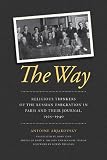
Antoine Arjakovsky. _The Way_: Religious Thinkers of the Russian Emigration in Paris and Their Journal, 1925-1940. Translated by Jerry Ryan. Edited by John A. Jillions and Michael Plekon. Notre Dame: University of Notre Dame Press, 2013. xiv + 766 pages. $65.00 (paper), ISBN 978-0-268-02040-8.
Reviewed by Frederick Matern (Independent Scholar)
Published on H-Catholic (December, 2014)
Commissioned by Carolina Armenteros
The emigration of Russian intellectuals following the Bolshevik Revolution and, in particular, the exile, ordered by Lenin, of leading thinkers on the so-called philosophers' steamboat, influenced not only the life and culture of the countries where the exiles sought refuge but also Russia itself, once the ideology of Marxism retreated enough to make room for new ideas in the last days of the USSR. The impact of this emigration on the intellectual history of both Russia and the West is still in the process of being evaluated, as more material becomes available to more researchers. Despite translations of many exiled Russian philosophers such as Nicholas Berdyaev, Fr. Georges Florovsky, Fr. Sergius Bulgakov, Vladimir Lossky, Lev Shestov, and Simeon Frank into English and French, much of that material is still only available to readers of the Russian language. The French professor of ecumenical theology Antoine Arjakovsky has taken up the mission of analyzing one of the most important repositories of this intellectual history, the “Organ of Russian Religious Thought,” a periodical titled Put’, or The Way.
This study of The Way is organized in three parts, reflecting what Arjakovsky takes to be three ages of the journal: the inception of the “modernist journal” from 1925-29; the “nonconformist” phase of the journal from 1930-35; and the journal’s final “spiritual” years, from 1935-40. The organization of the book is diachronic, reading as a trilogy, but within each part the author teases out, synchronically, themes of the intellectual life of the Russian exiles as it is reflected in historical events, as well as in the articles and debates that were published in the pages of the journal. The author’s method is painstaking, with many articles from the journal’s pages summarized succinctly. At the same time, he builds a narrative of the journal’s history as a history of Russian ecumenism in France, struggling against other movements in the community of exiles. The Way was the continuation of the mission of a publishing house co-founded by Berdyaev before the Revolution. The journal is, according to Arjakovsky, not only a record of the intellectual history of the Russian émigré community in interwar France, but also a symbolic history-bearing reality for the descendants of that community in the West and for intellectual life in post-Soviet Russia. It thus serves as a “locus of memory” (p. 4).
Part 1 of the book begins by describing the modernist traits of the members of the journal’s editorial committee, and goes on to describe the internal politics of the Russian Orthodox community in exile and then the ecumenical debates of the leading contributors to The Way. The story that emerges, in Arjakovsky’s telling of the life of the journal, is in essence a history of the ecumenical movement among a modernist faction of the Russian émigré community in France. The modernism of Berdyaev is discussed in some detail, in terms of his anthropology and view of the roles of church and state, along with differing positions of other leading contributors to The Way such as Fr. Georges Florovsky and Lev Karsavin, as well as the sophiology of Fr. Sergius Bulgakov. There is a discussion of the opposition to the ecumenical movement in its various forms: the Eurasianist reaction, the 1927 schism of the Russian Orthodox Church Outside Russia, and the role played in the debate by contributors to The Way. This part of the book also tells the story of the Russian Student Christian Movement, in which Berdyaev and other contributors to The Way were heavily implicated, its association with the YMCA, and the friction that this association caused between the RSCM and church leaders.
The first part ends with a chapter devoted to the relationship between the journal’s contributors and ecumenical thought as expressed in French Roman Catholicism and Swiss Protestantism. The passage on the relationship between Maritain and Berdyaev will be useful to students trying to understand the exiles’ relationship to Thomism, which was, in the case of Berdyaev, nuanced: while Berdyaev saw a gulf between Thomist philosophy and the Platonism of Russian religious philosophy, he nonetheless maintained a close friendship with the French philosopher, and seems to have had an influence on some of his most important work (p. 494).
Part 2 tells the story of the journal’s most active years, which were also years when nationalism was on the rise in Europe. The roles of Berdyaev, Bulgakov, and Florovsky stand out in the narrative. Fault lines in the emigration’s spiritual and political culture became more prominent. Even as the Russian Student Christian movement began to grow in importance, a division leading to the “raskol,” or separation (not quite amounting to a schism), within the Russian Orthodox Church, between the followers of Patriarch Sergius and those of Metropolitan Evlogy. At the same time, a younger, more traditionalist generation, led by figures such as Fr. Florovsky and Vladimir Lossky, was coming of age amongst the émigrés, critical of the modernism characterized by such figures as Berdyaev and Bulgakov. The authors of The Way embarked on several discursive explorations during these years: a theocentric one characterized by the reflections of Florovsky on Vladimir Solovyov and Fyodor Dostoyevsky; an anthropocentric one demonstrated by the deepening of Berdyaev’s personalist philosophy in those years; and a sophiocentric approach led by Bulgakov. Arjakovsky describes the work of these three, along with other key figures of these years, in rich detail, with some truly enlightening passages. He also gives an account of the relationships and dialogues that some of these exiles had with philosophers in the host countries of the West.
The third part of the book examines the final years of the journal, as war once again loomed over the exiles in Europe. This period in the life of the journal was marked by fierce debates on spiritual questions, such as theodicy, between Berdyaev, Shestov, and Bulgakov. It is also a story of the reconciliation, at least in part, of the older modernist and younger traditionalist generations in the face of the political and spiritual crisis tormenting Europe in those years. This part of the book also introduces the reader to the ecumenical activity of Lev Zander, a lecturer at the St. Sergius Institute who came to lead the Russian Student Christian Movement. The late years of the journal were years of intense ecumenical outreach with other denominations in Europe, and also, on the eve of the Holocaust, a repudiation of anti-Semitism. The book’s conclusion features a comprehensive review of the impact of the Russian émigré philosophers and theologians in the post-Soviet Russia of the 1990s, noting the repetition in the heated public debates of the Yeltsin era of the basic lines of thought traced by the exiles, opposing liberal followers of Berdyaev and Bulgakov against the red-brown (or “Eurasian”) followers of Peter Savitsky and Ivan Ilyin.
A word about the book’s methodology and organization is in order at this juncture. Noting the exiles’ tendency to “mythologize” the task of Russian philosophy while at the same time acknowledging their work as a “locus of memory” (p. 15), Arjakovsky combines two methods of historical research described by Antoine Prost: investigation and systemization (p. 13). For the most part, he has used this method to good effect. The book contains enough detail to be of use to scholars researching the interwar Russian intelligentsia in Europe, the life and struggles of the Russian Orthodox Church after the Revolution, the history of the ecumenical movement, and the modernist intellectual heritage. The study is both broad and deep enough that students well acquainted with the subject matter of the book will make new discoveries. The main source material, the articles published in the journal, is faithfully summarized and presented in context. An Internet address containing the open-access, full text of the journal in the original Russian is provided, and the articles’ titles are all translated and catalogued in the references section at the end of the book, which will be helpful for those wishing to do further research. References to all other primary and secondary sources are limited to the endnotes, presumably because space for references and the size of the volume would otherwise become a challenge for the publishers, although at 766 pages another 20 or so for a bibliography would seem to be justified, making it easier to pinpoint Arjakovsky’s other sources.
Considering the scope of the book, it should not come as a surprise that it would be a challenge to meet all the demands that such a methodological approach would entail. An investigative study of an entire religious and philosophical periodical spanning some fifteen years in the granular detail Arjakovsky aspires to is an enormous task in itself, to which the task of systemization of the work of diverse contributors over fifteen years has been added. While he was largely successful in doing so, with carefully placed references in the text to a large number of the hundreds of articles and reviews in the periodical’s history, there are points in the volume where systemization seems to have had an impact on how the facts are presented, perhaps as a result of trying to balance the two tasks. All this is complicated by the fact that this is a dissertation translated from French dealing with source materials in Russian.
For example, in 1998, when the work originally appeared as a PhD thesis, the concept of Eurasianism had yet to attract the attention in the French- and English-language literature that it has since. The implications of the label “Eurasianist” in terms of discussions of Russian nationalism are different now than they were in 1998. Arjakovsky does not precisely define what the term Eurasianist means in this book, but based on the lists of authors he flags as participants in the movement, the term seems to be applied rather more broadly than elsewhere. It is not clear, without a precise definition of what it means to be a Eurasianist, how contributors such as George Fedotov, who had “Eurasian friends” (p. 132) can be said to be Eurasianists themselves.[1]
The imprecision in defining Eurasianism is reflected in the author’s conclusion that the journal’s early period was marked by a “relative openness to the Eurasian movement” (pp. 56-57). In this passage, Arjakovsky identifies Eurasianism with the work of one of its founders, the Russian linguist Nikolai Sergeevich Trubetskoy. Arjakovsky reports, as a statistic about the journal, that “about a third of its Russian contributors participated in the [Eurasianist] movement at one time or another” (p. 57). This use of what looks like a quantitative methodology is particularly problematic here. He does not report what that participation might have consisted in; while one might make the case, for example, that Simeon Frank participated by virtue of having had a relationship for several years with the Eurasianist movement’s publishing house, despite vehement denials in his written correspondence that he should be branded a Eurasianist,[2] it is harder to see how the liberal personalist Berdyaev, who inaugurated the journal The Way with an ardent attack on the Eurasianist movement as a potential “Russian fascism” (p. 57), could be seen in any conceivable way to have been a participant, yet he too is named in that list. Even if a fair number of the authors listed as being a part of the “third of the Russian contributors” to the journal could be said to be full participants in the movement, the extent of some of these contributions to the journal is minimal, if they even properly count as contributions. From the list of contributors named by Arjakovsky, for example, the sole contribution in the entire history of the journal of the founding Eurasianists Pyotr Savitsky, Pierre Suvchinsky, and Nikolai Trubetskoy was in the form of a single jointly written letter to the editor of The Way in response to Berdyaev’s polemical criticism (p. 143). Given these facts, the conclusion of “relative openness [of the journal] to the Eurasianist movement” appears to be in question, despite the fact that several contributors who were broadly acknowledged as Eurasianists, most prominently Florovsky and Karsavin, contributed a fair number of articles to the journal. Florovsky, however, very publicly broke with the Eurasianists in 1928, before most of his contributions to The Way, and, in retrospect, claimed he had distanced himself from the movement to a point as far back as 1923.[3]
Arjakovsky continues that passage citing the agreement between Berdyaev and “S. Trubetskoy”—which is correct as far as it goes, since Sergey Nikolaevich Trubetskoy (1863-1905), a Russian liberal religious philosopher, did share a concern about the Russian Idea and its universal importance with Berdyaev, but he did not share the ideas of his son and founding Eurasianist Nikolai Trubetskoy, so it is not clear why Arjakovsky refers to the affinity between the elder Trubetskoy and Berdyaev to support the idea of the journal’s relative openness to the Eurasianist movement. The elder, S. Trubetskoy, is correctly identified later in the volume as having been a prominent liberal university rector (p. 276). Thus the impression is left of a relatively insignificant factual error which seems, in light of the author’s methodological task of systemization, to have had a greater impact than it need to have done. One can only speculate that this section of the book came from a different, perhaps earlier, period in the research of the opus, and would have benefitted from a closer error-checking against other, more solid parts of the work.
It must be acknowledged, however, that in the majority of themes he touches, from the internal divisions of the church and the exiles, to the theological content of the work of Florovsky and Bulgakov and the philosophies of Berdyaev, Shestov, Frank, and others, Arjakovsky is on firm ground, showing a mastery of the various subjects that arise throughout the contributions to the journal over the decade and a half of its existence. Throughout the rest of the book, the author avoids the use of quasi-statistics to survey the journal; rather, he plunges into the discourses and contributions of the authors, letting the great thinkers who participated in the journal speak with their own voices. The problematic passage on the Eurasianists thus seems to be an anomaly.
The afterword to the English translation provides, years after the original publication of the thesis, a chance to reflect on both ecclesiastic and political events that have occurred since that time. Arjakovsky looks at the developments in modern Russia and speculates on whether the thought of the scholars who contributed to The Way might have led to a more balanced discourse in Russian society, presenting alternatives to the path chosen in recent years. The force of such counterfactual thinking lies not in some recipe that might be applied later; rather, this is a reflection on the power of ideas, even ones that are old and seemingly forgotten, to shape events in the world. In this way, despite certain problems, Arjakovsky’s book is important and valuable, perhaps even more now than in the past, and worthwhile as a guidebook to this important period in intellectual and religious history.
Notes
[1]. In the quoted passage, there is a typo, which mistakenly identifies founding Eurasianist Nikolai Trubetskoy, the linguist, with his uncle G. Trubetskoy. The elder Trubetskoy was an important contributor to The Way before his death (p. 195). His Eurasianist nephew was highly critical of his ecumenical views (p. 143). Nikolai Trubetskoy is also confounded in this book with his father, Sergey Trubetskoy (pp. 56-57).
[2]. Philip Boobbyer, S. L. Frank: The Life and Work of a Russian Philosopher, 1877-1950 (Athens: Ohio University Press, 1995), 139.
[3]. Paul L. Gavrilyuk, Georges Florovsky and the Russian Religious Renaissance (Oxford: Oxford University Press, 2014), 78.
If there is additional discussion of this review, you may access it through the network, at: https://networks.h-net.org/h-catholic.
Citation:
Frederick Matern. Review of Arjakovsky, Antoine, _The Way_: Religious Thinkers of the Russian Emigration in Paris and Their Journal, 1925-1940.
H-Catholic, H-Net Reviews.
December, 2014.
URL: http://www.h-net.org/reviews/showrev.php?id=42278
 | This work is licensed under a Creative Commons Attribution-Noncommercial-No Derivative Works 3.0 United States License. |

