

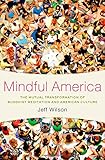
Jeff Wilson. Mindful America: The Mutual Transformation of Buddhist Meditation and American Culture. Oxford: Oxford University Press, 2014. 287 pp. $30.00 (cloth), ISBN 978-0-19-982781-7.
Reviewed by Franz A. Metcalf (California State University Los Angeles)
Published on H-Buddhism (March, 2015)
Commissioned by A. Charles Muller (University of Tokyo)
Over the decades, it has been my pleasure to review several books by Bernard Faure and Charles Prebish, scholars who have done genuinely groundbreaking work in Buddhist studies. Both Faure and Prebish have blazed entirely new territory, opening it to a new generation of scholars eager to follow their leads, even to go beyond them. While Jeff Wilson may loosely be following Prebish, reviewing several of Wilson’s books suggests he is much like Prebish and Faure, not only in lucidity but also in ability, like Huck Finn, to “light out for the Territory ahead of the rest.”
There are drawbacks to opening new fields. One must map new vistas carefully. And one is almost obligated to cover the territory evenly, stacking blazes and caching supplies throughout the new lands, without the time to really inhabit one and to deeply learn its ways and peoples. So it is with Mindful America, the first full-length Buddhist studies exploration of the brave new world of American mindfulness. As a reviewer extremely appreciative of the virtues of this book, I will, from time to time, nevertheless have to critique it, always for what is missing. I feel like an early nineteenth-century politico critiquing Lewis and Clark for failing to trace their water passage all the way to the Pacific. Still, such critique was part of the politician’s job and is part of mine.
In Mindful America, Wilson takes us on a tour of the procrustean phenomenon—indeed movement—of mindfulness in America. We expect this in a survey of a new field, but it was when Wilson went beyond the tour that I was most stimulated. Most frustrated, too, as I wanted more. As an illustration, even the book’s thirty-plus pages of endnotes—a place buttoned-down authors often give themselves freedom to comment or kvetch—are almost entirely bibliographic. In this review I will pay disproportionate attention to the book’s “beyond,” especially its postscript, but first its scope and shape.
Early in the introduction, Wilson puts the American adoption and adaptation of mindfulness in context: “An important guiding thesis for Mindful America is that this is actually how Buddhism moves into new cultures and becomes domesticated: in each case, members of the new culture take from Buddhism what they believe will relieve their culture-specific distresses and concerns, in the process spawning new Buddhisms (sometimes, crypto-Buddhisms) that better fit their needs” (p. 3). Wilson treats the history of Buddhism as a history of appropriation and change in response to worldly needs. I am sure this does not exhaust Wilson’s view of Buddhism, but Buddhism in this book fundamentally provides worldly benefits (this is true in Wilson’s previous work as well, for example, Mourning the Unborn Dead: A Buddhist Ritual Comes to America [2009]). The structure of the book grows from this view, as each chapter examines an aspect of the process of mindfulness’s (and Buddhism’s) adaptation. The book concludes with the postscript I so enjoyed.
One further comment on the introduction: Wilson forthrightly states, “At no point in this book do I address or attempt to tackle the issue of whether mindfulness actually works—that is to say whether it delivers any of the benefits suggested herein by my subjects, from nirvana to weight loss. I have no idea whether it works, and it is not a question I am interested in answering” (pp. 10-11). While I sympathize with Wilson’s desire to sidestep the perhaps unanswerable question of mindfulness’s efficacy, I wonder about his disinterest in it. Wilson is (like me, I should add for transparency) a Buddhist who has written popular press books on Buddhism. Yet he writes that “for my purposes here, it simply doesn’t matter whether mindfulness works.” Again, this is not a fault of commission: Wilson is careful to limit his “purposes here.” I just wish he would situate himself more candidly within the landscape of his subject. He writes that he has practiced “countless hours of mindfulness” but does not have “a personal mindfulness practice,” paralleling those countless hours to the “untold numbers of Christian prayers” he has uttered during other researches (p. 11). I do not believe a professed Buddhist can claim that these actions are parallel or that questions of mindfulness’s efficacy do not matter to them. Here, in my view, is a facade of something approaching objectivity, a facade endemic in religious studies and an objectivity that I contend does not and cannot exist.
Wilson and I differ on the task of religious studies. He states that the “specific task for the scholar of religious studies, as I understand it, is to investigate” religion and allied phenomena “in the service of illuminating such phenomena further.” Agreed, but in my view there is no investigation without intention and no illumination without evaluation. Further, these things, themselves, need our study. Wilson writes that “the determination of the quality of any given mindfulness book or the character of any particular mindfulness advocate or application is a decision that can be reached only by each subjective reader, and different readers will come to different conclusions.” He admits “I have my own reactions; in fact I have multiple reactions,” but he does not air them (p. 11). Readers sharing my view will repeatedly have moments of distraction when Wilson elects not to explore his intentions and reactions; readers of Wilson’s (inferred) view will not. Note that I use the word “distraction” intentionally: when distracted, readers need to reengage Wilson’s actual work, which always educates, even without a self-reflexive dimension.
Chapter 1, “Mediating Mindfulness,” examines the means and forms in which mindfulness comes to America. Naturally, this is the most historically oriented chapter, moving from the translation of sati to mindfulness in premodern Buddhist cultures to early twentieth-century forms to Walpola Rahula to various forms prior to the 1970s. It then turns to the Insight Meditation Society, Thich Nhat Hanh, and Jon Kabat-Zinn, the preeminent pioneers of American mindfulness (aside from possible indigenous forms). The chapter brings us up to date with mindfulness’s expansion beyond clergy-led forms, beyond even lay-led forms, into the self-help movement and journalistic reportage.
Chapter 2, “Mystifying Mindfulness,” begins Wilson’s examination of America’s consumption of mindfulness. Indeed, the title is a short answer to its own subtitle: “How Is Mindfulness Made Available for Appropriation?” “Americans alter, diminish, obscure, eliminate, or simply ignore the historic connection between Buddhism and mindfulness” (p. 44). Cosmology becomes metaphor, monastic context is removed, and Asians are replaced by whites. In the ninteenth and early twentieth centuries, mindfulness is used to sell Buddhism. In the late twentieth century, Buddhism is removed from mindfulness to sell mindfulness. By the early twenty-first century, “mindfulness is so appealing and denatured that it can be used to sell other products” (p. 73).
Chapter 3, “Medicalizing Mindfulness,” “continues the theme of mystification of Buddhist mindfulness ... by examining a very specific type of mystification and reapplication: the recontextualization of mindfulness as a psychological technique” (p. 76). Here the focus is on the ongoing work of Kabat-Zinn. Interestingly, Wilson reveals that Kabat-Zinn’s initial inspiration to decontextualize mindfulness came during a Buddhist retreat and was intended, in Kabat-Zinn’s words, to “‘provide right livelihood for thousands of practitioners’” (p. 85). Even as recently as 2008, Kabat-Zinn “felt incredible reassurance” at the positive response of a roshi in Kyoto who affirmed that Kabat-Zinn’s work was “a kind of living manifestation” of Buddhism (p. 87). There is no way to fully mystify that. Yet Kabat-Zinn and the movement in general hold that Buddhism is fundamentally the dharma, that the dharma is fundamentally mindfulness, that mindfulness is fundamentally universal, and that it is thus an upaya to bring mindfulness to the masses by whatever means necessary. But, as Wilson adds, this program has been so successful it has reshaped Buddhism in its own image. Wilson may be critical of this reshaping. Here is one of those moments of distraction I spoke of. As promised, we move on.
Of the six chapters, chapter 4, “Mainstreaming Mindfulness,” focuses most obviously on worldly benefits. Importantly, Wilson does not denigrate this. Rather, he sees a fascinating reversal in this mainstreaming process. “In the American context, this means that mindfulness—historically associated with the transcendent, renouncing side of Buddhism, as well as in a more minor way with attainment of monastically-desired superpowers—is assimilated instead to an alternate but equally venerable strand of Buddhist tradition: the quest for practical, worldly benefits by lay Buddhists” (p. 109). Note two key elements in Wilson’s observation. First, the reversal: mindfulness, originally embedded in the monastic and transcendent side of Buddhism, is re-rooted in its worldly and practical side. Second, Wilson’s acceptance of this: he does not judge the former to be “real” or “proper” Buddhism. Each side is equally, to use his word, “venerable.” Though I have gently critiqued Wilson’s reluctance to evaluate forms of mindfulness, here I appreciate a fruit of his position: a freedom from hypostasizing or reifying some favored aspect of Buddhism as its essence. If Wilson will not critique his subjects for hypostasizing, at least he does not fall into it, himself.
So, what are the (supposed) worldly benefits of mindfulness? Wilson devotes attention to its aspect of being a “mind cure,” to its help in combating food addiction and accepting the body, even to the work of the company OneTaste and its Orgasmic Meditation (OM) techniques. One cannot help but suspect Wilson is holding this last up for our scorn or ridicule, but, even here, he remains tacit. At the conclusion of this chapter, though, Wilson does allow himself a well-taken corrective. The mindfulness movement is not a revelation of the original Buddhism, before cultural accretions tainted and distorted it. Rather it is just another cultural adaptation to accrue worldly benefits. “Thus the immense popularity of mindfulness does not represent, as its proponents sometimes allege, a universal noncultural Buddhism,” but “another creative reinterpretation to meet local needs and anxieties” (p. 131).
For those of us who remember the 1960s or who themselves appear in Wilson’s bibliography in a non-scholarly guise (myself included in both camps), chapter 5, “Marketing Mindfulness,” will likely be a little unsettling. Its cornerstone is the keen observation that “the promoters of mindfulness in America ... know mindfulness is highly valuable and they know that they cannot actually sell the thing itself. Given this conundrum, peddlers of mindfulness must take two indirect approaches: they must either sell auxiliary products designed to introduce or augment mindfulness, or sell their expertise at teaching mindfulness and delivering the benefits of mindfulness” (p. 136). Wilson then proceeds to describe the auxiliaries sold by DharmaCrafts, Dharma Communications, and OneTaste, and the expertise (mostly books) sold by those with robes, degrees, or other sanctions. Wilson’s concern here, as elsewhere, is not to evaluate the offerings themselves, rather he is here evaluating the marketing of those offerings (e.g., Chade-Meng Tan’s Search Inside Yourself [2012] is mindfulness brilliantly marketed [p. 141]). Wilson describes (a bit too extensively) the divergent marketing of three books for women and cites Kozo Hattori’s proposals for making mindfulness more manly, including doing mindfulness in the military and in prisons. Later, Wilson will explore the former, but he nowhere treats the latter, a lacuna that, in the postscript, he suggests be filled. At last, Wilson does get just the slightest bit snarky when describing the marketing of MindfulMayo and Mindful Mints (pp. 156-157).
After the thoroughgoing commercialism of chapter 5, the final chapter, “Moralizing Mindfulness,” addresses its ethical aspects, both for individual conduct and political change. In the section “American Buddhist Jeremiads,” Wilson lets quoted excerpts (liberally sprinkled through every chapter) be particularly long, especially those of Congressman Tim Ryan. Despite Ryan’s importance to the chapter, I was left wishing for more of Wilson’s historical analysis and less of Ryan’s political posturing. Still, there are points in this chapter where it can be difficult to tell whether the views expressed are those of the examined and quoted authors or of Wilson himself. In the section “Mindfulness, Human Nature, and Values,” the reader glimpses what I believe is Wilson’s deeply held view that mindfulness is unsurprisingly solidly in line with Buddhist views and values. For example, writing of Soto Zen priest and dharma holder Jan Chozen Bays’s work on mindful eating, Wilson writes: “This emphasis on strict self-discipline is partially a trace of the monastic origins of these practices—seemingly, rigorously applied mindfulness during eating and other daily activities develops into a sort of lay, fully secularized neo-monasticism in the American context” (p. 174). Given the overwhelming deracination of mindfulness in America, and consequently in this book, it is a relief that Wilson at last pays some attention to Zen origins of Bays’s book. I suspect Wilson finds the neo-monastic lay lifestyle worthy of approbation. I am certain he finds it worthy of further study.
Wilson acutely observes that “in mindfulness movement writings the present moment becomes both savior and heaven: the vehicle for salvation and salvation itself” (p. 174). This process can lead, according to mindfulness enthusiasts, to the dawning of a new civilization, transformed by the mindfulness of individuals, but gradually leading to fundamental change in all dimensions of society. These are grand claims and quintessentially American ones.
After 175 pages of descriptive work, Wilson gets analytical in the ten-page postscript. Though ten pages can merely hint at deep analysis, still, those hints are stimulating. Wilson begins by connecting mindfulness to three categories in American religious history: metaphysical religion, spirituality, and liberal religion, powerfully tying mindfulness to each.
First, Wilson adopts the category metaphysical religion from the eminent American religious historian Catherine Albanese. Wilson claims that mindfulness fulfills all four of metaphysical religion’s characteristics: a focus on the mind and its powers, a concern with the relationship between inner and outer spheres, a preference for metaphors of movement and energy, and a therapeutic orientation. He is most convincing on the first and last factors, and I appreciate his drawing attention to the work of Shannon Wakoh Hickey on Mindfulness Based Stress Reduction as a manifestation of Albanese’s category.
Second, Wilson asserts that American spirituality has, at least since the early nineteenth century, welcomed meditation. Initially, as a connection to the cosmic, then as a respite from modernity. This leads to a striking claim, “The genius of mindfulness is that it takes this trajectory all the way to the end-point.... The goal is no longer detachment but thorough inhabitation of the moment, the better to enliven the activity and spiritualize it. The distance between the spiritual and the everyday, between the religious act and the mundane, has been completely collapsed and erased” (p. 192). I believe Wilson is right and I wish that he would have given us his evaluation of this achievement, as I believe it is epochal in the history of American religion. But, again, he just starts the conversation, leaving the evaluation to others.
Third, Wilson limns how forms of mindfulness have striven to trace their lineages back to Ralph Waldo Emerson and Henry David Thoreau and their liberal religious views. (Wilson does not articulate this, but this tracing thus links mindfulness to all three of his approaches at once, as these figures embody each.) Wilson notes that liberal religion successfully reformed American society in alignment with its own values. In doing so, it marginalized itself. The same process seems in play as liberal Buddhists work to make American society more mindful. As they succeed, “Buddhism not only loses control over mindfulness but potentially comes to be extraneous, lacking any meaningful role in mindfulness and failing to shape the further trajectories that mindfulness takes in American culture” (p. 193). Implicit is Wilson’s warning of the dangers this entails.
Wilson reinforces how mindfulness is “All Things to All People,” and that this is not a pretense but an expression of the adaptability of the technique (pp. 194-195). For Wilson, this “demonstrates the central Buddhist insight that all things are empty of self-nature” (p. 195). Perhaps this explains his refusal to judge mindfulness or its legitimacy as Buddhism. What, after all, is that? Scholars (and Buddhists) are well advised to heed this reminder.
Finally, Wilson presents us with recommended avenues for further scholarship: biographies; ethnographies (surprisingly including OneTaste; evidently, he was not ridiculing it, after all); legal studies of mindfulness’s incursions into schools, prisons, and the military; studies of how mindfulness is used and altered by non-Buddhists; studies of international forms of mindfulness; and further work on the economics of mindfulness and on Wilson’s own six themes, including the trenchant question, “What about the perspectives of Buddhists who attempt to resist these processes—how and why do they do so?” (p. 197). The fact that such a question can even be posed non-ironically testifies to the power and scope of the mindfulness movement. Wilson has blazed the trails and now looks to us.
As I hope is evident, I found this book fascinating, eye-opening, and just a little frustrating. The first primarily for the importance and timeliness of its subject matter. The second primarily for the clarity not just of Wilson’s vision, but of where he directs it: toward vistas others have been too narrow or too timid to view. The third to the inevitable limitations of a “pioneering first study,” as Wilson rightly labels this work (p. 3). Though, as expressed above, I was sometimes frustrated by Wilson’s reticence, that is due to methodological difference, not to a failure of the book, per se.
Mindful America's merits may be put into perspective by the fact that my final criticism is of the book’s typos. (My favorite: “Mindfulness is part of the diffuse spirituality movement in the West and is often marketed as a friendly, easy, personal practice that has no rules or commandants” [p. 173].) Perhaps this is connected to Oxford—possibly hoping for crossover sales—managing to release the book for a bargain price. If so, I congratulate them: it absolutely deserves those sales and I hope that the makers of the mindfulness movement will read it and consider its implications for their work and for Buddhism in America. I hardly need add that all scholars of contemporary Buddhism and of American history should do the same.
If there is additional discussion of this review, you may access it through the network, at: https://networks.h-net.org/h-buddhism.
Citation:
Franz A. Metcalf. Review of Wilson, Jeff, Mindful America: The Mutual Transformation of Buddhist Meditation and American Culture.
H-Buddhism, H-Net Reviews.
March, 2015.
URL: http://www.h-net.org/reviews/showrev.php?id=42265
 | This work is licensed under a Creative Commons Attribution-Noncommercial-No Derivative Works 3.0 United States License. |

