

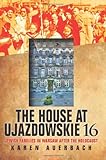
Karen Auerbach. The House at Ujazdowskie 16: Jewish Families in Warsaw after the Holocaust. The Modern Jewish Experience Series. Bloomington: Indiana University Press, 2013. 264 pp. $28.00 (cloth), ISBN 978-0-253-00907-4.
Reviewed by Anna Cichopek-Gajraj (Arizona State University)
Published on H-Poland (January, 2015)
Commissioned by Paul Brykczynski
Jewish Assimilation in Postwar Poland
In her important study The House at Ujazdowskie 16: Jewish Families in Warsaw after the Holocaust, Karen Auerbach, a scholar of modern East European Jewish history, follows the paths of ten families and three generations who, at various points, made their home at 16 Ujazdowskie Avenue in postwar Warsaw. Through these families, she explores childhood and early adulthood in prewar Poland, survival in hiding or in the Soviet Union, and postwar return to Poland. Auerbach traces the families’ postwar trajectory from the building of Communism via the publishing institutions of postwar Poland, through greater and lesser disappointments and eventually to their final disassociation from the Communist regime. She then describes their children’s childhood in 1950s and ’60s Poland, often in radically secular homes distanced from their Jewish background. Auerbach presents the antisemitic campaign of 1968 as a turning point that forced all of the “Ujazdowskie children” to confront their Jewishness through emigration or further assimilation. She ends with a description of the youngest generation of Warsaw Jews, who are most willing to reclaim their Jewishness in contemporary Poland.
Auerbach’s work deserves the highest praise as it is the first attempt at a comprehensive study of Jewish assimilation across generational lines covering the last eighty years of post-Holocaust Poland. She claims that “the families’ histories are an example of the paths by which Polonizing Jews sought entrance into nineteenth- and twentieth-century Polish society as well as the ambiguous fate of those aspirations. Their assimilation into Polish society over the course of the postwar generations in Poland coexisted in tension with antisemitism and emigration which underscored integration’s limits” (p. 5). Further, she writes that “in this history we confront in exaggerated form the very problem of defining Jewishness in modernity and the ever-present question of how to incorporate Jewish identity into a sense of belonging to the countries in which Jews live” (p. 9). With these questions, Auerbach probes the central themes of social Jewish history. Using a microhistorical theoretical framework, she shows that assimilation in postwar Poland had its limits even when antisemitism did not pose an immediate threat. Although the parents distanced themselves from such markers of Jewish identity as language and religion, their social networks—spouses and friends—remained Jewish. It was only the next generation that would take a step further toward, what historian Todd Endelman (Radical Assimilation in English Jewish History, 1656-1945 [1990]) called, “radical assimilation” and marry and befriend mainly non-Jews.
Auerbach makes a convincing argument as she beautifully weaves together the personal and the political. With knowledge, skill, and nuance, she narrates personal dramas cast on a backdrop of postwar Polish history. She reports that Szymon Rudnicki once told her, “You could write the entire twentieth-century history of Poland through this building” at 16 Ujazdowskie (p. 189). And she does. Her scholarly and journalistic talent is on full display. She writes beautifully with an extraordinary sensibility and understanding of the personal: of individual choices and of experiences. She offers a nuanced and deeply human narrative with an excellent contextualization of Warsaw, Poland, and Eastern Europe in the twentieth century. The reader can almost feel the impact of broader political developments on individual lives. The city of Warsaw gets its voice as well. This center of postwar Communist and opposition politics becomes an important presence in her narrative. The reader gets an excellent sense of the streets and buildings that made up the very fabric of postwar lives.
Auerbach uses an impressive source base, including oral interviews, personal papers and writings, published memoirs, and newspapers and archival collections in Polish and Yiddish. However, her use of oral history requires more theorization considering that it makes up such a key aspect of her analysis. She tackles the pitfalls of personal memory only briefly and, some might argue, insufficiently. Also, she does not explicitly situate herself in the broader historiography of Jewish assimilation and communism. Auerbach does not use Endelman’s work on radical assimilation, which could have helped better articulate her argument. Path-breaking work on Jewish Communism by historians Marci Shore (Caviar and Ashes: A Warsaw's Generation Life and Death in Marxism 1918-1968 [2009]) and Jaff Schatz (The Generation: The Rise and Fall of the Jewish Communists of Poland [1991]) obviously inform her work but she does not explicitly position herself vis-à-vis these authors. Most disappointing is her conclusion or lack thereof. The reader looks to her epilogue for a closing argument that would bring together all that she has so brilliantly accomplished in her narrative. But it is not there. The epilogue only describes Auerbach’s personal road to her research and adds more characters with tenuous connections to the main body of her work, leaving the reader without a conclusion.
These minor critiques notwithstanding, Auerbach’s book is undoubtedly an achievement. Beautifully written and skillfully contextualized, her study of Jewish assimilation in postwar Poland will become a must read for everyone interested in twentieth-century Polish-Jewish history.
If there is additional discussion of this review, you may access it through the network, at: https://networks.h-net.org/h-poland.
Citation:
Anna Cichopek-Gajraj. Review of Auerbach, Karen, The House at Ujazdowskie 16: Jewish Families in Warsaw after the Holocaust.
H-Poland, H-Net Reviews.
January, 2015.
URL: http://www.h-net.org/reviews/showrev.php?id=42232
 | This work is licensed under a Creative Commons Attribution-Noncommercial-No Derivative Works 3.0 United States License. |

