

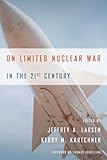
Jeffrey A. Larsen, Kerry M. Kartchner, eds. On Limited Nuclear War in the 21st century. Stanford Security Studies Series. Stanford: Stanford University Press, 2014. 312 pp. $27.95 (paper), ISBN 978-0-8047-9089-5; $90.00 (cloth), ISBN 978-0-8047-8912-7.
Reviewed by James A. Russell (Naval Postgraduate School)
Published on H-Diplo (November, 2014)
Commissioned by Seth Offenbach (Bronx Community College, The City University of New York)
America today suffers from a pronounced and enduring strategy deficit. Everywhere Americans turn, they are confronted by decisions and actions taken by the country around the world that seem disconnected from anything remotely resembling careful consideration of ends, ways, and means. Instead, Americans are left with a decade of failure in two irregular wars, knee- jerk reactions by political leaders to world events, wildly inflated threats that seem driven by the media, military leaders who do not know what strategy is, and last (but not least) a public that appears disinterested in America’s global interests and objectives.
The same, it has to be said, goes for the strategic studies community in the academy. In academics’ mad rush to appear relevant in this era of irregular war, many of the scions of the academy at such places as Harvard, Yale, Columbia, Princeton, New York University, and Stanford have enlisted a bevy of retired generals who have returned home from their failure on the battlefield to trumpet their insights and accomplishments to students and eager news reporters at cable TV networks. It’s a mess.
As noted by Thomas Kuhn, however, in his seminal work The Structure of Scientific Revolutions (1962), out of the wreckage of intellectual discombobulation and paradigmatic anomaly can come new ideas that propose a different set of relationships between variables that suggest new ways of thinking about phenomena. In short, out of the seeds of failure and disaster can sprout intellectual rigor, sound analysis, and forward thinking. In Jeffrey A. Larson and Kerry M. Kartchner’s edited volume On Limited Nuclear War in the 21st Century, the strategic studies community has answered the proverbial call in a series of trenchant essays that deconstruct a critical national security challenge that most of us wish did not exist. Assembling a star-studded cast of scholars, analysts, and policy practitioners, Larsen and Kartchner have produced some of the most important new thinking on an old topic since the foundational works of Bernard Brodie (Strategy in the Missile Age [1959]), Charles Osgood (Limited War Revisited [1979]), and Henry Kissinger (Nuclear Weapons and Foreign Policy [1957]) were published.
Perhaps the most significant thing about this book is that it was written at all, the brainchild of two editors and a publisher willing to bring it to press. As noted by Larsen and Kartchner in the volume’s introduction, we cannot and should not ignore the perils of a world in which nuclear weapons remain in the hands of states in adversarial relationships and a world in which some state- and non-state actors continue to see nuclear weapons as a useful instrument. The nature of the strategic environment demands that we confront the possibility of a war in which nuclear weapons are used short of mutually assured destruction scenarios.
As Mark Trachtenberg has argued in History and Strategy (1991), the “golden age” of strategic thought in the United States was relatively short- lived and has been relegated to minor status in the academy. Larsen and Kartchner, however, maintain that it is time to dust off and update the arguments of this earlier era to help prepare us for variations in the “unthinkable.” In this vein, this book is a good companion to Planning the Unthinkable: How New Powers Will Use Nuclear, Chemical, and Biological Weapons (edited by Peter R. Lavoy, Scott D. Sagan, and James J. Wirtz) volume published in 2001.
In chapter 2, “The Origins of Limited Nuclear War Theory,” Andrew Ross cogently notes that the questions surrounding the uses of these weapons short of total war received much attention at the dawn of the nuclear era. Brodie, Kissinger, and Osgood all grappled with the problem of applying nuclear weapons in coercive bargaining frameworks. Ross covers the intellectual landscape of these earlier works to remind us that there is still a rich mother lode of thinking from this era that can elucidate the problems of the present.
The volume is sensibly organized into three sections. Part 1 assesses the history of limited war theories. Part 2 covers the risks of twenty-first- century nuclear war. Part 3 provides a series of essays that examine the challenges posed by nuclear war in the twenty-first century. Each of these sections consists of a series of essays that address different aspects of the phenomenon. The essays are all approachable, and fit nicely into the volume’s organizational structure.
Three of the chapters are particularly noteworthy. In chapter 8— “The End of the Nuclear Taboo?”—George Quester takes on the critical issue of nuclear nonuse that has sought to explain why no states have used nuclear weapons since the end of World War II. Quester cautions against believing in the viability of any taboos in the twenty-first century. In chapter 6, “Future Scenarios of Limited Nuclear Conflict,” Tom Mahnken analyzes the range of possible situations in which actors would consider limited nuclear use. Not surprisingly, Mahnken’s analysis finds that these scenarios abound, raising challenges for America’s deterrence and assurance strategies around the world. In chapter 8, “On US Preparedness for Limited Nuclear War,” Bruce Bennet examines the applicability of the U.S. nuclear arsenal for limited war contingencies. In chillingly meticulous detail, Bennet maps out the missions each leg of the triad could be expected to fill in limited war scenarios.
The point of the volume is that the United States needs to reengage in a meaningful dialogue about serious strategic questions—starting with the role that nuclear weapons play in defense strategy and policy. This is a book for any courses in strategic studies and is clearly relevant to policy professionals and practitioners. As represented by the great collection of authors in this volume, there clearly is a community of professionals and academics capable of informing and guiding this critical debate. Kudos to the editors and publisher for getting the discussion started.
If there is additional discussion of this review, you may access it through the network, at: https://networks.h-net.org/h-diplo.
Citation:
James A. Russell. Review of Larsen, Jeffrey A.; Kartchner, Kerry M., eds., On Limited Nuclear War in the 21st century.
H-Diplo, H-Net Reviews.
November, 2014.
URL: http://www.h-net.org/reviews/showrev.php?id=42207
 | This work is licensed under a Creative Commons Attribution-Noncommercial-No Derivative Works 3.0 United States License. |

