

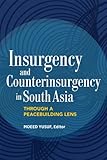
Moeed Yusuf, ed. Insurgency and Counterinsurgency in South Asia: Through a Peacebuilding Lens. Washington, DC: United States Institute of Peace Press, 2014. 328 pp. $24.95 (paper), ISBN 978-1-60127-191-4.
Reviewed by Chris Colley (Indiana University)
Published on H-Diplo (February, 2015)
Commissioned by Seth Offenbach (Bronx Community College, The City University of New York)
Approaches to Insurgency and Counterinsurgency in South Asia
The edited volume Insurgency and Counterinsurgency in South Asia is a timely book that examines insurgencies and counterinsurgencies (COIN) in India, Nepal, Pakistan, and Sri Lanka. The volume brings together nine South Asian experts who explore the underlying causes of violence as well as attempts by the various states to deal with the conflicts. Each of the nine core chapters is a detailed case study that traces the process of the various insurgencies. The authors explore the conflicts through different lenses and while not always directly speaking to each other’s work, provide a fine-grained description and analysis of each conflict. This volume contributes to the literature in that it provides a South Asian perspective on violence and in several of the chapters up-to-date interpretation of specific insurgencies. A chief goal of the volume is to focus more attention on insurgencies rather than on terrorism, which the editor believes has dominated recent works on South Asia (p. 6). The editor also feels that previous work on these insurgencies has placed these conflicts in “silos” that fail to explain the important links between the causes and characteristics of particular insurgencies and between the way states react to these rebellions (p. 7).
Much of the recent work on insurgencies and COIN has focused on American military efforts in Iraq and Afghanistan. This volume contributes to our understanding of the broader field. Readers are presented with three chapters on the insurgency in Kashmir. In Happymon Jacob’s chapter on Kashmir, he argues that at its core the conflict can be traced to New Delhi’s denial of democracy to the state as well as repeated attempts to destroy various democratic institutions. He writes that while third-party involvement by Pakistan was a key aspect of the insurgency, domestic causes are much more important in explaining violence than external factors.
Rekha Chowdhary’s chapter has a strong focus on the involvement of Pakistan in the Kashmir conflict and does a fine job of complementing Jacob’s chapter. Her essay also speaks to various models of COIN which often stress the need to find political rather than military solutions to insurgencies. Chowdhary points out that the security forces in Kashmir were not trained to deal with the situation they confronted. Importantly, the Indian state was influenced by its approach to insurgencies in the Punjab and the northeast. In these conflicts the state relied initially on a heavy kinetic approach to COIN that was not successful. Chowdhary argues that military solutions in Kashmir were counterproductive. Of great importance to scholars of COIN and security in general, is the “learning process” a state goes through in carrying out COIN. Chowdhary points out that in the mid-1990s, this process started to take shape as members of the military and government recognized they had mishandled the situation and a political settlement was required.
The volume does provide a Pakistani perspective of the insurgency in Khalid Mahmood’s chapter. His contribution traces the process of Pakistani involvement and offers an account of the negotiations for peace. Interestingly, he argues that peace was not achieved because the “net was not cast wide enough to bring those that mattered on board” (p. 91). He further claims that the judicial crisis in Pakistan in 2007 was the final blow to Pakistan’s attempts at peace. While his chapter is mostly descriptive, it does provide an interesting insight into the Pakistani side of the conflict.
The insurgency along the Pakistani border with Afghanistan is the subject of the fourth and fifth chapters of the volume. Muhammad Amir Rana, in his chapter, provides a detailed background to the conflict and to the multiple militant groups. Importantly, for the purpose of COIN, he argues that the Pakistani military was not trained for COIN operations and this helps explain some of the challenges the state has encountered. This lack of training is a very important factor in COIN operations. Perhaps one shortcoming of the chapter and the book in general, is the scant attention devoted to models of COIN and the theoretical literature that has been developed on COIN over the previous decades. This does not detract from Rana’s chapter, but it would provide for a more complete chapter.
Shaukat Qadir’s piece on Pakistan does adhere more to the literature on COIN. He points out that the Pakistani state has lacked a broad-based holistic COIN strategy over the past decade. Like Rana’s chapter, Qadir’s argues that the state did not take the insurgents seriously in the initial stages of the conflict). However, Qadir writes that since 2009 the government has started to change its tactics. This assertion is valuable in that it contributes to the broader context of COIN literature. He also argues that COIN must be won through reinforcing law and order as well as supporting certain economic and political changes. The fact that the military is now training Pakistani police in COIN tactics and that the government is using the media in its strategy is important. Qadir’s chapter is helpful in addressing these aspects of COIN, but greater elaboration on the governments COIN operations would be helpful in a separate chapter as this may be of great interest to both the scholarly community and those in government.
The Maoist rebellion in Nepal is analyzed by both S. D Muni and Bishnu Raj Upreti. Muni provides a solid background to the conflict and highlights some of its roots causes such as the sense of neglect and discrimination that led to a fertile recruiting ground for the Maoists and their “people’s war.” He also breaks the insurgency into two distinct periods, the first from 1996 until 2001 and the second, from 2001 until 2006. His chapter is a good descriptive account that will appeal to areas specialists, but it does not necessarily speak to the broader literature.
In contrast, Upreti’s contribution speaks to the generalizability of the conflict and may be of interest to political scientists. In setting up a conceptual framework, he divides the conflict into four different phases. This chapter complements Muni’s piece and has a greater focus on the actual conflict. Importantly for those interested in the current state of affairs in Nepal, his chapter examines the situation in the post-2006 environment. Specifically, he discusses the political struggles such as the difficulty in the rehabilitation and integration programs designed to incorporate the Maoists into the national army and the political process. As of the publication of this volume this has not yet taken place and Upreti believes this paramount to the overall peace process.
This final section of the book deals with the civil war in Sri Lanka. In their two chapters, Chalinda D. Weerasinghe and Kumar Rupesinghe provide readers with a thorough description and analysis of the conflict. Weerasinghe explains what he sees as three interrelated causal dimensions of the conflict that deal with political, economic, and ethnoreligious variables. The Sinhala-language-only policies were a significant cause of Tamil grievances that helped to ignite the 1983 riots and subsequent civil war. Importantly, he also discusses the key issue of a credible commitment problem. He argues that the Sri Lankan government is not interested in committing to a future that would include a meaningful place in Sri Lanka for the minority Tamils. This analysis speaks to the civil war literature and highlights a common deal breaker in ethnic conflicts around the world. Weerasinghe asks a key question of whether majoritarian democratic systems undermine ethnic politics, especially in cases with majority coalitions.
In his chapter on Sri Lanka, Rupesinghe traces the rise of the Liberation Tigers of Tamil Eelam (LTTE) and highlights the role of India as a third party in the conflict. His chapter will be of interest to scholars and policymakers who study third-party intervention. For example, in 1987, thirty-two training camps for the rebels were set up in India’s state of Tamil Nadu. These camps hosted over 20,000 insurgents. This chapter may be considered controversial as he downplays the estimated 40,000 civilians who were believed killed during the last stages of the conflict that resulted in government victory. To be fair to Rupesinghe, he does question whether the victory is complete. His chapter may be particularly relevant to those who advocate or question military solutions to protracted insurgencies. The scorched earth, kinetic approach is not at all about winning “hearts and minds” and does not address the root causes of conflict. In this regard it is likely too early to judge whether the government’s victory is permanent or just another delay in a conflict that has festered for over half a century.
Overall, this volume will be of interest to South Asia area specialists, journalists covering the region, as well as policymakers. The in-depth analysis and attention to detail in each of the four cases is well done. Political scientists, however, may be slightly disappointed in the book. While the volume does mention various practices related to COIN and hints at models of COIN, it does not provide a comprehensive model or theory of COIN in its collection of essays. Some of the articles do address political science literature, but they do not deeply engage it. For the academic and theoretically driven community this is a drawback. The case studies provided do fit into the existing COIN literature. The examples of third-party intervention are particularly relevant to scholars of civil war. The case of Sri Lanka is of interest to those engaged in the study of complete military victory and credible commitments in conflict. The volume could also use a chapter on relevant COIN operations to place South Asia in the universe of cases. The literature on COIN models and theory would be a welcome addition to the book. One more slight limitation of the volume is the heavy reliance on secondary sources. The vast majority of citations are not primary sources and are not attributed to fieldwork. These criticisms aside, the volume offers a very good description of four cases of insurgency and COIN. It is here that the book makes it greatest contribution.
If there is additional discussion of this review, you may access it through the network, at: https://networks.h-net.org/h-diplo.
Citation:
Chris Colley. Review of Yusuf, Moeed, ed., Insurgency and Counterinsurgency in South Asia: Through a Peacebuilding Lens.
H-Diplo, H-Net Reviews.
February, 2015.
URL: http://www.h-net.org/reviews/showrev.php?id=42205
 | This work is licensed under a Creative Commons Attribution-Noncommercial-No Derivative Works 3.0 United States License. |

