

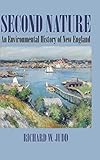
Richard William Judd. Second Nature: An Environmental History of New England. Amherst: University of Massachusetts Press, 2014. 344 pp. $24.95 (paper), ISBN 978-1-62534-066-5; $80.00 (cloth), ISBN 978-1-62534-101-3.
Reviewed by Katherine Grandjean
Published on H-Environment (August, 2014)
Commissioned by David T. Benac (Western Michigan University)
Of Tilled Fields and Thirsty Cities: New England Environmental History, On Balance
Beneath the Quabbin Reservoir, in what was once the Swift River valley of central Massachusetts, lie four submerged towns. Old roads lead, eerily, to the edge of the water. Local legend persists that when the reservoir’s water level falls, a pointy church steeple can be seen rising from below. (It’s a myth: All of the buildings in the immersed towns were torn down, before the flooding. Only cellar holes remain.) The towns were sacrificed because, in the early twentieth century, Boston was thirsty. Despite years of seeking additional water sources, and dams built on both the Sudbury and Nashua Rivers to create reservoirs, the city needed water. So, in 1938, Massachusetts simply dissolved the four towns to prepare for the Quabbin’s creation. Town residents fought the move all the way to the Massachusetts Supreme Judicial Court, but lost. Homes were bulldozed. 7500 bodies were exhumed and relocated to new cemeteries. Then the flooding began. Dana, Enfield, Greenwich, and Prescott, Massachusetts, in the meantime, became known as the “drowned towns.”[1]
They are almost as submerged, although not quite, in Richard W. Judd’s sweeping new synthesis of New England environmental history, Second Nature: An Environmental History of New England. The book covers the entirety of the human era in New England, from the first human arrivals to the “rewilding” movements of recent years. Judd’s objective in Second Nature is to find a path between the “environmental determinism” so characteristic of early works of environmental history (in which human actors are pushed, almost involuntarily, in particular directions by nature) and the more recent declension narrative (in which historians cast “culture as antagonistic to and dominant over nature”) (p. ix). Representative of this latter camp, he contends, are such influential works as William Cronon’s Changes in the Land: Indians, Colonists, and the Ecology of New England (1983) and Carolyn Merchant’s Ecological Revolutions: Nature, Gender, and Science in New England (1989). He’s right: Cronon and Merchant, among others, are glum about the effects of men and industry on environment. Judd amends previous studies by covering a much longer chronology, but he also aims to be more balanced.
He sees in the New England environment, in fact, a special balance between “nature and artifice.” This is, to Judd, the “second nature” of the book’s title—an equilibrium between human manipulations and the natural world, marked by New England’s archetypal landscape of forest, farm, and village. How did such a mixed environment come to be? he asks. The book’s three sections explore social and economic developments for answers. Part 1, “The New World Transformed: New England to 1800,” much like Cronon’s Changes in the Land, details the transition from a regional environment managed by Native people to one shaped more markedly by colonists. Strained resources “devastated” Indians, Judd writes, but the era also witnessed the advent of a “Puritan second nature”—mixed farming and painstaking divisions of land that resulted in early New England’s patchwork of “garden, tilled field, pasture, orchard, meadow, stream, and woodland” (pp. 18-19, 84-85).
Part 2, moving into the nineteenth century, delves into the paradoxes of New England’s industrial age. “By the end of the century,” Judd attests, “New Englanders were more alienated from nature and, at the same time, more attuned to the natural elements in the landscapes around them” (p. 95). Alongside developments in fishing, logging, manufacturing, mills, and other industries, Judd finds the origins of New Englanders’ appreciation of nature. He appropriately sets transcendentalism, and the musings of men such as Henry David Thoreau, against industrialization: the literary and the economic were intertwined. Judd also points out that farms and factories coexisted in nineteenth-century New England; rather than inhabiting mutually exclusive space and time, they were “partners in a regionwide agro-industrial transformation” (p. 123). We learn, similarly, in part 3 (“Conservation”), that exploitation and conservation went hand in hand. New Englanders largely pioneered the nation’s earliest attempts at conservation, Judd writes, and often that meant preserving and protecting altered landscapes—not simply the pristine pockets of “first nature,” but even “industrialized rivers” and “urban neighborhoods” (p. 178).
Second Nature’s scope—the effort to bring fisheries, reforestation, colonial wars, and romanticism into the same arena, in a long durée history—makes it an important and impressive work. In his dedication to looking for the origins of the evolving New England environment, Judd misses some opportunities to reread particular episodes of the region’s history in light of environmental developments, and to provide a more nuanced narrative of mankind’s interplay with natural history. He overlooks recent scholarship, for instance, on the environmental factors that shaped early English settlement and contributed to the Pequot War and King Philip’s War, pitting colonists against Native people.[2] He also opts to avoid much discussion of how environmental strains, battles, and changes dovetailed with later social and political developments, like immigration and the Depression. One can imagine a New England environmental history more akin to Mark Fiege’s recent offering, The Republic of Nature: An Environmental History of the United States (2012), which more seamlessly integrates the standard narrative of American history with attention to environmental forces. But, to be fair, that isn’t Judd’s project.
Readers will admire Judd’s clear writing and evenhandedness. His book is engaging and ready to be mined by lecturers. Still, it is hard to shake the feeling that all, in environmental history, is not balanced. The region’s major public works projects were, for instance, as Judd implies, things of awe. By many measures, the Quabbin Reservoir was a major feat of civil engineering, and to this day, it serves millions of Massachusetts residents. But that feat came at the expense of 2,500 people who, with little compensation, were told that they could never go home again. Aside from displacing several thousand souls, the Quabbin’s creation may also have rendered untenable any further efforts to claim rural resources for urban residents.[3] Some may want to read more about such political fallout, or about other particularly thorny episodes of the region’s history.
Nonetheless, even those prone to look for gloomy tales of drowned towns and fouled rivers will find much of use in this book. Second Nature is a much-needed ecological overview of New England’s history and will be a useful resource for students, teachers, and other readers alike.
Notes
[1]. Ben Cosgrove, “Drowned Towns: Preserving the Lost Communities of the Swift River Valley,” The Harvard Advocate (Winter 2009), accessed at <http://www.theharvardadvocate.com/content/drowned-towns-preserving-lost-communities-swift-river-valley>.
[2]. See, for example, Virginia DeJohn Anderson, “King Philip’s Herds: Indians, Colonists, and the Problem of Livestock in Early New England,” William and Mary Quarterly 51, no. 4 (1994): 601-624; and Katherine A. Grandjean, “New World Tempests: Environment, Scarcity, and the Coming of the Pequot War,” William and Mary Quarterly 68, no. 1 (2011): 75-100.
[3]. Sarah Elkind, Bay Cities and Water Politics: The Battle for Resources in Boston and Oakland (Lawrence: University Press of Kansas, 1998), 165.
If there is additional discussion of this review, you may access it through the network, at: https://networks.h-net.org/h-environment.
Citation:
Katherine Grandjean. Review of Judd, Richard William, Second Nature: An Environmental History of New England.
H-Environment, H-Net Reviews.
August, 2014.
URL: http://www.h-net.org/reviews/showrev.php?id=42132
 | This work is licensed under a Creative Commons Attribution-Noncommercial-No Derivative Works 3.0 United States License. |

