

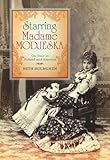
Beth Holmgren. Starring Madame Modjeska: On Tour in Poland and America. Bloomington: Indiana University Press, 2012. 432 pp. $39.95 (cloth), ISBN 978-0-253-35664-2.
Reviewed by Kyrill Kunakhovich (Harvard University)
Published on H-Poland (December, 2014)
Commissioned by Paul Brykczynski
On Tour in Poland and America
Beth Holmgren’s latest work tells the story of Helena Modrzejewska, one of the leading stage actresses of the nineteenth century and a major star in Poland and America. Born in Krakow in 1840, Modrzejewska ascended through the ranks of provincial stages to become the prima donna of Warsaw’s imperial theaters. Then, at the height of her popularity—at age thirty-six—the actress left Warsaw for California, where she anglicized her name to Modjeska and began her career anew. Holmgren’s account follows Modrzejewska’s journey in both countries, ably weaving Polish- and English-language sources into a revealing portrait of an itinerant life. In remarkable detail, it reconstructs Modrzejewska’s artistic development, social circle, and cultural imprint over the span of two continents and seven decades. Above all, Holmgren explores how the actress fashioned herself on stage and off, paying special attention to her three greatest roles: as a Polish patriot, a Polish American migrant, and an American theater star.
Through Modrzejewska’s early career, Holmgren deftly traces the links between theater, class, and nationalism in partitioned Poland. Growing up in the era of national uprisings, the actress developed “a patriotism of soldierly discipline and dramatic display [that] steeled her commitment to acting” (p. 32). Yet the theater also offered a path of upward mobility for this unmarried mother from a humble background. As Modrzejewska’s star rose, she gained entry to the salons of noble families like the Potockis, where she “eagerly train[ed] to act naturally as a lady” (p. 60). The actress eventually married an aristocrat, Karol Chłapowski, and this new social status proved a boon to her career: once Modrzejewska “had achieved the innate theatricality of a Krakow aristocrat,” Holmgren argues, her acting won new plaudits from viewers and critics alike (p. 102). Surrounded by a circle of admiring writers—including Henryk Sienkiewicz and Stanisław Witkiewicz—the actress turned into a national sensation, feted and celebrated across the partitions. Yet it was only by leaving Poland, paradoxically, that she truly became a national icon. Foreign acclaim made Modrzejewska “close to omnipotent in the theater and society,” allowing the actress to transcend petty politicking and take on a symbolic role (p. 114). As a genteel, successful “cultural ambassador,” she morphed into a full-fledged representative of the Polish nation (p. 14).
Modrzejewska left for America in 1876, accompanying her husband on a quixotic quest to set up a utopian community near Anaheim. The community quickly went under, plagued by poor planning and insufficient expertise, but the failure of this “California dream” allowed the actress to chase another on the San Francisco stage (p. 123). While Modrzejewska’s profession and notoriety set her apart from most Polish migrants, she shared many of their basic challenges, and Holmgren uses her story to shed new light on the Polish American experience. In contrast to foreign stars like Sarah Bernhardt, Modrzejewska always insisted on performing in English, even as she struggled to shed her accent and to learn a new repertoire. Socially, the actress and her husband became “ensconced among her adopted nation’s cultural elite,” forging friendships with Henry Wadsworth Longfellow, the critic William Winter, and the actor Edwin Booth (p. 206). Still, Modrzejewska maintained close ties with Polish American communities across the United States, and especially with Polish Catholic churches, which she regularly attended and patronized. The actress also wasted no opportunity to promote Polish causes among her American friends, integrating Polish plays into her repertoire and even advocating Poland’s independence—an act of defiance that earned her a ban from Russian authorities in Warsaw. Like many immigrants, Holmgren concludes, Modrzejewska/Modjeska lived a binational life, inevitably engaged in a process of “constant self-translation” (p. 254).
In tracking Modrzejewska’s career, Holmgren paints a rich picture of American theater at the turn of the twentieth century, as it evolved from lowbrow entertainment to high art. The noble bearing that the actress cultivated in Poland proved a major selling point in America, where she and her husband, “Count Bożenta,” were presented as European aristocrats. (Notably, such a presentation carried no traction in London, and Modrzejewska’s attempts at an English career fizzled out in a matter of months.) Trading on this image, Modrzejewska focused on Shakespearean roles, which also realized “her self-imposed mission of socially uplifting and artistically advancing the American stage” (p. 153). At the same time, the actress worked to expand the canon by incorporating new works of European realism, such as Henrik Ibsen’s A Doll’s House and Hermann Sudermann’s Magda. Both productions scandalized critics with their sympathetic portrayal of fallen women but offered Modrzejewska a rare opportunity to tackle unconventional female roles. Holmgren shows how the nineteenth century’s star system gave actors wide leeway to choose their repertoire, staging, and ensemble. As one of America’s biggest stars, Modrzejewska was instrumental in creating a “highbrow American theater” while enjoying “a broader professional and personal latitude than she ever would have attained in Poland” (p. 206).
Holmgren’s study is a truly transnational biography, elegantly written and immaculately researched. Its real achievement is to make Modrzejewska whole, not just by bridging two national narratives but by integrating her public and private personae. Alongside an actress gaining fame, we see a merchant’s daughter striving for respectability, an immigrant trying to make sense of a new world, and a mother raising her son in an unfamiliar landscape. What is more, we see how these personal challenges forged a distinguished artistic identity. As Holmgren suggests, Modrzejewska’s professional success stemmed in no small part from her ability to move between different countries, cultures, and classes. The actress became adept at playing roles both on stage and off, shrouding her life in an aura of legend. At times, Holmgren seems to indulge in this legend herself: lengthy quotations from critics establish Modrzejewska as a star of the highest order, so as to persuade the reader that she “belongs” with Booth and Bernhardt. In effect, Holmgren carries on her subject’s cherished mission to “demonstrate ... Poland’s cultural greatness to the world” (p. 14). In this sense as in many others, Holmgren stays true to Modrzejewska, crafting a complex and evocative portrait. Starring Madame Modjeska will be of interest to scholars of nineteenth-century Poland, world theater, and American immigration.
If there is additional discussion of this review, you may access it through the network, at: https://networks.h-net.org/h-poland.
Citation:
Kyrill Kunakhovich. Review of Holmgren, Beth, Starring Madame Modjeska: On Tour in Poland and America.
H-Poland, H-Net Reviews.
December, 2014.
URL: http://www.h-net.org/reviews/showrev.php?id=42098
 | This work is licensed under a Creative Commons Attribution-Noncommercial-No Derivative Works 3.0 United States License. |

