

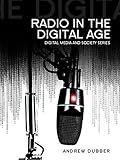
Andrew Dubber. Radio in the Digital Age. Cambridge: Polity Press, 2013. 208 pp. $22.95 (paper), ISBN 978-0-7456-6197-1; $64.95 (cloth), ISBN 978-0-7456-6196-4.
Reviewed by Anya Luscombe (University College Roosevelt)
Published on Jhistory (July, 2014)
Commissioned by Heidi Tworek (University of British Columbia)
Readers who choose this book thinking it is about digital radio are wrong, Dubber writes. “It is not about the digitalization of radio broadcasting or about the development of digital broadcasting platforms ... nor about podcasting, online music services, timeshifting, or iPods.” Instead, it is “about radio—and everything radio means—in an age that is characterized by digital media.” He goes on to say that the book “considers the ‘age’ as the thing that is digital, rather than the media itself” (p. 16). Given the aptly chosen title of the book, Radio in the Digital Age, it is surprising that the difference has to be spelled out. Perhaps it is because Dubber tries to do something that few others have attempted so far: to offer a wide-ranging, provocative discussion of the idea of radio and its complexities and of the elements that in the digital age remain constant and those that no longer apply or have been altered.
It would be a mistake to think, however, that this book is merely a theoretical or philosophical consideration of radio in an age intrinsically different than the electronic and analogue one. Dubber makes use of many vivid examples to consider the new technology, new programs, and new forms of interaction in this digital time period. Indeed, it is in using concrete examples—including those that mention podcasting, online music services, timeshifting, and iPods—that his interpretations of radio in a digital age come alive. This is where the book’s strength lies. His exposition of theoryin the first two chapters, however, is rather confusing. Dubber attempts too much: a discursive categorization of radio to consider what radio is, along with discussions of techne and time, ages of media, ontology of media affordances, and the ecology of tele-information services. In the following chapters, he frequently refers back to only media affordances and the idea of Allocution (which as he explains on page 41 he borrows from Jan L. Bordewijk and Ben van Kaam’s modes of “tele-information services”[1]), which helps the reader to understand the complexities of radio in this new age. His explanation of “affordances,” in other words, a “potential that subsists within a shared context, which may be selected, intended, and acted upon,” is particularly useful (p. 35). Just as when there is a table in the room, an affordance of the room (but not a compulsory activity) is tabletop dancing, Dubber’s analogy runs. So too the digital media environment offers affordances that we can choose to take or leave.
When reading about the ten discursive frames of radio that Dubber posits in chapter 1, one initially wonders why it is necessary to attempt such a categorization—is it really that hard to accept that we share a common understanding of radio? Dubber argues that radio has no fixed characteristics and the ten discursive frames are needed to discuss shifts in factors that have influenced and continue to influence the medium. So much more the pity then that while undoubtedly implicit throughout the book, these frames only appear explicitly again in chapter 8; it would have helped the coherence of the work to spell out why the frames are relevant in each separate area that Dubber examines: everyday life, music, stories, technology, and society. Chapter 1 would furthermore have benefited from a brief outline of what the reader could expect in the following chapters.
Chapters 3-7 offer a fascinating and comprehensive discussion of how radio in the digital age shapes our lives and is shaped by the “affordances” of the age. Chapter 3, “Radio and Everyday Life,” examines timeshifting, podcasting, and the illusion of localism. Audiences can choose to listen to radio programs at times that suit them; listeners can pause, skip, or resume programs; and programming, no longer limited to schedules and timeslots, can be reedited or enhanced by program producers and audiences. As Dubber says, “in the digital age, interestingness may trump aural wallpaper as a deliberate programming strategy” (p. 52). However, digital also means quicker, which in turn leads radio industries to expect more from its workers in the same time frame or pay them less for the same quantity of work. Digital too means radio stations can sound more local by, for example, incorporating local advertising in programs that are produced nationally.
Similarly in chapter 4, Dubber explains how the digital environment may lead to the use of music programming to reward focused, deliberate listening by people and the creation of niche programs or supplementary material and extra radio channels through streaming media and web content. Conversely, economic factors and the power of major media networks in the digital age lead to restrictions on musical offerings. This oppositional tendency can also be seen in radio that tells stories, the subject of chapter 5. “Digital technology has enabled radio storytellers to take listeners on an imaginative journey in ways never possible before. However,... the automation, digitalization, and ever tighter radio formatting that have enabled radio institutions to make efficiencies ... have left little room for experimentation and deviation” (p. 102). In the rest of this chapter, Dubber gives numerous examples of how digital age radio can effectively capitalize on visual input; these include charmingly named initiatives, such as duckrabbit, Pickle, and Cowbird. The digital environment also gives nonprofessionals access to accessible and affordable media production tools, allowing them to create their own programs or contribute to programs developed by professionals.
Chapter 6 discusses the technology of radio and some of the differences between digital and analogue. Some of this information is somewhat repetitive. Dubber considers the issues involving DAB, HD, and satellite radio, giving insights into the situation in the United Kingdom, United States, and New Zealand. Chapter 7 moves the focus of the book from the affordances of the technologies to the “ends to which the medium is to be put [and] the political and economic framework” (p. 153). Dubber argues that the digital age fundamentally challenges the historical assumptions that nation-states could control or agree on radio transmissions. And, he goes on, while these new times and new affordances could theoretically give policymakers and technologists opportunities to innovate, in practice it looks like those currently in power will continue to determine the future for radio. Public broadcasters, Dubber believes, could take “on a role of thought leadership when it comes to the political economy of the media” (p. 166). Moreover, he hopes that community radio too can provide lessons for radio practitioners and scholars as they negotiate and think about the future of radio.
What is clear throughout the book is that the digital age means a brand new age for radio; Dubber calls it “The New Mythic Age of Radio.” While many of us still find ourselves in freefall, he argues, radio as a mythic force is back (p. 179). We may be afraid of all the changes or concerned about the future of radio, but Dubber finds no reason to worry. He does not, as he says, attempt to answer questions or solve problems related to radio in the digital age. Rather, he hopes to start a discussion in this important area of media studies. In that he succeeds. Much of his success is due to his lively way of writing and the way his enthusiasm and love for everything that constitutes radio is not only palpable throughout the book but also contagious.
Note
[1]. Jan L. Bordewijk and Ben van Kaam, “Towards a New Classification of Tele-information Services,” in McQuail’s Reader in Mass Communication Theory, ed. Denis McQuail (London: Sage, 2000), 113-124.
If there is additional discussion of this review, you may access it through the network, at: https://networks.h-net.org/jhistory.
Citation:
Anya Luscombe. Review of Andrew Dubber, Radio in the Digital Age.
Jhistory, H-Net Reviews.
July, 2014.
URL: http://www.h-net.org/reviews/showrev.php?id=42055
 | This work is licensed under a Creative Commons Attribution-Noncommercial-No Derivative Works 3.0 United States License. |

