

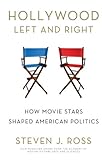
Steven J. Ross. Hollywood Left and Right: How Movie Stars Shaped American Politics. Oxford: Oxford University Press, 2013. 512 pp. $34.00 (cloth), ISBN 978-0-19-997553-2.
Reviewed by Brooks Flippen (Southeastern Oklahoma State University)
Published on H-USA (August, 2014)
Commissioned by Donna Sinclair (Central Michigan University)
Political liberals, many conservatives will argue today, dominate three important institutions: the media, the universities, and Hollywood. In this new book, University of Southern California film historian Steven J. Ross sets his sights on debunking the last of these three. Exploring the history of Hollywood from its inception through the present, Ross offers case studies of ten leading Hollywood figures, five liberal and five conservative. Alternating these studies in a rough chronological fashion, Ross suggests that it was the conservatives who had a longer and more direct influence on the nation’s political history. The liberals were more vocal and issue oriented—and more visible—but the conservatives produced more tangible results, among their lot a governor, a senator, and even a president. Of the ten figures Ross highlights, nine were actors and the tenth was an early producer and studio head.
At the outset Ross correctly notes that what movie stars think of politics does matter. He explains the motives of the House Un-American Activities Committee (HUAC) on the introduction’s first page: “They understood that movie audiences were also voters, and they asked themselves: Who would people be more likely to listen to: drab politicians or glamorous movie stars?” (p. 3). It is a truth so obvious that it is almost intuitive. Ross notes the intimacy that movie audiences feel for the actors they watch, adding that Americans love the stars when they stick to their projected image but brutally condemn them when they cross that image or show their flaws. Despite this truth, one cannot help but wonder if Ross overstates Hollywood’s importance. For example, also at the outset, Ross states definitively: “The conservative revolution of the 1980s could not have happened without the groundwork laid by Louis B. Mayer, his protégé George Murphy, and his protégé Ronald Reagan” (p. 4). Really? While Hollywood was important, was it the one essential ingredient without which history would have been different? This smacks of hyperbole, diminishing the influence of print and broadcast journalism, the campaigns of the politicians themselves, and a number of other factors.
One might expect an academic like Ross to denounce the historic influence of Hollywood in politics. In fact, Ross applauds Hollywood’s involvement, whether from the political Right or Left. Hollywood’s political activism has encouraged participatory democracy. Unlike paid political commentators motivated by ratings and profit, Hollywood’s activism has always been pure, of the heart. Tinsel Town’s activists were, in short, models of the Founding Fathers’ vision of a nation of citizen-statesmen.
Ross begins with the silent star Charlie Chaplin, whose political activism was the most subtle. Chaplin, the first Hollywood actor to spread a political message, quietly parodied and mocked authority, his antifascism evident in his comedic portrayal of Adolf Hitler but his embrace of communism, at least in its stated ideals, earning the wrath of much of the public. Louis Mayer, Ross continues, set the template for Hollywood Republicanism. Mayer got directly involved in the Republican Party’s media strategy and advised the GOP’s Herbert Hoover. In time he became the head of the California Republican Party. As the lone producer, Mayer remained largely out of the spotlight but his low-tax, business agenda advanced nevertheless. Ross explores the HUAC episode through the lens of actor Edward Robinson, “Little Caesar” to much of the public. Robinson’s antifascism became conflated with communism, earning him the wrath of anti-Semites and Red-baiters. It was a sad tale, the charges derailing Robinson’s career and leading him into depression and bitterness. Ross’s inclusion of George Murphy may appear surprising at first glance as the actor was perhaps the least well known of the figures discussed in the book. Ross argues, however, that Murphy’s ascension to the United States Senate foretold the rise of his more famous successors, Ronald Reagan and Arnold Schwarzenegger, both predictably covered. Of the liberals who got the most directly involved in politics, Warren Beatty stands out. Like Mayer advising Hoover, Beatty advised George McGovern and other Democrats, helping to champion the concert fundraiser. Like Mayer, however, Beatty remained relatively behind the scenes. When it came to the issues motivating liberals, Ross’s selections are obvious: Harry Belafonte and civil rights, and Jane Fonda and the Vietnam War. Of all the figures Ross includes, Charlton Heston is perhaps the most interesting, given his evolution from the political Left to Right, culminating in his famous advocacy for gun rights. Like Fonda, Heston seemed to enflame the opposition. Of all the figures Ross omits, perhaps one stands out the most: John Wayne. While mentioned in passing, the “Duke” embodied much of the rough and tough individualism and nationalism so attractive to the political Right.
Ross does an excellent job placing his subjects into context and, in this sense, his introductory chapter is essential. Ross notes the dynamism not only of national and world events but also of Hollywood, for example, the early importance of the studio system but the growing independence of the actors. Given the emotions that Hollywood evokes, Ross notes that the perceptions of political activism evolved. Many actors were—and undoubtedly remain—fearful of too great an involvement lest they alienate key segments of their audience, if not, at times, the government. Ross notes that the emergence of the twenty-four news cycle increased the celebrity status of actors, and thus augmented their potential political stage. There are many angles to this tale and Ross does a good job of tying them together.
Conservative readers may perceive a subtle bias in this work, for example, in one instance Ross suggests that the Democratic Party’s “democratization”—a term embodying a core principle that all Americans arguably share—“pushed Heston to the right” (p. 9). In another instance, Ross writes that the commentator Glenn Beck “succeeded in getting his audience to read (or at least buy) serious works of political theory such as Friedrich Hayek’s The Road to Serfdom” (p. 417). Implicit in this, of course, is the assumption that Beck’s conservative audience would not have otherwise been so interested in such an intellectual treatise. Ross notes that while conservatives and liberals alike “want a better world,” the conservative message was one of “fear and reassurance” while the liberal message was one of “hope and guilt.” The political Right “plays more to emotion,” Ross notes (p. 412). Since fear and emotions usually sway more voters than hope, the conservative message has had more direct political success. Fear and emotion—not exactly, a conservative might argue, a positive portrait of their movement. One could argue other subtle examples as well. While Ross’s position in academia will undoubtedly suggest to conservatives another institution that they perceive as biased—higher education—and thus underscore for them the impartiality in this book, the reality is that Ross for the most part does a good job of approaching his subject in a fair and equal manner. If nothing else, his argument is based in sound research, including a great number of archives. A complete bibliography might have helped at the end but the extensive citations include an impressive array of secondary literature.
This book will earn a wide audience. In addition to those trained and knowledgeable in modern American political history or American social history, movie lovers with no other interest in the past will be attracted to its biographical component. Ross is an excellent writer and the narrative flows smoothly, easy for a general audience to understand. While readers who do have a little broader background in the historical context will undoubtedly appreciate the story to a greater degree, Ross does not lose those less well informed. This book is absolutely terrific for students at any level of higher education. Given the familiarity that students have with celebrities—the celebrity culture that Ross notes—and the opinions many have already formed politically, they will undoubtedly want to speak up, encouraging classroom discussions. This text would make an excellent addition to any film history class, combining the text with clips of the movies or actors themselves.
The epilogue, like the introduction, is necessary to wrap up Ross’s tale, and once again Ross does a good job concluding. The epilogue carries the reader past the 2008 election cycle and mentions such entertainers as Fred Thompson, Oprah Winfrey, and John Stewart, suggesting, if nothing else, that historians have only begun to mine the subject. So much comes to mind that could have been added or explored, developments like the Internet or people like Angelina Jolie or Ben Affleck, to name only a few. Of course Ross could not have included it all. This book will probably prove more a beginning of the discussion than its end. As such, it is a welcome addition to the literature.
If there is additional discussion of this review, you may access it through the network, at: https://networks.h-net.org/h-usa.
Citation:
Brooks Flippen. Review of Ross, Steven J., Hollywood Left and Right: How Movie Stars Shaped American Politics.
H-USA, H-Net Reviews.
August, 2014.
URL: http://www.h-net.org/reviews/showrev.php?id=42048
 | This work is licensed under a Creative Commons Attribution-Noncommercial-No Derivative Works 3.0 United States License. |

