

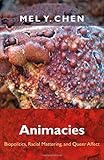
Mel Y. Chen. Animacies: Biopolitics, Racial Mattering, and Queer Affect. Perverse Modernities Series. Durham: Duke University Press, 2012. xi + 297 pp. $84.95 (cloth), ISBN 978-0-8223-5254-9; $23.95 (paper), ISBN 978-0-8223-5272-3.
Reviewed by Erin Kingsley (University of Colorado at Boulder)
Published on H-Disability (December, 2014)
Commissioned by Iain C. Hutchison (University of Glasgow)
Stitching Together Life
I put off picking up Mel Y. Chen’s Animacies: Biopolitics, Racial Mattering, and Queer Affect for quite some time. The paperback cover, featuring a close-up of a toad’s skin, is not welcoming, and the title similarly leaves one cold. “Animacies”: what does that word conjure up? Not a lot, other than animation, animate, and livelihood, and one glance at this book gathering dust on my desk did nothing to animate my soul. All this being said, however, I was pleasantly surprised when I began reading. Chen’s prose is animate; it leaps off the page and sparks in the reader both respect in Chen’s outstanding linguistic ability and wonder in the flow of her prose, her mastery of theoretical sources, and the flux of her intense, immense subject. Animacies is a good read, that rare academic monograph that illuminates its subject without putting its other subject, the reader, to sleep.
Animacies “draws upon recent debates about sexuality, race, environment, and affect to consider how matter that is considered insensate, immobile, deathly, or otherwise ‘wrong’ animates cultural life in important ways” (p. 2). The author wants to reevaluate the cultural notion of animacy, especially in light of ongoing discussions about what constitutes a proper body (both a temporarily able-bodied and a non-able-bodied individual). Chen explains that her chosen title of Animacies speaks to the relational flow of life, the “animus,” that is normatively viewed as an ontological either/or binary of alive or dead rather than figured as existing on a spectrum of liveliness. Chen insists that we must reconsider our construction of rocks, toads, and other things in the world as merely dead or full of nonhuman life, inanimate, and must instead revalue the concept of animus as an integral aspect of all things. What may happen, Chen wonders, if we begin to include “nonhuman animals” and “even inanimate objects” in our biopolitics? (p. 6). Her book then proceeds to answer this hypothetical question.
There is no easy way to categorize or contain Animacies, and attempting to do so would be to do the book an injustice, for its intersectionality is its point. The book is interdisciplinary and multimodal (the author fondly describes it as “feral”), as Chen leaps adroitly from discussions of queer theory to feminist theory; linguistic theory to postcolonial theory; and investigations of race and class to that of contemporary studies, media studies, and popular culture. She draws on her considerable linguistic background to explore the concept of animacy in language (“Words” section), in animals (“Animals” section), and in metals (“Metals” section). Each section contains two chapters, with an afterword at the end of the book.
In the “Words” section, Chen employs the concept of the “animacy hierarchy” through which humans describe human and nonhuman forms of life in linguistic “orders of value and priority” (p. 13). Chen performs a dizzying array of linguistic, object-theory, racial, queer, feminist, and postcolonial analyses to investigate the linguistic concept of animacy. She then asks how we can re-animate objects that are consistently figured linguistically as inanimate. In the most compelling section of “Words,” Chen reads closely two public insults to illustrate their linguistic play on concepts of race, animality, and non-animacy (for example, calling someone a “monkey”). Chen insists that animacy is therefore “political, shaped by what or who counts as human, and what or who does not” (p. 30). Turning to the word “queer” to illustrate the concept of animacy, Chen claims the term has not been fully reclaimed, and to those ends, she explores the linguistic history of the term. This section should be required reading for all new students of “queer theory” (a term that I now hesitate to use after reading Chen’s explication).
In the second section of the book, “Animals,” Chen considers “how animality, the ‘stuff’ of animal nature that sometimes sticks to animals, sometimes bleeds back onto textures of humanness” (p. 89). In particular, she considers the ways animals are mapped onto Asian bodies, therefore this section intersects with animal studies, queer studies, and Asian studies. Chen explores the biopolitics of animal reproduction and highlights the ways in which animal sexuality and reproductive capacity surface in cultural representations, especially in Asian cultural productions. One example finds Chen analyzing the performativity of Michael Jackson (his turning into a panther during a music video), attesting that such “transexuality,” moving between human and animal, effectively “reiterates the porosity of the very human-animal border” (p. 152).
The third and final section of the book, “Metals,” opens with a consideration of the racialized conversations about lead. She analyzes lead as a “cultural phenomenon,” looking specifically at the 2007 American scare over Chinese toys and their lead content and questioning how smiling, white, middle-class infants came to symbolize the lead scare. Chen claims that a new lead was created from this 2007 incident, a lead with roots in “contagion discourse” and tied to “ideas of vulnerable sovereignty and xenophobia” (p. 168). She finally links the lead scare to the early twentieth century “Orientalized threat to white domesticity” (p. 170). Chen then broadens her inquiry into the animacy of contamination to toxins in general, including mercury, and toxicity’s affect on bodies that highlights the porosity and fluid boundaries of such bodies. She explores the notion of intoxication and of being polluted as intimately linked to a queering and disabling modality, including the excellent query, “Is, then, the toxic body the disabled body?” (p. 201).
If I had to categorize this book, I would say it is firstly queer theory, then postcolonial, then animal studies, then biopolitics, then cultural studies, with substantial forays into disability theory, Asian studies, and linguistic theory. The book is also timely, building on recent scholarship that interrogates interdisciplinary possibilities of queer theory—for example, Robert Azzarello’s Queer Environmentality: Ecology, Evolution, and Sexuality in American Literature (2012) and Judith Halberstam’s The Queer Art of Failure (2011). The field of disability studies, as well, is spiraling into topics that are ever more complex, for example, considering the interaction between humans and their environment: see Cary Wolfe’s What Is Posthumanism? (2010) and Anthony Carrigan’s “Postcolonial Disaster, Pacific Nuclearization, and Disabling Environments” (publishd in the Journal of Literary and Cultural Disability Studies in 2010). Chen also highlights throughout her use of “animacy theory,” making this monograph quite possibly the first book of animacy theory, which “embraces the ramified sites and traces of shifting being” (p. 187). The most important aspect to remember about Chen’s book is its rooting in interdisciplinary, interstitial research and scholarship. The book itself is animate, lively; it moves fluidly between areas of inquiry, highlighting their commonality and their areas of intersection. As a body scholar interested in matters of reproduction and nonnormative bodies, I was especially interested in the book’s engagement with figures like Stalking Cat, a man who surgically altered himself to appear feline.
If there is a weakness, I would suggest that it lies in the book’s very interdisciplinary nature. The disparate composition of the chapters means the book would be difficult to fit into any one course. In chapter 6, for example, the narrative skips through the notion of toxicity to narratives of disability to Judith Butler’s queer theory and Donna Haraway’s cyborg theory to notions of immunity to Chen’s own subjective experience as a toxic body (both a body with “gendered ambiguity” and a body suffering from mercury poisoning that is now extremely sensitive to smell and smoke) to autism and its link to mercury. And this is only a very partial list of where the chapter delves. I understand Chen wants her book to display the “feral transdisciplinarity” of her topic, but sometimes the reader finds it difficult to grasp a clear and cohesive vision of her argument. Further, while I appreciate the author’s note on reading and interpreting diagrams, I did not find the diagrams included in the book useful. Finally, I found the format of the book, with endnotes rather than footnotes, difficult, as one has to page back and forth between the text and the notes to follow the trail of any interesting sources and cites.
Animacies is a significant addition to disability theory, gender theory, linguistic theory, queer theory, cultural theory, postcolonial studies, and feminist theory, and is the first book, in my mind, to perform a transnational, transhistorical, and interdisciplinary investigation into the concept of animacy. It is a work that would be at home in both the undergraduate and the graduate classroom (certain chapters, at least), and should be read by any scholar of feminist, queer, disability, linguistic, or postcolonial bent. In this book, Chen has perfected the impossible art of writing a book that is, somehow, all things to all people—or at least, it should be. There is something for everyone here. Animacies is a groundbreaking work of interstitial scholarship that will no doubt pave the way for more beautiful, stitched together, and lively monographs. Chen refuses to categorize both her book and its subjects; the reader would be wise to follow this lead and embrace the text as the lively hybrid that it is.
If there is additional discussion of this review, you may access it through the network, at: https://networks.h-net.org/h-disability.
Citation:
Erin Kingsley. Review of Chen, Mel Y., Animacies: Biopolitics, Racial Mattering, and Queer Affect.
H-Disability, H-Net Reviews.
December, 2014.
URL: http://www.h-net.org/reviews/showrev.php?id=42024
 | This work is licensed under a Creative Commons Attribution-Noncommercial-No Derivative Works 3.0 United States License. |

