

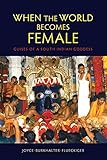
Joyce Burkhalter Flueckiger. When the World Becomes Female: Guises of a South Indian Goddess. Bloomington: Indiana University Press, 2013. xvi + 314 pp. $27.00 (paper), ISBN 978-0-253-00956-2.
Reviewed by Anne Feldhaus (Arizona State University)
Published on H-Asia (April, 2015)
Commissioned by Sumit Guha (The University of Texas at Austin)
Playing with Gender in South India
Playing with gender is enormously popular these days in many parts of the world. In recent decades, it has also become a favorite topic in humanities scholarship. Before publishing the book under review, Joyce Flueckiger had already made several solid contributions to the discussion of the religious roles of gender in India, including the two books Gender and Genre in the Folklore of Middle India (1996) and In Amma’s Healing Room: Gender and Vernacular Islam in South India (2006). In this most recent book, she moves beyond folksongs and healing to address directly questions of the relationships between a goddess and her devotees, and the ways that those devotees play with gender.
Looking from afar at goddess traditions, one can easily hope that such traditions shed light on gender relations in the human society in which the goddesses are worshiped. For example, some feminists have taken the fact that many people in India worship goddesses to mean that women have an exalted position there. Others ironically juxtapose the subservient human female of so-called real life with the dominatrix Durgā or Kālī. Flueckiger’s book takes us well beyond either of these positions, portraying in richness and depth a goddess tradition in which people perform a number of variations on gender identities, roles, and relations. Flueckiger shows how narratives about a goddess and rituals directed to her illuminate her devotees’ understandings of women, men, marriage, divinity, and the cosmos.
The tradition Flueckiger analyzes is that of Gaṅgāmmā, a goddess widely worshiped in Andhra Pradesh. Flueckiger focuses on festivals of and narratives about Gangamma in and near the famous temple town of Tirupati in southern Andhra Pradesh. At Tirupati, Gangamma takes a variety of forms, residing primarily in unpretentious shrines in households and neighborhoods. She is one of a set of seven sisters who are understood to be village-protector goddesses. As with many similar goddesses, Gangamma’s marital status is ambiguous, as is her relationship to gods found in Sanskrit texts and grander temples.
Flueckiger uses a variety of prisms to approach both the goddess and the ways that her worshipers play with gender. In the first half of the book, Flueckiger turns our attention to narratives and rituals that reveal a cosmology based on fierce femininity. She analyzes multiple interpretations of two principal narratives about the goddess, describes the major rituals of the annual festival calendar, and explores one relatively uncommon interpretation of the relationship between Gangamma and the river goddess Ganga (the Ganges), who is more commonly found in textual and iconographic traditions. The chapters of the second half of the book focus on various types of devotees who relate to Gangamma in different ways. The most dramatic of these are the men who take on the garb of the goddess as she appears in different episodes of one of two principal stories about her. But Flueckiger also devotes a good deal of attention to other kinds of servants of the goddess, to women who enter into a quasi-marital relationship with Gangamma, and to one woman who carried on an intensely personal, ardently devotional relationship with the goddess.
Traditions of goddesses like Gangamma present dense, difficult subject matter. Flueckiger’s interpretation of Gangamma traditions is based on a series of short visits to Tirupati stretching over almost twenty years, along with a year-long stay there approximately halfway through this period. This fieldwork becomes the medium through which Flueckiger presents her analysis. Much of the book takes the form of Flueckiger’s accounts of particular instances in which she observed people doing specific things, and a great deal more of it relates conversations she had with individuals and small groups of people. Flueckiger’s descriptions effectively evoke the sights and sounds of the festivals and of daily ritual life. She sets the scene of the conversations and narratives she reports, allowing the people she spoke with to tell us about the goddess in their own words. Flueckiger interprets this material in ways that are perhaps her own, but that appear to grow organically from what Gangamma’s devotees themselves told her. Through words and remembered gestures of the people she worked with, Flueckiger not only shows how their “world becomes female” but also articulates what that means in the lives and understanding of the devotees, male as well as female. Most strikingly, Flueckiger shows how this goddess-centered view of reality allows men to cultivate a different kind of masculinity, one that includes a feminine element.
When the World Becomes Female explores other topics too, besides the central one of gender and its transformations. Throughout the book, for example, we see the age-old question of the interplay of ritual and narrative, and Flueckiger points out most strikingly the role of ritual as a form of knowledge independent of narrative. Finally, one chapter provides an extremely poignant portrait of a family dispossessed by the modernization, Brahminization, and “Sanskritization” of the Gangamma temple where they served until recently as priests.
Veṅkaṭeśvara, the best-known god of Tirupati, is mentioned occasionally in the book, but for the most part he remains firmly in the background. The world of Gangamma and her devotees overlaps only partially, it seems, with the pan-Indian--indeed, international--pilgrimage tradition of the hilltop temple and its priests. Some readers will want to see a bit more discussion of what importance, if any, the Tirupati temple and its god have in the religious lives of Gangamma’s devotees. But perhaps the book is already complex enough, and Flueckiger is probably wise not to make it any denser than it already is. By keeping her focus on how the people she is writing about play with the oppositions between male and female, married and unmarried, and divine and human, Flueckiger’s study explores human possibilities of much wider application than the small temple town in which they are set.
If there is additional discussion of this review, you may access it through the network, at: https://networks.h-net.org/h-asia.
Citation:
Anne Feldhaus. Review of Flueckiger, Joyce Burkhalter, When the World Becomes Female: Guises of a South Indian Goddess.
H-Asia, H-Net Reviews.
April, 2015.
URL: http://www.h-net.org/reviews/showrev.php?id=42008
 | This work is licensed under a Creative Commons Attribution-Noncommercial-No Derivative Works 3.0 United States License. |

