

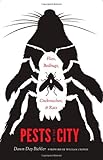
Dawn Day Biehler. Pests in the City: Flies, Bedbugs, Cockroaches, and Rats. Weyerhaeuser Environmental Books Series. Seattle: University of Washington Press, 2013. Illustrations. 336 pp. $34.95 (cloth), ISBN 978-0-295-99301-0.
Reviewed by Julie Urbanik (Department of Geosciences)
Published on H-HistGeog (June, 2014)
Commissioned by Robert M. Wilson (Syracuse University)
Putting Pests in Their Place
As long as you do not read this book in your kitchen, your bedroom, your bathroom, or really anywhere that you actually live or work, you will be fine. All kidding aside, Dawn Day Biehler’s Pests in the City: Flies, Bedbugs, Cockroaches, and Rats is not for the squeamish or for those prone to the heebie-jeebies; what it is, though, is a fascinating exploration of the entanglements between urban life, class, race, and gender identities, and nonhumans classified as pests. Working at the intersection of environmental history, historical geography, urban geography, and animal geography, Biehler has managed to synthesize a large amount of archival data about the handling of pest infestations in major cities of the United States over the course of the twentieth century.
In the introduction, she outlines three major themes that she sees as central to understanding how these pests epitomize urban social relations and planning. The first theme is that of public-private relations in the home. She traces how the home--as a place--was constructed in multiple ways in relation to pest infestations. Seen alternately as an exclusively private space or as a public one subject to government intervention and control, the urban dwelling became simultaneously the problem and the solution to hygienic living. Just who gets to construct when the home is private or public is part of her second theme focusing on social injustice along race, gender, and class lines. Pest infestations were, and continue to be, a problem largely endured by lower-income residents. The social stigma of being unable to keep a clean home blurred into judgments and prejudices against women, people of color, and the poor--often reinforcing stereotypes and socioeconomic segregation. Tying the research together, the third theme focuses on the many people working on behalf of communities suffering from pest infestations and the promises and failures of urban reform over the decades. The methods of pest control, the money allocated for subsidized housing, and political fights over accountability all circled around notions of public/private and identity constructions.
The book is organized into two parts. The first part, focusing on the promises of modern pest control, includes a chapter on each pest and how it was dealt with in the early part of the twentieth century. The second part consists of two chapters exploring rat infestations from the civil rights era toward the present and the scourge of cockroaches in the modern era. There is an extensive notes section (sixty-two pages), which provides a thorough trail of sources; a selected bibliography; and two short sections of historical images that add a deeper level of experience for the reader. It is one thing to read about unsanitary outhouses, but quite another to be confronted with the image of exactly what that looked like.
While people around the world have been living with these four species forever, the desire to control them and the concerns about their health implications for humans came to the fore in the United States around the turn of the twentieth century. The rise of medical entomology and the scientific motherhood movement provided a framework within which city beautification proponents and public health workers could build a moral call to action. In all four cases, there were concerns that these pests were disease vectors and that they acted as “agents of interconnection” between humans and between urban dwellings (p. 28).
The concerns about flies went hand in hand with the growing call for effective waste management practices in urban spaces. At the turn of the twentieth century, urban areas were still densely inhabited by a variety of livestock, but working horses and a lack of management for their extensive droppings meant flies had an easy time of it. In addition, flies landing on horse feces just outside a backdoor alley could easily land on people’s food inside. Programs to install window screens and enforce manure cleanup codes became the focal point of change. But getting the cleanup and enforcement to happen in lower income areas was a real challenge--especially when many of these families were unable to afford to install window screens and/or did not even want to use them because it prevented easy conversation with neighbors. For mothers, flies were a major concern. At this time, Americans were shifting to using cow’s milk as baby food, but with cow's milk babies could not fight off gastrointestinal germs as well as they could with human breast milk, and so they became susceptible to illness from fly contamination. Interestingly, Biehler highlights how the modernization of urban transportation was the key to getting control of flies. “The decline of urban horses brought more significant environmental changes than did public investment in sanitation, housing, or citizen education, severing ecological ties with one of the two urban species upon which flies relied the most” (p. 54).
Bedbugs, which arrived in the United States on the bodies and in the luggage of Europeans, were as equally resilient to eradication efforts. Bedbugs became linked to class and racial identities because of the poor regulatory system for landlord caretaking and low wages forcing people to crowd into already questionable housing. Urban reformers argued for the federal government to intervene, and it was not until 1937 that Congress passed the Housing Act, which required the government to allocate money for public housing. Public housing was seen as a way to solve pest infestation problems since this type of housing could be more openly controlled by government officials and not rendered to the private sphere. The push toward public housing also came at the same time as the rise of chemicals--the term exterminating came into being around 1905 and the chemical industry saw its role as a provider of health services. One of the earliest chemicals used was Hydrocyanic acid (HCN), which proved effective at killing bedbugs but, unfortunately, also proved effective at killing people and pets because it was so hard to contain the vapors.
It was not until the arrival of DDT that inequalities in the economic geography of bedbug infestation began to balance out, but DDT was originally used as chemical warfare on cockroaches. Cockroach infestations demonstrated that “homes and bodies remained permeable to pests and chemicals despite the promises of modernity and containment” (p. 85). Biehler shows how DDT took the place of HCN and reinforced the notion that pest control could be handled by the private sphere--and by women in particular. The problem was that in the post-World War II period, growing prosperity by the white population created a rush to the suburban lifestyle and the result was not only a lower tax base for the increasingly poorer urban areas, but also a lack of political will to maintain public housing infrastructure.
In the case of rats, the problems faced by those in the closest contact with them follow the stories of flies, bedbugs, and cockroaches. In fact, “insiders in infested communities saw rats as fleshy manifestations of the ecology of injustice and demanded that the benefits of American postwar prosperity be extended to their homes” (p. 150). Baltimore had one of the first city codes to mandate rat proofing of all homes and Congress attempted to address the issue with the Rat Control Bill in 1967, but politicians and suburban and rural citizens were unable (or unwilling) to understand just how awful a problem rats could be. Parents had to protect their sleeping babies, and rat bites were common for children and adults in particularly hard hit areas. Rats, like the three other pests, easily moved between public and private spaces like homes and alleys and proved resilient to a variety of chemical interventions. In the end, “ecology’s promises of healthy city environments proved nearly as elusive as the promises of postwar pesticides” (p. 113).
Biehler goes to great lengths to get the reader to understand the human dimensions of living with these “pest” species; however, I think it would have been helpful if she also deconstructed the category of “pest” by exploring the ethological and ecological knowledge we have about rats, flies, cockroaches, and bedbugs--especially given the surprising level of intelligence we understand both rats and cockroaches to have from their use in laboratory settings. By relegating them solely to the category of “pest,” Biehler misses out on an opportunity to challenge human-animal boundaries in the same way that she challenges the human-human boundary making in relationship to this issue.
With that said, this book is undeniably a significant addition to the burgeoning literature in urban ecologies and animal geography. It is a fascinating read and I learned a tremendous amount about the role of animals in urban histories. I would consider it required reading for any advanced animal geography, environmental studies, or urban studies students. The book as a whole can be easily incorporated into graduate classes on these topics, and the individual chapters on the “pests” can be used to explore many key concepts around identity, place, and the nonhuman in undergraduate classes. By so thoroughly melding together the notions of race, class, gender, place, and the nonhuman, Biehler demonstrates how inseparable human-animal relationships are in the urban setting.
If there is additional discussion of this review, you may access it through the network, at: https://networks.h-net.org/h-histgeog.
Citation:
Julie Urbanik. Review of Biehler, Dawn Day, Pests in the City: Flies, Bedbugs, Cockroaches, and Rats.
H-HistGeog, H-Net Reviews.
June, 2014.
URL: http://www.h-net.org/reviews/showrev.php?id=41950
 | This work is licensed under a Creative Commons Attribution-Noncommercial-No Derivative Works 3.0 United States License. |

