

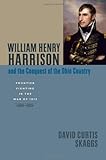
David Curtis Skaggs. William Henry Harrison and the Conquest of the Ohio Country: Frontier Fighting in the War of 1812. Johns Hopkins Books of the War of 1812 Series. Baltimore: Johns Hopkins University Press, 2014. Maps. xvii + 303 pp. $44.95 (cloth), ISBN 978-1-4214-0546-9.
Reviewed by Deena Parmelee
Published on H-War (October, 2015)
Commissioned by Margaret Sankey (Air University)
The depth of David Curtis Skaggs’s knowledge and understanding of the War of 1812 comes through in this study of William Henry Harrison’s role on the Old Northwestern frontier. Skaggs places Harrison and his role before and during the war in comprehensive military and political contexts.
Skaggs may be more gentle in his treatment of Harrison’s dealings with American Indians than some readers might wish, but he is by no means an apologist. Readers who bring existing opinions about Harrison and Indians to this book will not have their minds changed, because that is not Skaggs’s main focus. Instead he offers a deeper, fuller examination of Harrison’s influences, attitudes, and motivations. For example, he emphasizes the importance of training with Anthony Wayne in Harrison’s military and diplomatic development (including his presence at the negotiations of the Treaty of Greenville), as well as his time as governor of the Indiana Territory. He also demonstrates the influence of Charles Rollins’s classical military histories and Julius Caesar’s Commentaries on Harrison; these works influenced his tactical choices as a commander and he quoted from them in letters and reports throughout his military career.
This is not simply a military biography. Another component of Skaggs’s work is an examination of the role played by volunteer militia on the frontier, in the War of 1812; in Harrison’s tactical plans; and in the larger development of the American military operational tradition. Skaggs attributes Harrison’s unswerving support of well-trained, well-equipped volunteer militia in part to his years with Wayne, and spends a great deal of time detailing militia personnel and their actions in Harrison’s campaigns. Harrison frequently favored the use of volunteer militia over that of regular army units, for a number of reasons. The volunteers tended to be where he needed them, when he needed them, while the regular army was often late to a campaign, was under-trained, and frequently led by inexperienced officers. In Harrison’s experience, the volunteers, especially those from Kentucky, were led by men with real field experience. Further, Harrison knew many of them personally, including Isaac Shelby, a governor of Kentucky. The use of the militias, however, was one of the root causes of Harrison’s chronic problems with the federal military establishment back East, particularly Secretary of War John Armstrong, with whom Harrison was almost perpetually at odds. Skaggs observes that Harrison’s faith in the militias demonstrates his other influence on the subject: his belief in the Jeffersonian tradition of the citizen soldier.
Another aspect of Harrison’s conduct of his campaigns in the war to which Skaggs pays particular attention is the cooperation between Harrison and US Navy Captain Oliver Hazard Perry. In the short history of the United States, there had never been such coordination and cooperation between the branches of the service as Harrison and Perry conducted. Skaggs recounts the extensive planning the men did, beginning in mid-summer of 1813 and continuing through their mutual and respective successes that autumn. He repeatedly observes how rare such collaboration was, particularly when the situation merited meticulous timing as well as bending rules established by their respective commanders. However, Skaggs also admits that despite their successes, Harrison and Perry did not win the war, or even do much to further its end. Instead, Skaggs maintains that the contribution of Perry and Harrison—with specific regard to the outcome of the war—was that it made the British more willing to accede to the boundaries established in 1783. Since Harrison and Perry had made territorial gains, the British could not risk demanding additional land beyond what had been established in 1783.
A particularly nice feature of the book is the number of useful maps. Many are reprinted from various nineteenth-century histories of the War of 1812, and a few are modern; the former are particularly helpful for understanding Harrison’s campaigns and the movement of troops. Skaggs occasionally references modern place-names in order to assist readers’ understanding of the geography of the region, but does not bludgeon them with a litany of useless, unfamiliar names. Better still, the maps are placed within the context of the narrative, so readers do not have to flip back and forth between a section of narrative and a map placed at the start of the book.
Skaggs provides a comprehensive examination of Harrison in the context of the battles for which he is best known. This is not necessarily a beginner’s book, assuming as it does a fair depth of knowledge about the War of 1812 and US politics of the early Republic era. It is, however, well worth reading.
If there is additional discussion of this review, you may access it through the network, at: https://networks.h-net.org/h-war.
Citation:
Deena Parmelee. Review of Skaggs, David Curtis, William Henry Harrison and the Conquest of the Ohio Country: Frontier Fighting in the War of 1812.
H-War, H-Net Reviews.
October, 2015.
URL: http://www.h-net.org/reviews/showrev.php?id=41939
 | This work is licensed under a Creative Commons Attribution-Noncommercial-No Derivative Works 3.0 United States License. |

