



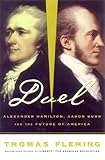
Thomas Fleming. Duel: Alexander Hamilton, Aaron Burr,and the Future of America. New York: Basic Books, 1999. xiv + 446 pp. $30.00 (cloth), ISBN 978-0-465-01736-2.
Reviewed by Michael P. Gabriel (Department of History, Kutztown University of Pennsylvania)
Published on H-Pol (June, 2000)
Hamilton, Burr, and Politics in the Early Republic
Thomas Fleming's Duel: Alexander Hamilton, Aaron Burr and the Future of America, is a highly readable account of the fateful "interview" between two of the dominant figures in the early republic. Geared towards the general public, the book offers far more than another study of the duel, however. As the subtitle indicates, Fleming also explores the era's volatile political background and how later American history was influenced by it. Throughout the 406 pages of text, the author incorporates into his narrative such issues as the rise of Napoleon Bonaparte, the possible secession of New England and the West, and the Burr Conspiracy.
The book opens in January 1804 with a comparison of Hamilton and Burr. Although they were political enemies, the two Revolutionary War veterans had much in common. Both "General" Hamilton and "Colonel" Burr were heavily indebted, politically ambitious, and located on the margins of power. Hamilton headed the defeated Federalist Party, but was increasingly isolated as its other members sought a more centrist position. Burr was the Vice-President but had lost Thomas Jefferson's trust as a result of his actions in the contested presidential election of 1800. Still, both men saw a glimmer of hope that they would be restored to positions of authority. Jefferson's policies, such as the Louisiana Purchase and his assault on an independent judiciary, had alienated not only Federalists, but also moderate Democratic-Republicans.
According to Fleming, Hamilton was motivated by the desire for permanent fame, such as founders of empires achieved. He would not accumulate wealth, join the British-influenced Episcopal Church, or do anything that would threaten his honor or political viability. He would even fight a duel, although he opposed them on "'religious and moral principles'" and had lost his eldest son in one. Burr was "something new and important in American life, a professional politician" who actively sought power (p. 121). He conferred with Federalists, listened not disapprovingly of their talk of creating an independent northern confederation, and proposed "a union of all honest men," a dig at partisans in both parties. Fleming speculates that this was the true origin of Hamilton's hatred of Burr. The former Secretary of the Treasury feared that the Vice-President would supplant his leadership of the Federalists and prevent him from achieving his destiny.
Much of the middle portion of Duel deals with Burr's failed 1804 attempt to win the New York governorship, which he hoped to use as a steppingstone to a presidential bid. Fleming is especially strong at illustrating the vicious political infighting that took place. Quoting extensively, he shows how the pro-Jefferson alliance between the Clinton and Livingston families repeatedly smeared Burr and helped cause his landslide defeat.
Surprisingly, Hamilton largely did not participate in this mudslinging. Although he spoke against Burr in private, he did not actively campaign against him. Still, Fleming sees this as the origins of the famous encounter. He argues that Burr learned of Hamilton's comments and decided to challenge him to a duel. Fleming asserts that the Vice-President had become enchanted with the idea of restoring his political fortunes and extracting revenge on Jefferson with a bold venture. He would lead an army of westerners to conquer Spanish Florida and/or Texas and possibly even the newly-acquired Louisiana Territory. Challenging Hamilton would not only discredit or destroy a long-time political nemesis, but would also eliminate a possible rival to his becoming an American Bonaparte. The author provides elaborate details about the events immediately proceeding the duel, Burr's mortal wounding of his opponent, and the duel's aftermath. Although many in both parties disliked the domineering Hamilton, they did not want to see him die in such a senseless manner. Burr escaped prosecution, but further tarnished his reputation.
The book's final section focuses on Burr's later career, his western conspiracy and possible British support for the venture, and his 1807 trial for treason. Interestingly, Fleming argues that, during this period, Burr became a surrogate Hamilton. In one of his last acts as Vice-President, he presided over Federalist judge Samuel Chase's impeachment trial and derailed the radical Democratic-Republicans' attack on the judiciary. Similarly, Burr's acquittal for treason "banned the evil genie of 'constructive treason' -- the conspiracy without the overt act -- from American jurisprudence forever" (pp. 393-394). Through these actions, Burr strengthened the courts against potentially tyrannical, popularly-elected assemblies and thereby "profoundly strengthened the conservative side of the American experiment" (p. 394). Fleming concludes by speculating that had either Hamilton or Burr been available immediately before or during the War of 1812, they might have achieved their ambitions. Voters could well have turned to either man to save the country from failing Jeffersonian policies. By this point, however, one was dead and the other discredited.
While Duel is generally good, it needs a tighter chronology. The sequence of events is occasionally difficult to follow because Fleming jumps forward and back in time. More significantly, the author should develop further why Burr challenged Hamilton to a duel after his failed gubernatorial run. Why would not the Vice-President have sought satisfaction from someone who actively worked against him, such as George and DeWitt Clinton or the slanderous newspaper editor, James Cheetham, instead of Hamilton? Fleming's interpretation is plausible, but needs greater explication. Despite these considerations, Duel is still worthwhile and neatly fits with the recent scholarship on Hamilton.[1] Drawing upon both primary and secondary sources, it offers useful personal insights on the two main characters, Jefferson, and the thoroughly corrupt General James Wilkinson. It also helps illuminate the complex web of foreign affairs, personal ambition, and partisan politics that tangled early U.S. history, as well as the widespread acceptance of dueling. Any student or scholar interested in this period could benefit from this book.
Notes
[1]. See Brookhiser, Richard. Alexander Hamilton: American. New York: Free Press, 1999; Kennedy, Roger G. Burr, Hamilton, and Jefferson: A Study in Character. New York: Oxford University Press, 2000; and Rogow, Arnold A. A Fatal Friendship: Alexander Hamilton and Aaron Burr. New York: Hill and Wang, 1998.
Copyright (c) 2000 by H-Net, all rights reserved. This work may be copied for non-profit educational use if proper credit is given to the author and the list. For other permission, please contact H-Net@h-net.msu.edu.
If there is additional discussion of this review, you may access it through the network, at: https://networks.h-net.org/h-pol.
Citation:
Michael P. Gabriel. Review of Fleming, Thomas, Duel: Alexander Hamilton, Aaron Burr,and the Future of America.
H-Pol, H-Net Reviews.
June, 2000.
URL: http://www.h-net.org/reviews/showrev.php?id=4193
Copyright © 2000 by H-Net, all rights reserved. H-Net permits the redistribution and reprinting of this work for nonprofit, educational purposes, with full and accurate attribution to the author, web location, date of publication, originating list, and H-Net: Humanities & Social Sciences Online. For any other proposed use, contact the Reviews editorial staff at hbooks@mail.h-net.org.

