

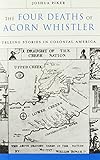
Joshua Piker. The Four Deaths of Acorn Whistler: Telling Stories in Colonial America. Cambridge: Harvard University Press, 2013. 320 pp. $29.95 (cloth), ISBN 978-0-674-04686-3.
Reviewed by Kevin T. Harrell
Published on H-AmIndian (November, 2014)
Commissioned by F. Evan Nooe (University of South Carolina Lancaster)
Finding Meaning in the Elusive Art of Storytelling
Joshua Piker’s Four Deaths of Acorn Whistler is a fascinatingly original microhistory about how the seemingly unimportant execution of “a second-tier [Upper Creek] headman from a third-tier [Upper Creek] town” actually mattered on an imperial scale (p. 31). Understanding why Acorn Whistler “had to die” is Piker’s central inquiry, and while his impeccable research to unravel this question is a testament to his skills as a historian, it is his approachable style and method as a writer that enables readers a truly unique insight into the interconnectedness of southeastern life during the eighteenth century. With a novelist’s sense, Piker effortlessly weaves concepts of time, space, and intercommunal and interpersonal relationships into a fabric of coherent and distinct voices, each vying for a measure of autonomy in an increasingly integrated world. Through the lenses of biographical sketches and macro-scale modeling, Piker’s skillful composition busily animates life along the margins of empire.
Piker’s task is to chart a complex series of accounts resonating from the April 1, 1752, assassination of twelve Cherokees by twenty-six Lower Creeks on the highway outside Charleston, South Carolina, but still within sight of the town’s church steeples. The symbolic location and timing of the attack was almost as important as the identity of the perpetrators. Cherokee corpses lay strewn across property adjacent to the estate of Governor James Glen—the very man whose tottering political legacy largely depended on assurances that his Indian visitors returned home safely and that the interminable frontier violence that had increasingly come to characterize his administration might be managed bureaucratically. The attack was an affront to Glen personally and British authority generally.
The burden of retribution rested on Glen and his influential Lower Creek counterpart Malatchi of Coweta. Despite knowing that Acorn Whistler was (mostly) innocent, Glen and Malatchi took the path of least resistance and blamed the hapless Upper Creek warrior for inciting the Cherokee’s murders. How this decision-making process unfolded and encircled the correlative leaders contextualizes the personal motivations of a rarely assembled cast of characters—all of whom serve as Piker’s principal storytellers concerning Acorn Whistler’s value as the perfect fall guy.
For the last two and a half centuries scholars addressing Acorn Whistler generally assumed his culpability for the events of April 1. Piker describes him as “a relentless self-promoter” and “terminally tone deaf” (pp. 6, 23). Contemporaries knew him as fractious, inclined to excessive drinking, inconsistent with others, and violent when it served a political purpose. He spoke for the joint Upper and Lower Creek delegation on March 31 and made promises affirming a lasting peace. But then Acorn Whistler contradicted himself when Glen pressed him for information about the murders, later admitting he knew of the Lower Creek’s plan but doing nothing of consequence to stop them. Despite this though, Piker convincingly overturns the supposition of Acorn Whistler’s guilt. For one, Acorn Whistler had a concrete alibi. He and his Upper Creek entourage had been in town drinking when the ambush took place. Moreover, his judicious decision to linger in town following the attack stood in sharp contrast to the Lower Creek’s flight. Perhaps most significant in his defense was that “generic headmen did not order around generic warriors” (p. 107). As an Upper Creek with no discernable connection to the Lower Creeks or their town of origin, Acorn Whistler could have never commanded such a group in battle. Why then was he executed for their misdeeds?
After foregrounding the April 1 incident, Piker structures his book around four sources of information about Acorn Whistler: the governor, the emperor, the town, and the colonists. Each source used stories about Acorn Whistler to remake, reposition, and renew their claims on lost ground in their personal lives, hoping that by elevating his status and darkening his name they might improve their lot in Britain’s new model empire. Glen, while initially seeking satisfaction from the Lower Creeks, changed his story about the man out of desperation to foster pan-Indian unity in the region and avoid driving the potentially dangerous Malatchi into the waiting arms of the French. Accusing Acorn Whistler was a more expedient course that might convince London he was firmly in control of local matters and could be trusted with a more prominent role in shaping Britain’s imperial destiny in North America.
Glen’s second story fit the narrative crafted by the always-fascinating Mary (Musgrove) and Thomas Bosomworth in their bid to present themselves as representatives of both Creek and British worlds. Neither Bosomworth, of course, wielded anything resembling the authority they purported to possess. Piker identifies the couple as “the colonists” because they “embody a particularly instructive version of the colonial condition” (p. 197). Determined to escape crushing debts and reclaim a lost fortune in land, and consumed with staving off perceived threats to their reputations, the pair was planning an audience in London with royal officials when they learned Glen needed an agent to the Creeks. They changed their preparations and quickly manufactured a story against Acorn Whistler that would endear them both to the governor and Mary’s cousin Malatchi. Such an errand would only strengthen future petitions, they reasoned.
Malatchi eventually accepted Acorn Whistler’s guilt and concocted his own set of lies, as shown in chapter 3, “The Emperor.” Blaming an Upper Creek headman instead of Lower Creek warriors averted any possible repercussions coming to his people. Acting as Glen’s enforcer would also bolster his relationship with the British and aid his ambition of becoming the unrivaled leader of a unified Creek nation. Malatchi understood that “the right story would convince the British that things that were as yet relatively insubstantial—the Creek nation and its emperor—were real, and then use the British belief in those things to call them into being” (p. 83).
One would expect to find staunch supporters among Acorn Whistler’s Upper Creek kin and townsfolk. This was not the case. In chapter 5, “The Family and Community,” Piker returns to Okfuskee—the site of his lauded 2004 study (Okfuskee: A Creek Indian Town in Colonial America) and the most important locality in Acorn Whistler’s orbit—revealing fascinating new insights about extant tensions between rival Creek communities and factions. The Okfuskees suspected Acorn Whistler an accessory but not deserving death. Obstinately refusing to accept his responsibility, however, was not a viable option in this political climate. Doing so would only empower Malatchi and the rival town of Coweta; alienate the British, who simply wanted an end to the crisis; and enrage the Cherokees, which was certain to extend a bloody war to their home front. Okfuskee’s leadership eventually succumbed to these pressures and grudgingly accepted a story that would smooth things over in the best possible way.
In the end, no one won. Acorn Whistler was executed. Glen lost his job. The Bosomworths failed to fully recover their lands and escape mounting debts. Malatchi never became the leader of a unified Creek nation, dying four short years later. The Okfuskees lost a member of their community and gained a great deal of distrust for British and Lower Creek motives.
Piker’s book will appeal to a wide audience and belongs alongside similar forays by James H. Merrell, Ned Blackhawk, Ari Kelman, and Karl Jacoby.[1] His writing style is accessible and entertaining. When he is forced to make assumptions about material, he does so, but to his credit, candidly admits as much to his readers. The book cannot be skimmed. There are too many nuances. His technique might offend the cognoscenti of the profession, who prefer traditionally arranged monographs with deliberate progressions from a clearly stated thesis. The Four Deaths of Acorn Whistler is not conventional in that sense. It rediscovers historical narrative and proves that the more we learn about the colonial South, the more confusing and ambiguous of a place it becomes. The region as a whole looms as an entanglement of ulterior motives and high stakes risk where figures existed not as good or bad, colonist or Indian, but simply human beings trapped in the cynical snares of history.
Note
[1]. James H. Merrell, ‘“I desire all that I have said … may be taken down aright’: Revisiting Teedyuscung’s 1756 Treaty Council Speeches,” William and Mary Quarterly, 3d ser., 63, no. 4 (October 2006): 777-826; Ned Blackhawk, Violence over the Land: Indians and Empires in the Early American West (Cambridge: Harvard University Press, 2008); Ari Kelman, A Misplaced Massacre: Struggling over the Memory of Sand Creek (Cambridge: Harvard University Press, 2013); and Karl Jacoby, Shadows at Dawn: An Ache Massacre and the Violence of History (New York: Penguin Press, 2008).
If there is additional discussion of this review, you may access it through the network, at: https://networks.h-net.org/h-amindian.
Citation:
Kevin T. Harrell. Review of Piker, Joshua, The Four Deaths of Acorn Whistler: Telling Stories in Colonial America.
H-AmIndian, H-Net Reviews.
November, 2014.
URL: http://www.h-net.org/reviews/showrev.php?id=41908
 | This work is licensed under a Creative Commons Attribution-Noncommercial-No Derivative Works 3.0 United States License. |

