

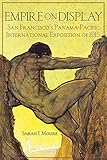
Sarah J. Moore. Empire on Display: San Francisco's Panama-Pacific International Exposition of 1915. Norman: University of Oklahoma Press, 2013. xii + 240 pp. $34.95 (cloth), ISBN 978-0-8061-4348-4.
Reviewed by Sebastian Lukasik
Published on H-SHGAPE (April, 2015)
Commissioned by Julia Irwin (University of South Florida)
Fantasies of Empire
Pageantry, spectacle, and the visual arts have played a central role in delineating the ideological contours of imperial regimes for as long as “empire” has existed as a distinct category of historical analysis and as a form of political organization. The growing body of scholarship dedicated to dissecting these cultural representations of empire and relating them to the theory and practice of imperialism and colonialism fully reflects this trend. Historians and art historians such as Jonathan Brown, J. H. Elliot, David Cannadine, and Hamid Irbouh, to name just a few, have focused on the intersections between art, ceremony, power, and political legitimacy to open up new perspectives on the ideas and structures that underpinned the global empire of the Spanish Habsburgs, Britain’s relationship with its overseas possessions and dependencies in the Victorian and Edwardian eras, and France’s governance of its North African “subject peoples” in the first half of the twentieth century.[1] In Empire on Display, Sarah J. Moore, an art historian whose research focuses on the linkages between art and American national identity, scrutinizes a key chapter in the development of America’s very own imperialist fantasies and ambitions through a similar set of analytical lenses. In the process, she constructs a compelling argument that significantly broadens our understanding of the cultural impulses behind America’s emergence as a world power during the Progressive Era.
Thematically, Moore’s study focuses on the Panama-Pacific International Exposition held in San Francisco in 1915. Moore argues that the exposition, intended as a celebration of San Francisco’s miraculous recovery from the the devastating earthquake of 1906 and the opening of the Panama Canal in the summer of 1914, represented a microcosm of the assumptions and cultural attitudes at the heart of America’s expansionist policies in the Pacific and the Caribbean in the early years of the twentieth century. The exposition’s central layout, the design and symbolism of its key architectural and sculptural highlights, and the visual imagery that adorned the promotional materials advertising the event both reflected and articulated those attitudes and assumptions. Chief among them was the view that America’s leap overseas, beginning with the Spanish-American War, represented the country’s natural progression along “an evolutionary trajectory of civilization” (pp. 5-6) whose key historical manifestation could be found in the conquest of the American West in the nineteenth century. Viewed in this light, the projection of American power to the Pacific fulfilled a dual purpose. First, it was a direct and logical continuation of a historical destiny grounded in America’s recent subjugation of its “internal colony” between the Mississippi and the Pacific coast. Second, the transition from continental conquest to overseas imperial adventures provided a meaningful solution to the cultural insecurities that Frederick Jackson Turner’s notion of the apparent closing of the western frontier engendered in the American psyche. With the disappearance of the frontier, efforts to establish an overseas American empire would offer new opportunities for the regeneration of American manhood and the crystallization of socially and culturally cohesive frameworks of national identity.
Moore develops her central argument through a fascinating close reading of the various “texts” encoded in the monumental architecture, sculptural ensembles, ethnographic displays, and gigantic scale models of such manmade and natural wonders as the Panama Canal, the Grand Canyon, and Yellowstone National Park that, collectively, represented the exposition’s principal attractions. These installations underscored the parallels and continuities between the taming of the America West by intrepid pioneers who personified the virtues of virile manhood and the more recent achievements of America’s technological ingenuity and political initiative. The Panama Canal was, of course, the epitome of these accomplishments. As the greatest showcase of early twentieth-century engineering, its construction was depicted “as the culmination of the triumph of technology over wilderness on the trajectory of westward expansion that defined American culture and history in the nineteenth century” (p. 47). Equally significant, the canal’s completion provided evidence of the renewed vigor of American manhood whose defining image was supplied by the celebrated photograph of President Theodore Roosevelt at the controls of a Bucyrus steam shovel taken during his highly publicized inspection of the canal’s construction in late 1906. The image of Roosevelt, the quintessential American “manly man” of the Progressive Era, subjugating nature with the aid of cutting-edge technology to facilitate America’s destiny as an agent of civilizational progress, crystallized the notion of the engineer as the natural successor to the hardy pioneers who had “won” the American West. Just as the latter had staked their place in history by pushing “back the forces of chaos at the frontier,” the engineer now sought to override the imperfections of nature itself, seeking to correct, in the words of one contemporary observer, “the oversight of nature in omitting to provide a channel into the Pacific” (pp. 62-63).
The Panama-Pacific Exposition mirrored and amplified this view of America’s imperial fantasies as the intersection of masculinity with technology in the service of a linear and evolutionary construct of civilizational progress. The layout of the fairgrounds juxtaposed the “staged authenticity” of a Hopi village, highlighting an exotic culture slowly giving way to the irresistible advance of progress, with the monumental neoclassicism of the exhibition’s architectural focal point: a cluster of buildings and sculptural ensembles of truly imperial magnificence whose esthetic inspiration, that of ancient Rome, evoked America’s own aspirations of universal empire. Reinforcing the exposition’s focus on natural and cultural primitivism yielding to, and being restrained and civilized by, the benevolent advance of technologically sophisticated and manly imperialism was the pairing of gigantic scale-model reproductions of two of America’s greatest natural landmarks--Yellowstone National Park and the Grand Canyon--with a similar gigantic miniature of the Panama Canal, complete with fully functioning locks and model ships that passed through the locks from one end of the canal to the other at a pace relative to the amount of time it would take a real vessel to transit the actual canal. Combining didacticism with entertainment, these displays effectively “encapsulated the fair and its themes of progress, expansion, manliness and civilization for the broadest possible audience and enjoyed a circulation unmatched by the more traditional renderings” (p. 169).
To say that the research that underpins the book’s arguments is impressive would be an understatement. Moore has examined a formidable body of primary materials such as posters, brochures, pamphlets, stationary, maps, photographs, and contemporaneous press coverage. In addition, her work is grounded in a detailed and highly nuanced understanding of several historiographies that do not always “talk” to each other, from the literature on the changing constructs of masculinity in the early twentieth century, to scholarship dealing with the intellectual and ideological roots of American imperialism, to her own background in American art history. One wishes Moore had provided a more concrete indication of how the cultural texts and subtexts of American imperialism reflected in the Panama-Pacific Exposition influenced the practices and policies of American imperialism. That, however, is beyond the book’s purview, and is thus no more than a quibble. On the whole, this remarkably fine work offers a great deal not only to historians of imperialism in the Progressive Era, but also to scholars concerned with other aspects of that turbulent period. In particular, Moore’s compelling argument concerning the importance of gendered discourse to the American imperial project should provide an incentive for historians of Progressivism to revisit and reevaluate their understanding of how the Progressives themselves understood and defined “progress” regardless of their sphere of action.
Notes
[1]. Jonathan Brown and J. H. Elliot, A Palace for a King: The Buen Retiro and the Court of Philip IV (New Haven, CT: Yale University Press, 1986); David Cannadine, Ornamentalism: How the British Saw Their Empire (New York: Oxford University Press, 2002); Hamid Irbouh,Art in the Service of Colonialism: French Art Education in Morocco, 1912-1956 (New York: St. Martin's Press, 2005).
If there is additional discussion of this review, you may access it through the network, at: https://networks.h-net.org/h-shgape.
Citation:
Sebastian Lukasik. Review of Moore, Sarah J., Empire on Display: San Francisco's Panama-Pacific International Exposition of 1915.
H-SHGAPE, H-Net Reviews.
April, 2015.
URL: http://www.h-net.org/reviews/showrev.php?id=41870
 | This work is licensed under a Creative Commons Attribution-Noncommercial-No Derivative Works 3.0 United States License. |

