

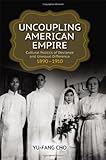
Yu-Fang Cho. Uncoupling American Empire: Cultural Politics of Deviance and Unequal Difference, 1890-1910. SUNY Series in Multiethnic Literature. Albany: State University of New York Press, 2013. xiii + 212 pp. $75.00 (cloth), ISBN 978-1-4384-4899-2.
Reviewed by Gregg French (Western University)
Published on H-USA (May, 2014)
Commissioned by Donna Sinclair (Central Michigan University)
Delinquents in America’s White Heterosexual Union: Yu-Fang Cho’s Literary Assessment of Cultural Politics in the American Empire, 1890-1910
During the period surrounding the turn of the twentieth century, the cultural imaginations of white heterosexual Americans living within the American Union were presented with a series of challenges from within the country and from abroad. As the United States continued its economic and political expansion during the second half of the nineteenth century, white heterosexual American culture was forced to struggle with the appearance of free African Americans; single working-class immigrant women from Europe; the importation of Chinese laborers; and the incorporation of America’s new colonial subjects from Latin America, Southeast Asia, and various islands scattered throughout the Pacific Ocean. Labeled as delinquents or deviants and often referred to as ex-slaves, white slaves, and yellow slaves, these individuals’ “nonconformity to heterosexual respectability” “proved” to white heterosexual Americans that they were not worthy to become equal citizens in both the nation and the empire that they were helping to create (p. 3).
In her work, Uncoupling American Empire: Cultural Politics of Deviance and Unequal Difference, 1890-1910, Yu-Fang Cho argues that from 1890 to 1910 the federal government’s restrictive immigration laws, operating in concert with the institutionalization of marriage by reformers, enabled control mechanisms to be put into place that refused citizenship to nonwhites through the institution of marriage, thus “consolidating white patriarchal privileges” and “policing gendered and radicalized labor” (p. 9). A revisionist approach to the role that one’s perceived race and sexuality played in the politics of the era, Cho’s book challenges the narrative associated with white heterosexual images of the period. Building on previous work of such academics as Matthew Frye Jacobson and Amy Kaplan, Cho, an associate professor of English at Miami University, thoroughly explains the cultural anxieties experienced by white heterosexuals. She details the cultural and legislative tools that they used to maintain their culturally constructed idea of how the American Union should appear, as the metropole of empire came into contact with individuals from the outside world. However, Cho’s work is unique in that she uses the institution of marriage to highlight how Asian laborers, gays and lesbians, Jewish immigrants, African Americans, and single young working women were excluded from the benefits experienced by white heterosexuals during this period.
Rooted in the fields of literary criticism, cultural studies, and transnational history, Cho employs a Foucauldian genealogical approach to connect a collection of print sources (novels, short stories, political cartoons, narratives from missionaries, and journalist articles) that appear to be unrelated. Therefore, she uses a diverse set of literary sources to prove that the benefits associated with the institution of marriage were unequal. She highlights this lack of equality in four pivotal debates of the period: the age-of-consent campaigns that existed in Britain and the United States, African American racial uplift, the exclusion of Chinese immigrants, and American colonial expansion into Asia. Through these debates, Cho investigates how interracial intimacy and adultery, and intraracial marriages of minority groups, confused the narrative. This confusion of the narrative forces the reader to reconceptualize how the institution of marriage defined an individual’s inclusion or exclusion from the civitas; and how it connected American citizens, partially franchised individuals, the fully disenfranchised (see the Expatriation Act of 1907), and colonial subjects with one another. This is by far Cho’s most impressive contribution to the historiography surrounding race and gender, particularly during the period under discussion. By forcing the reader to consider several different “alternative imaginings,” created by interracial and intraracial relationships, Cho shows how segregation and exclusion existed in a country that endorsed itself as a nation that promoted equality (p. 17).
Her work is divided into two main parts. Part 1 considers the role that domesticity played in the discourse surrounding the role of women in society, female sexuality, and black nationalism by analyzing the fictional works of Henry James and Pauline Hopkins. In part 2, Cho argues that by referring to Chinese immigrants as “yellow slaves,” using the previous black-white division of race, white women were able to construct their own unique type of femininity. In this section, she uses sensational accounts written by white women as well as political cartoons from newspapers in San Francisco; short stories about romantic love and marriage that were written by women, specifically Sui Sin Far; and American missionary periodicals from China. Both parts of the book use the backdrop of white heteronormativity, along with the institution of marriage, to highlight the existence of other narratives and the interconnected web that individuals in interracial and intraracial relationships were forced to navigate during this time.
Uncoupling American Empire is an insightful work that presents a revisionist approach to the traditional narrative associated with race, sexuality, and the American imperial project during the decades surrounding the turn of the twentieth century. Cho’s use of the institution of marriage accentuates attempts made by governmental bodies and reformers to establish the American Union as a white heterosexual nation, while presenting the reader with a new and fresh take on the topics under discussion. However, by attempting to incorporate the work into the fields of cultural, American, transnational, ethnic, gender, and sexuality studies, while using methods from all of these fields, as well as feminist and queer theory, Cho’s argument becomes convoluted within the work. Yet her diverse use of print culture presents the reader with a strong sense that writers of the period were actively discussing the topics being addressed in this work. Another weakness is Cho's assumption that the reader is familiar with the sources; she fails to thoroughly introduce each source. A more detailed description of the sources would increase the accessibility of the work. For graduate students and academics who specialize in the fields of literary criticism, cultural studies, and transnational history, this book will generate future progressive works that highlight individuals who, due to their race, country of origin, or sexuality, have far too often been omitted from the narrative.
If there is additional discussion of this review, you may access it through the network, at: https://networks.h-net.org/h-usa.
Citation:
Gregg French. Review of Cho, Yu-Fang, Uncoupling American Empire: Cultural Politics of Deviance and Unequal Difference, 1890-1910.
H-USA, H-Net Reviews.
May, 2014.
URL: http://www.h-net.org/reviews/showrev.php?id=41846
 | This work is licensed under a Creative Commons Attribution-Noncommercial-No Derivative Works 3.0 United States License. |

