

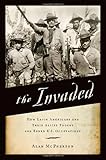
Alan L. McPherson. The Invaded: How Latin Americans and their Allies Fought and Ended U.S. Occupations. New York: Oxford Univeristy Press, 2013. 416 pp. $45.00 (cloth), ISBN 978-0-19-534303-8.
Reviewed by Abigail Markwyn
Published on H-SHGAPE (May, 2015)
Commissioned by Julia Irwin (University of South Florida)
Lessons from Resistance to US Occupation in Twentieth-Century Latin America
Alan McPherson tackles a complex and timely subject in his book, The Invaded: How Latin Americans and Their Allies Fought and Ended U.S. Occupations. Following in the footsteps of recent scholarship that seeks to better contextualize US foreign policy, he takes as his subject the occupied: the people of Haiti, the Dominican Republic, and Nicaragua in the 1910s through the 1930s. Arguing that of the approximately forty US interventions in the region between the 1870s and the 1930s, these three cases offer the most sustained occupations and therefore the strongest resistance movements, he ultimately concludes that resistance movements were key to ending US occupation. Resistance emerged not from cohesive nationalist movements, but from local issues and concerns, and peaceful activists played as much of a role as guerrillas. Moreover, he effectively argues that these cases were not isolated episodes, but instead reflected larger trends in the US occupation of foreign nations up to the present day.
McPherson divides the book into four clearly delineated sections: “Intervention Resistance,” “Occupation Resistance,” “The Stakes,” and “Transnational Networks and US Withdrawals.” Each section consists of short chapters that address the specific issues in each nation. Most chapters are focused on one country, but there are a few thematic chapters in which McPherson brings together larger issues in multiple nations. Generally, this organization works well, although the combination of both chronological and thematically organized chapters can be a bit confusing.
Part 1, “Intervention Resistance,” explains the motivations behind US intervention and describes the early resistance and US efforts at pacification. McPherson effectively links the political history of caudillismo in Latin America to the challenges facing these governments before, during, and after occupation. Each nation presented the United States with a caudillo-driven political struggle that US officials thought could be best solved through occupation and reshaping of their respective political cultures. McPherson here walks the reader through the early forms of resistance in the three nations, demonstrating the varied impetuses behind each of them.
The second set of chapters, “Occupation Resistance,” addresses the long years of occupation in each nation and lays out the key points of resistance. Rather than an immediate response to intervention, McPherson argues that much of this resistance was a response to the abusive behavior of US troops and officials. He offers a compelling look into the daily interactions that made up the resistance in these three nations. Most importantly, he demonstrates that it was these daily injustices that compelled resistance, rather than abstract senses of nationalism. In Haiti, for instance, the reinstatment of the corvée, a forced labor system, sparked increasing resistance and prompted an investigation of the situation. In the Dominican Republic resistance was even more decentralized, he argues, with “atomized roaming bands” focused on the “methods of occupation,” which in turn grew more brutal as resistance increased, prompting a vicious cycle of violence (p. 68). On their own, these examples might seem minor, but taken together, this system of daily abuses and frustrations reflected the style of US occupation, which McPherson describes as “brutal, acquisitive, disrespectful, and racist,” and turned occupied peoples into enraged peoples (p. 91).
Part 3, “The Stakes,” takes a thematic look at the cultures and politics of resistance. McPherson demonstrates that US occupiers did not seek to fully Americanize these peoples, since the motivating goals of the occupation were political and economic rather than cultural. Nonetheless, the presence of the US military undeniably affected the cultures of each nation and prompted resistance from within. Ironically, he argues, this resistance tended to defend elitist forms of traditional culture in each nation, further disfranchising the lower classes. Politics, as the primary goal of the occupation, provided the catalyst for the most sustained and effective resistance movements. Here, McPherson’s argument about the nature of the local emerges with great clarity. He demonstrates that the clash of local interests with US reforms doomed efforts to permanently alter political systems and styles in each nation.
Finally, in part 4, McPherson turns to the heart of the matter--the politics of withdrawal. Here he reveals that it was both external and internal resistance movements that forced the end of US occupation. Just as the international human rights movements of the 1980s would force an end to the South American dictatorships, so too did an international movement force US withdrawal from Latin America. Through propaganda and lobbying, US citizens began to question occupation policy and withdraw their political support from those who favored it. Withdrawal, however, did not mean US objectives were met, and in some cases the United States left the nations in at least as much political disarray as they found it. In the DR, for instance, he notes that the “very nature of occupation made changes in political control nearly impossible,” and in some respects, only reinforced the Dominican tradition of “government by force” rather than self-government (p. 193). This was one tragedy of these occupations. The US improved infrastructure and helped occupied countries manage their debts, but the occupiers failed to change the fundamental political structure of any nation. Instead, US shortsightedness reinforced tendencies toward antidemocratic practices and heavy-handed rule, which left the nations in some cases in worse situations after occupation than before.
McPherson wraps up his book with a series of conclusions about the nature of resistance, clearly written to help readers connect this history to contemporary US foreign policy. As he states, he hopes to make this history “part of the useable past,” rather than antiquarian stories about banana republics (p. 263). Summed up in pithy phrases and then briefly outlined, he offers clear conclusions about the situation facing both occupied and occupiers. These conclusions offer the reader, both those historically-minded and those more interested in current issues, concrete lessons about the nature of resistance (links between rural and urban, its lack of nationalism, as well as the effects of occupation on US provincialism), as well as the reasons for the failure from the US perspective (differing priorities from the State Department and the boots on the ground) and the resilience of local political culture, which he concludes remained “anti-democratic, self-interested, and ruinous to the nation” (p. 266). Finally, he points to memory, noting that the persistence of negative memories about the occupation, as well as positive memories of resistance leaders (Sandino as the most notable) left a lasting impact on these nations.
McPherson’s book is essential reading for historians of American foreign policy as well as Latin Americanists. His ability to navigate both Spanish-language and English sources enriches his narrative and offers an important perspective to the book. This book also offers important insight into the historiography of early twentieth-century American imperialism. By focusing on the invaded/occupied, rather than simply the invaders, he is able to offer a nuanced portrait of US policy--and its often deleterious results--that should be essential reading not only for those interested in early twentieth-century history, but also for those interested in gaining insights into possible ramifications of US policies today. McPherson navigates the “presentism” of his book well--and although he clearly writes this with an eye to contemporary US occupations, in no way does that undermine the integrity of his analysis. This is a fascinating and valuable addition to the historiography of early twentieth-century US relations with Latin America.
If there is additional discussion of this review, you may access it through the network, at: https://networks.h-net.org/h-shgape.
Citation:
Abigail Markwyn. Review of McPherson, Alan L., The Invaded: How Latin Americans and their Allies Fought and Ended U.S. Occupations.
H-SHGAPE, H-Net Reviews.
May, 2015.
URL: http://www.h-net.org/reviews/showrev.php?id=41783
 | This work is licensed under a Creative Commons Attribution-Noncommercial-No Derivative Works 3.0 United States License. |

