

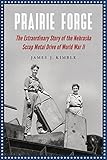
James J. Kimble. Prairie Forge: The Extraordinary Story of the Nebraska Scrap Metal Drive of World War II. Lincoln: University of Nebraska Press, 2014. 236 pp. $19.95 (paper), ISBN 978-0-8032-4878-6.
Reviewed by Bruce D. Cohen (University of North Texas)
Published on H-War (July, 2014)
Commissioned by Margaret Sankey (Air University)
The Second World War home front is so frequently idolized as the epitome of civilian support for troops overseas that only in the last two decades or so has serious scholarship examined its particulars. How willingly did Rosie the Riveter head off to the shipyard? To what extent did race or income affect feelings about the war or willingness to enlist? How vigorous was the black-market economy that operated outside the ration cards and shortages that were reflected in films and posters from the era? James J. Kimble, a Seton Hall communications professor, provides a captivating addition to this genre with Prairie Forge: The Extraordinary Story of the Nebraska Scrap Metal Drive of World War II. The work examines in detail the enormously successful statewide campaign that both served as a model for a follow-up national scrap drive and, Kimble suggests, had a material effect on American capacity to prosecute the war.
Scrap metal is essential to the modern steelmaking process. Kimble briefly explains the history of steel, bringing the Bessemer process, the open hearth, and pig iron into terms easily understood. Indeed, he calls upon a 1960s Donald Duck animated film that taught countless schoolchildren the basics of steel to explain key concepts. Because scrap metal greatly diminishes the need for refined iron, it was critical to wartime industrial production. Indeed, while American embargo of oil and rubber is generally associated with the Japanese decision to go to war against the United States, Kimble notes that the embargo of scrap metal in 1940 was directly related to a concern about U.S. industrial capacity should war break out. Scrap is also seasonal. Once winter comes, it is very difficult to work with outdoor scrap (and iron ore cannot be shipped across the icy Great Lakes), and if a sufficient scrap supply is not in place by late fall, a shortage cannot be made up until the following spring.
Key Roosevelt administration officials recognized in early 1942 that on-hand scrap metal would be insufficient by year’s end, especially since the need to expand existing capacity would itself require thousands of tons of new steel production. A national scrap metal drive, of sorts, was in place; it was highly centralized from Washington, and heavily bureaucratized and hopelessly inadequate to the task. In stepped Henry Doorly, sixty-one-year-old Barbadian immigrant, Omaha World-Herald publisher (and son-in-law of his predecessor in that role), and strident Nebraska Republican. Spurred to action by a comment his wife made (and as Kimble demonstrates, likely influenced by a few successful regional scrap drives that had been covered by national wire services), Doorly quickly organized a statewide scrap-metal drive using the tremendous publicity available through his newspaper. He set a goal of one hundred pounds of scrap metal (and rubber) per Nebraskan, to be gauged in a county-against-county contest for most scrap per capita. Naysayers pointed out that the state had already garnered fifteen pounds per person in an earlier drive, and there was little likelihood for what must have seemed a ridiculous target.
Kimble assesses the Nebraska scrap drive in an approach consistent with his academic specialty of domestic propaganda. In Prairie Forge, he identifies three pairs of themes, each of which he traces through the book. “Competition and camaraderie” reflected the dual incentives that drove the World-Herald campaign. County pride (as well as fraternal, academic, scouting, and business organizations that also engaged in friendly scrap contests) helped move the drive along, but in the greater context of a large proud group of Cornhuskers doing their part together. “Tractors and tricycles” meant that everyone had a part to play; while farmers typically had large implements and tractors, every home, factory, office, and school had something of value to donate the drive. Finally, in “fact and fancy,” Kimble describes the way in which the narrative was presented to the public. While the actual shortfall in scrap was dire, the campaign stressed direct (if imaginative) links between the scrap collected in Nebraska and the steel helmets, bullets, ship hulls, and tanks that it would become in short order. This emphasis had the immediate and long-lasting effect of making every participant a frontline troop, and seems to have been instrumental in bringing the drive to a successful end.
By any measure, the campaign was a tremendous achievement. In three weeks, the state collected over 67,000 tons of scrap, with a final tally of 103.64 pounds per capita (p. 119). Doorly and his chief assistant were quickly brought before a Washington meeting of publishers from across the country and their “Nebraska Plan” was used as a model for a national autumn campaign. That scrap drive was even more successful, providing 5.3 million tons of scrap, which was sufficient to keep up with the government’s ambitious plans through the crucial winter of 1942-43 (p. 142).
Kimble’s work is a solid, thoroughly researched, and extremely accessible monograph on a discrete vignette from the World War II home front. Later editions will benefit from a map of Nebraska, whose ninety-three counties, numerous towns and cities, and local newspapers are frequently referenced. But its explanation of the problem and exploration of the straightforward solutions that Nebraskans adopted present a good story, well-told. It provides a case study of a successful campaign that quickly involved the public in a project in which it had little obvious interest. In that respect, it would be appropriate for an undergraduate or graduate media class, but will also appeal to any reader interested in the Nebraska scrap drive. Without doubt, it should be on the shelf of every Nebraska public library, and could easily be the springboard for local study of how one’s town, school, or county participated in the event.
If there is additional discussion of this review, you may access it through the network, at: https://networks.h-net.org/h-war.
Citation:
Bruce D. Cohen. Review of Kimble, James J., Prairie Forge: The Extraordinary Story of the Nebraska Scrap Metal Drive of World War II.
H-War, H-Net Reviews.
July, 2014.
URL: http://www.h-net.org/reviews/showrev.php?id=41616
 | This work is licensed under a Creative Commons Attribution-Noncommercial-No Derivative Works 3.0 United States License. |

